


Lawful updates can preserve information while changing every visible state. Persistence requires a specified relation across completions, not resemblance alone.
The positive idea of continuing organization
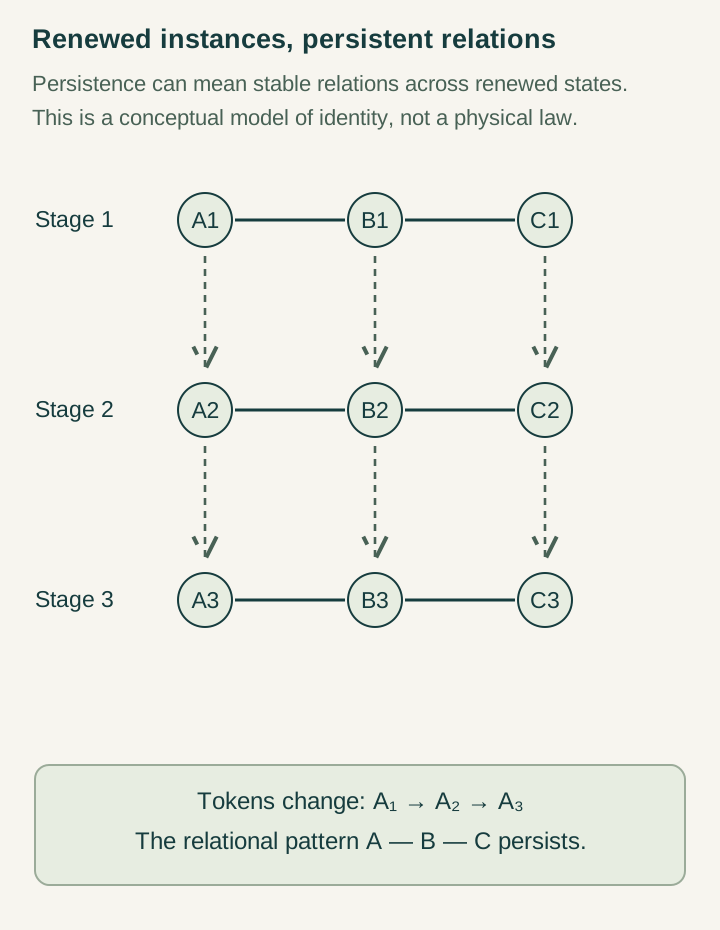
A flame maintains a recognizable shape while its material flow changes. A melody retains an identity across different performances. These examples show that persistence can concern an organized relation rather than an unchanged collection of constituents.
The SMM interpretation of ever-renewed creation asks a more fundamental question: why do stable forms and correlations continue to appear at all? Mohamed Haj Yousef’s public account presents renewal as ongoing dependence on a source. The modern modeling task is to supply the lawful relations that make successive appearances one coherent history. Familiar examples motivate that task without proving that all physical reality undergoes discrete recreation.
Open the full-size diagram →
A changing state can preserve a property
Take a pair of real numbers (x,y) and update it by U(x,y)=(-y,x). Both coordinates can change, but x²+y² remains invariant. After four updates the original pair returns. The update thus combines change with exact conservation.
The invariant is not the whole identity of the state: many pairs share the same radius. It identifies one persistent property. A physical object requires a richer set of relations, such as charge, internal structure, position relative to other objects, and predictable interaction. Each proposed conserved relation needs its own dynamical justification.
Test persistence by changing the preparation
Suppose a device prints A after every cycle. This behavior does not show that it remembers its previous output; it might independently reset to A. Now write A or B into the device and ask the next cycle to preserve the chosen symbol. Success requires a correlation between the intervention and later output.
This is the difference between repeated appearance and retained information. A renewal model must explain why the new record encodes the actual prior preparation rather than an arbitrary story about it. Including an observer’s memory in every new configuration does not finish the explanation unless its relation to earlier events follows from the update.
A frame sequence needs an internal viewer
The film analogy helps distinguish production from display. It also imports machinery: a projector, a frame rate, a memory of neighboring frames, and a viewer outside the film. A cosmological construction must account for the corresponding functions within the modeled world.
Two frames showing a marker at different locations determine displacement only after the marker’s identity is tracked. They determine average speed only after a clock supplies duration. Different paths between the sampled positions can remain observationally indistinguishable. A source theory therefore needs a transport law and observation protocol, not just an ordered collection of complete pictures.
What DTT completion must retain
DTT places nested inner formation before outer availability. Completion can mark when a record has become stable enough for an admitted observer to use. It should retain every distinction needed for future predictions within the specified test language.
Consider two source histories with the same visible arrangement but different phases. If a later recombination experiment detects that phase difference, the visible arrangement alone is not a sufficient state. A stronger completed state must retain the relevant phase or an equivalent predictive variable. Renewal and completion are compatible with hidden structure, but the structure cannot be discarded and later silently restored.
A constructive standard for persistence
A finite model can state its update, its invariant relations, the completion condition, and a resource budget for memory. It can then calculate how long a record survives and which perturbations destroy it. Perfect indefinite retention is an idealization that requires explicit resources; useful physical records may instead be reliable over a stated range.
Read A54 and A62 with A92 and A117–A121. The forward SMM/DTT problem is to derive the same retention mechanism for objects, measuring devices, and observer memory. Can one source law preserve their mutual correlations while producing changing spatial configurations? That would make persistence an achievement of the theory rather than an assumption hidden inside each new appearance.
Continue with the articles
- The Principle of Ever-renewed Creation
Ever-renewed creation motivates an account of persistence through changing states. Update rules, invariants and retained memory show what SMM/DTT must specify for renewed records to support recognizable objects and continuous histories.
- Creation Scenario: the World as a Movie
The world-as-a-movie analogy connects renewed appearances with apparent continuity. Its limits reveal why a physical model needs linked frames, embedded observers, clock readings and retained correlations to explain motion and memory.
- The Three Hypotheses of the Single Monad Model
The three SMM hypotheses concern a common source, lawful renewal and the relation between generative order and observed time. Their combined physical content depends on a shared dynamics that constrains geometry, clocks and propagation together.
- Retained observations versus predictive states
A readable record need not contain enough information to predict its next update. An exact leakage criterion identifies when a linear completion is autonomous and measures the error when hidden information returns.
- A record that carries its own completion certificate
An autonomous history Hamiltonian can generate both a data record and a flag tied to its completed write. The exact construction retains incomplete outcomes, coherent intermediate stages, and finite observation windows.
- From a continuous pointer to a binary memory
A smooth threshold converts a continuous pointer into a certified binary memory. Its error can be bounded, while sharper thresholds increase the registration energy in the specified free-field model.
- Keeping an observed label stable
A transported record can preserve an already observed label under a declared class of later readings. Exact projector identities and channel-error bounds distinguish genuine retention from unchanged one-time statistics.