
A common origin becomes informative when it constrains the readouts together; a specified paired readout illustrates multiplicity but does not alone select physical space.
Place the source before the spatial picture
When hearing single source, it is natural to imagine one tiny object somewhere in a large empty room. That image already assumes the space whose origin SMM seeks to explain. The Monad instead names a proposed common generative foundation; its priority concerns the relationships from which observable places are to be constructed.
A musical score offers a limited analogy. One organized score can specify many notes and relations among them, but its numerical unity does not make every performance identical. The mathematical question is which distinctions the source permits and what rules relate them. Those rules, rather than the word one, supply explanatory content.
One system can have several possible states
A single counter can display zero, one, two, and three as it advances. There is one counter system and four distinguishable display values. No contradiction arises because counting systems and counting their possible states are different operations.
By contrast, a genuinely one-element state set with one fixed output cannot produce different records through a fixed autonomous rule. Variation requires some structure: states, relations, operations, memory, or changing input. The SMM task is to justify that structure economically. A common source should restrict several observable laws through the same ingredients, rather than conceal a separate arbitrary mechanism for every phenomenon inside a single name.
Work through a six-role readout
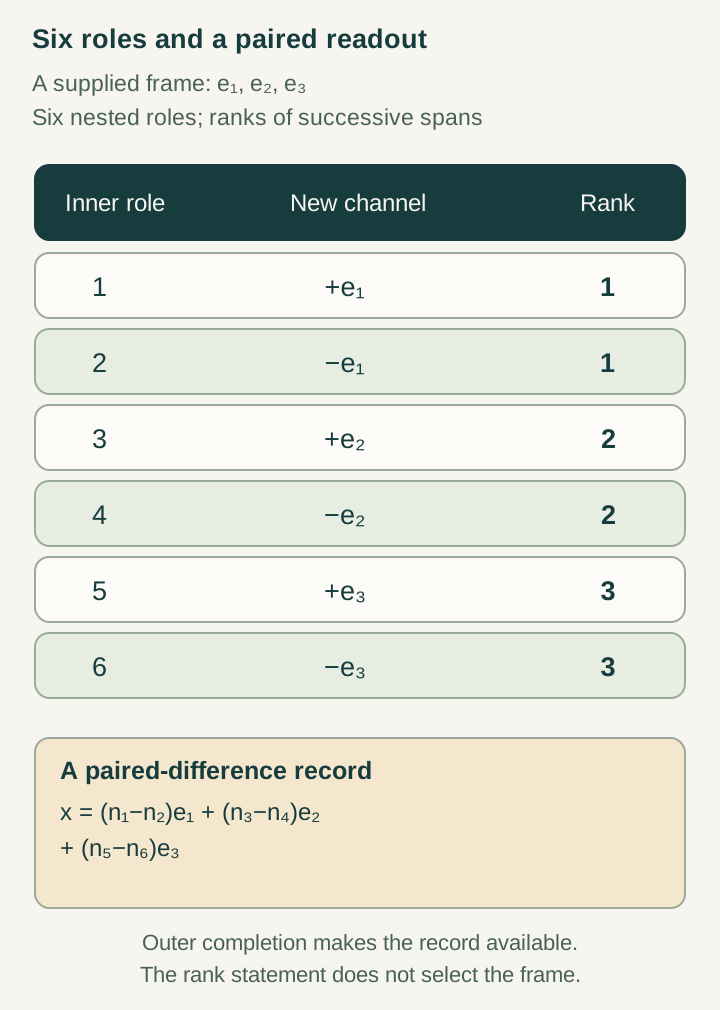
Take six binary digits, each zero or one, arranged in three pairs. Define a three-component record by subtracting the second digit of each pair from the first. Each component can be minus one, zero, or one. The six digits admit 64 source addresses, while the readout has only 27 distinct records.
For one pair, zero has two realizations, (0,0) and (1,1), while either signed value has one. The central record (0,0,0) therefore has eight source addresses; a corner such as (1,1,1) has one. Equal address weights give unequal record weights. Counting appearances requires the completion rule to say how those multiplicities are treated.
Make the six roles dependent
In a six-digit binary counter, higher digits change through carries generated by completed lower-digit cycles. This is one evolving counter with nested periods, rather than six independent time axes. Pairing its digits as above yields the successive span ranks one, one, two, two, three, three.
The seventh DTT role is outer completion: the designated prepared record becomes available. It is neither an extra digit nor a fourth spatial direction. The finite construction demonstrates that the proposed organization can be represented exactly. Selecting that counter, pairing, archive, and completion condition from a physical source law is a further task, with assumptions that should remain visible.
Three components do not yet tell us what is near
The records can be drawn as a three-dimensional grid, but the drawing alone does not select distance. If an admitted operation changes exactly one component by one unit, the fewest operations from (0,0,0) to (1,1,0) is two. A Euclidean drawing assigns the length square root of two in the same coordinate units.
Both numbers answer definite questions. One counts axis steps; the other uses a quadratic metric. They become physically relevant through specified probes and calibration. Likewise, the counter’s scan order is not automatically a particle trajectory. The operations forming the archive and the operations carrying signals between records need separate definitions before their relationship can be derived.
Many possible places are different from many clicks
A quantum state may assign amplitudes to several detection alternatives, while an individual run records one localized outcome. The extended predictive description and the localized record answer different questions. SMM’s common-origin intuition can motivate a single account of both, but it must reproduce coherent combination as well as outcome probabilities.
A list of places visited by a classical cursor does not by itself provide interference. An appropriate phase carrier and observation rule are needed. The Time Chest book companion develops that benchmark through a balanced interferometer. Here the important connection is structural: multiplicity must be defined at the level of states, alternatives, and retained records before those categories are identified.
Look for one relation that cannot be freely changed
Return to the binary example and compare the central record with a corner. Work out their weights under uniform address sampling, then ask what operation could make all 27 records equally likely. That change is an added rule and may require extra resources or a different preparation.
Continue with A1, A56, and A126. A stronger common-source result would tie together spatial relations, clock response, and transport so that changing one forces a specified change in the others. That is the practical difference between organizing many outputs under one generator and explaining why the observable world’s relationships agree.
Continue with the articles
- The Single Monad Model of the Cosmos
The Single Monad Model proposes one generative source for the many events of experience. Its central concepts lead to a precise question: how can common dynamics produce geometry, clocks and matter together?
- Unicity and multiplicity: the conceptual problem
Unity of source, unity of law and unity of structure are different ideas. Simple generative examples show how one rule can yield distinct records and why multiplicity requires more than assigning a single name to its origin.
- The Single Monad
The Single Monad names a unique generative source rather than a particle at a privileged location. Distinguishing the source from its state space and operations explains why unity must constrain observable outcomes to have explanatory force.
- From one source to many observable records
A common state can support coherent alternatives and many distinguishable records. An interference calculation shows why an SMM/DTT account must connect inner composition with outcome probabilities rather than assume classical alternatives.
- Six inner stages and one publication interface
A six-digit nested counter with paired signed readout realizes ranks 1, 1, 2, 2, 3, 3 before one completion interface. Its exact counts reveal sampling bias and the restricted assumptions behind the six-channel bound.
- Why a bare source does not imply spacetime
A structureless source cannot select a nonzero metric, an oriented vector or a proper causal cone while preserving every change of representation. Recurrence, composition and observable readout supply the additional structure needed for an SMM/DTT reconstruction.
- Reading Volume IV: Time Chest
Time Chest offers a conceptual route into particle–wave questions and temporal confinement. An ideal interferometer connects its themes with retained phase, localized records and the operational baseline a DTT account must reproduce.