Time Chest offers a conceptual route into particle–wave questions and temporal confinement. An ideal interferometer connects its themes with retained phase, localized records and the operational baseline a DTT account must reproduce.
Time Chest is presented as a comparatively concise route into the book series. Its public structure page describes three stages: background on time and cosmology, an outline of the Single Monad Model, and a discussion of the Duality of Time postulate and its proposed physical consequences. The emphasis is conceptual rather than a replacement for the longer mathematical treatments.
That organization is useful because the wave–particle question crosses several levels of explanation. One must distinguish experimental outcomes, mathematical state descriptions, and interpretations of what is happening between observations. A temporal interpretation should connect those levels rather than replace their definitions with a metaphor.
02Why interference is a useful starting point
For two coherent alternatives with amplitudes a and b, the probability or intensity associated with their sum contains a cross term. If a relative phase is varied, that term changes. An incoherent mixture instead averages probabilities and does not retain the same phase-sensitive cross contribution.
This elementary identity captures a central demand on any temporal account. It must explain how the relevant phase information is retained and recombined. Saying that a particle alternates between possibilities is insufficient unless the model supplies the amplitude rule and the resulting statistics.
|a+b|² = |a|² + |b|² + 2 Re(a* b).
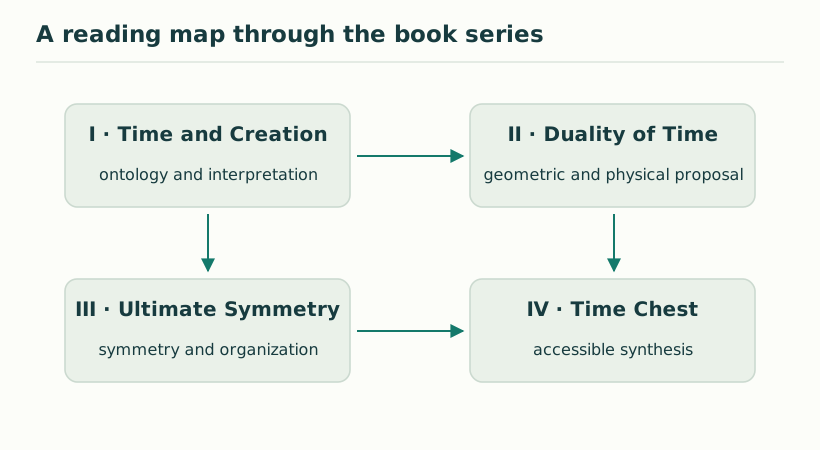
Figure 1. A reading map through the book series. A thematic map, not a claim that the later mathematical results follow automatically from the earlier texts. Readers can move from the ontology of time to physical constructions, then return to the interpretive questions. View full size ↗
03A balanced interferometer makes the question concrete
In an ideal balanced two-path arrangement, amplitudes reaching one output can be written as 1/2 and e^(iφ)/2. Its detection probability is (1+cosφ)/2; the complementary output has probability (1-cosφ)/2. The probabilities sum to one and depend on the relative phase.
These expressions are a standard quantum baseline under the idealized beam-splitting and coherent-propagation assumptions. A DTT account must reproduce them before adding a new prediction. It must also say what changes when path information is recorded, because the record can alter which alternatives remain coherent.
P₊=(1+cosφ)/2, P₋=(1-cosφ)/2.
04Confinement, extension, and observation
The book’s title contrasts temporal confinement with spatial transcendence. As an interpretive theme, this invites a distinction between a localized recorded event and a more extended generative description. The connection becomes mathematically useful only after the relevant state, support, and observation map are defined.
A localized click does not imply that every earlier state property was localized in the same way. Conversely, an extended amplitude does not by itself allow controllable faster-than-light signaling. A model must derive both its interference statistics and its constraints on usable communication, rather than infer one from the language of extension.
05The SMM/DTT bridge
SMM asks how one source can support many distinguishable appearances. DTT proposes that inner generation and outer completed observation play different roles. An interferometer gives this distinction an exact challenge: which inner distinctions remain available for recombination, and when does a completed record make them effectively distinct?
The autonomous-record and operational-quotient articles refine that question. A record that is safe to discard for one experiment may be essential for another. Predictive completeness depends on the allowed future procedures, so a temporal interpretation should specify those procedures explicitly.
06How to read the accessible volume alongside the drafts
Use Time Chest to establish the conceptual questions, then follow particular claims into the technical articles: phase selection for the meaning of complex amplitudes, record completion for measurement, and cone reconstruction for causal propagation. This avoids expecting a short conceptual treatment to carry every analytic proof.
The result is a layered understanding of the research program. The intuitive images help readers ask the right questions; explicit models determine which answers follow. The explanatory calculations in this guide state their assumptions and observational meaning, preserving the distinct roles of conceptual interpretation and explicit modeling.
KEEP THE CONNECTION
Key ideas
Interference requires a retained relative phase and a recombination rule.
A localized outcome and an extended state description answer different questions.
Temporal interpretation must reproduce the operational quantum baseline.
Scope of the argument. The interferometer calculation is an idealized explanatory baseline, not a claimed new DTT prediction.
Edition information and chapter headings are verified from the cited author or publisher records. Full chapter text is not reproduced in this catalogue.