
In this article
- The problem of one and many
- Three meanings of unity
- Many outputs from one rule
- Distinctions require records
- DTT introduces order into the problem
- A one-state obstruction
- From an image to a construction
Unity of source, unity of law and unity of structure are different ideas. Simple generative examples show how one rule can yield distinct records and why multiplicity requires more than assigning a single name to its origin.
The source uses the relation between a circle and its center to discuss how multiplicity can depend on unity without dividing its origin. It also distinguishes absolute unicity from the unity of a composite whole. The central problem is not merely arithmetic. It asks how genuinely different manifestations can share an origin while the origin is not treated as a collection of those manifestations.
Numerical unity means one member of a class. Structural unity means several parts functioning as one organized system. Ontological unicity means that the proposed source does not owe its unity to the assembly of parts. These claims differ. A single machine can have many components; a single equation can describe many solutions; an allegedly indivisible source is a stronger philosophical proposal.
This vocabulary matters for SMM because otherwise one can slide unnoticed from a single mathematical symbol to a claim of metaphysical indivisibility. A symbol is easy to write; the explanatory work lies in the structure and consequences assigned to it.
A simple recurrence xₙ₊₁ = 2xₙ modulo 5 produces different values from one update rule. With x₀ = 1, the sequence is 1, 2, 4, 3, 1. The rule is fixed while the states vary. This elementary example demonstrates that unity of law and diversity of outcomes are compatible.
It does not prove a single-source ontology. The example presupposes a state set, an initial condition and arithmetic relations. Its value is diagnostic: it shows exactly which additional structures are needed when one proposes to explain many outcomes through one generating principle.
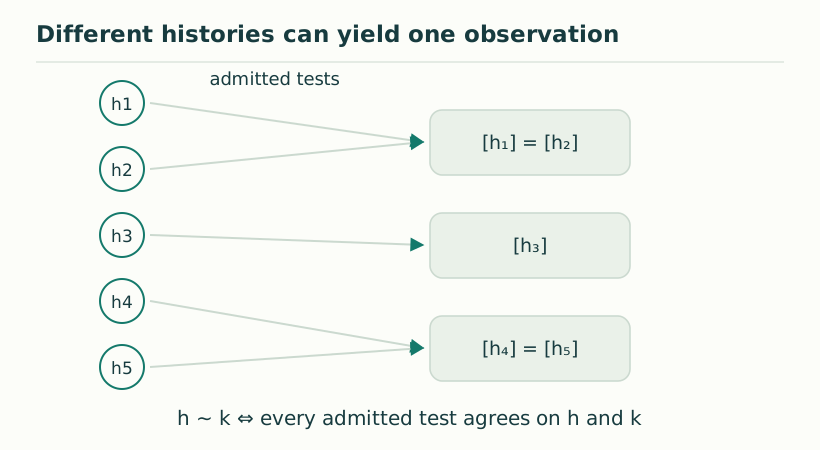
Multiplicity becomes observable when some operation can distinguish alternatives. If every permitted measurement gives the same result on states s and s′, those states are operationally equivalent even if the mathematical description names them separately. Conversely, one underlying state can support several distinct observables without being a bag of unrelated substances.
The formal relation s ~ s′ can represent observational equivalence. Passing to equivalence classes removes distinctions that the available operations cannot detect. This gives a rigorous way to discuss the difference between a rich generating description and the world accessible to observers.
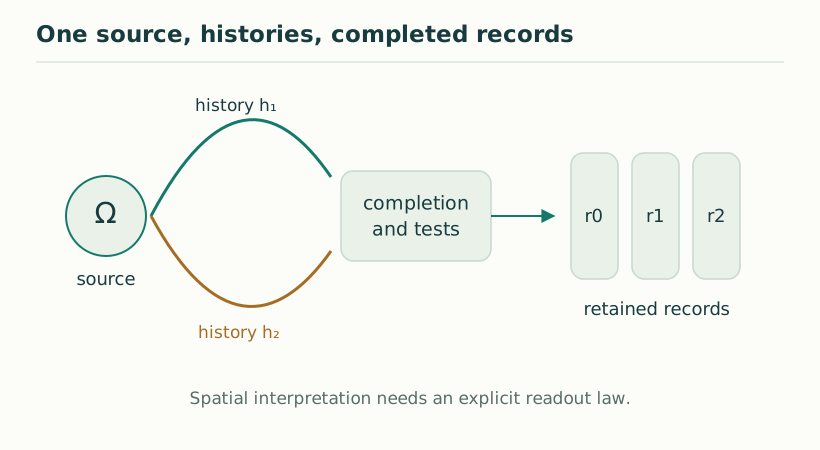
The DTT proposal uses temporal generation to relate unity and multiplicity. Observable extension would arise through organized inner operations and their completed records. The order of those operations matters: a list of possible points is not yet a geometry, just as a list of words is not yet a sentence.
A reconstruction must explain stable adjacency, distinguishable states and consistent comparisons across completions. Retained relations allow an observer to encounter plurality as a coherent world rather than as unrelated appearances. This is where the philosophical question becomes a mathematical construction problem.
Let the entire source state space contain exactly one element s, let the autonomous update satisfy F(s)=s, and let the readout R be fixed. Every completed record is then R(s), so no distinguishable record sequence is generated. This elementary result shows that a featureless one-state mathematical system cannot explain observable multiplicity by itself. It does not refute metaphysical unity: it identifies the structure a formalization must include. Relations, a nontrivial state carrier, memory or admissible operations can provide distinctions while preserving a common source. The explanatory question is why those structures have their particular form and whether their unity imposes nontrivial constraints on the resulting world.
The center-and-circle image is an effective language of dependence, but a circle already contains spatial structure. It illustrates a relation rather than deriving space from a point. The productive SMM question is whether a model can generate the relations assumed by that image. Success consists in explicit, shared constraints among records, derived from a common dynamics with independently defined measurements.
KEEP THE CONNECTION
Scope of the argument. Historical interpretation and original explanatory analysis; formal examples are illustrative models, not claimed deductions from scripture.
Historical public topic address, redirected to this edition’s revised explanation. It identifies the topic’s provenance; the revised page supplies its own reading locators and claim scope.
Source register →