
A paired six-channel source has an exact rank-three image. Its measure, stability and local dynamics can all be calculated, but each follows from a specified interface that a stronger source law must select together.
1. One update and six dependent inner roles
Choose an integer q≥2 and a six-digit internal address d=(d₁,…,d₆), with each digit in {0,…,q−1}. Encode it as n=Σa=16qa−1da. The autonomous elementary update increments n modulo q⁶. Digit d₁ changes at every advance; digit d₂ changes when the first digit completes a cycle; each later digit depends on a longer nested carry.
Starting at zero, the first qᵃ addresses allow exactly the first a digits to vary. This gives six genuinely dependent stages: later stages contain the work of earlier ones. Their periods q, q²,…,q⁶ are derived from one counter rule. They are not six independently adjustable laboratory times.
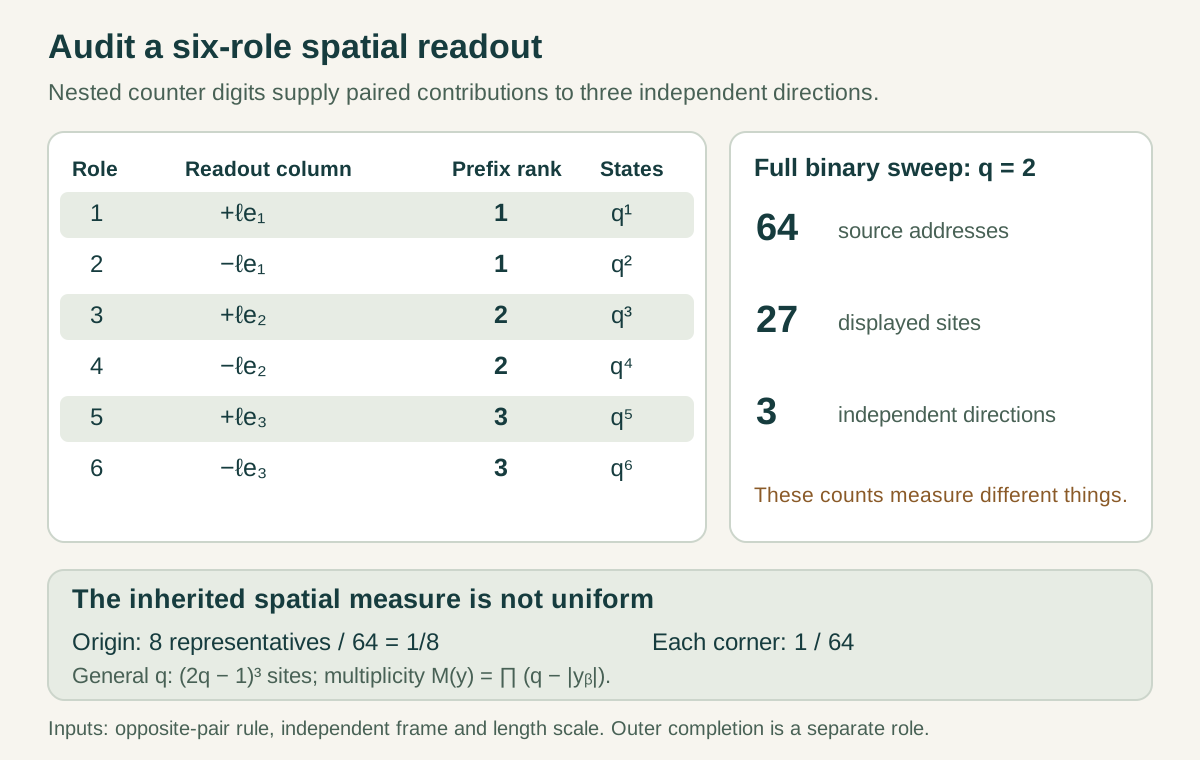
Now supply a real vector space W with independent vectors e₁,e₂,e₃ and a positive length calibration ℓ. Define a readout:
The pairing, frame and scale are declared data. The construction turns DTT’s paired-role idea into a finite model whose exact implications can be checked. It is stronger than drawing three axes beside six names, because a single update actually generates the relevant records. It remains a conditional construction until the source law itself explains why these channels, pairings and detectors are physically selected.
2. Prove the complete rank sequence
Write the readout as a matrix C whose columns are ℓe₁,−ℓe₁,ℓe₂,−ℓe₂,ℓe₃,−ℓe₃. During an a-stage prefix, every output lies in the span of its first a columns. This span contains at most ⌈a/2⌉ independent frame directions.
For the lower bound, the prefix includes the all-zero address and a single one in every available odd digit position. Their differences from the zero output are ℓe₁, then ℓe₂, then ℓe₃. These vectors are independent by hypothesis. The affine rank is therefore exactly ⌈a/2⌉, yielding 1,1,2,2,3,3.
The paired rule admits an independent minimality statement. Let P exchange primitive channel partners and require CP=−C. Every channel vector splits into an even and an odd part, x=(x+Px)/2+(x−Px)/2. The even part is annihilated by C. If P has p exchanged pairs and f fixed channels, its odd eigenspace has dimension p. Consequently rank C≤p and m=2p+f≥2 rank C.
Six is minimal within this opposite-pair architecture. Three already signed coordinates or four tetrahedral generators do not obey the same primitive-channel rule. Establishing a physical six-level necessity requires a reason to select the architecture, plus the identification of one primitive channel with one inner role. The proof locates that obligation precisely.
3. Count the spatial image and its inherited measure
For a single completed pair, y=d₁−d₂ takes all values from −(q−1) to q−1. A given difference y has q−|y| representatives: choose the smaller digit within the allowed interval, and the larger is then fixed. Thus a full three-pair sweep has q⁶ addresses but only (2q−1)³ distinct sites.
The probability formula assumes uniformly sampling the addresses of a complete sweep. Its normalization follows from Σy=−q+1q−1(q−|y|)=q² and multiplication of the three independent factors. No probability rule is inferred merely from the shape of the image.
For q=2, the address count is 64, the site count 27 and the affine rank three. The origin has eight representatives and probability 1/8. Each corner has one representative and probability 1/64. A regular-looking cube therefore carries a nonuniform inherited measure. At q=3, there are 729 addresses and 125 sites; the origin has 27 representatives and probability 1/27.
These comparisons matter for an emergent-space theory because a geometry and its sampling measure enter different physical predictions. Removing duplicate labels produces a set; it does not by itself make later observations uniform on that set. A source that reweights outcomes must specify the actual preparation, acceptance or averaging operation responsible for the new measure.
4. Separate the frame, metric and stability of the readout
Let F be the matrix with columns e₁,e₂,e₃ in a chosen orthonormal laboratory comparison frame. Then Q=ℓFy, and the physical squared norm is ℓ²yᵀGy with G=FᵀF. Independent columns guarantee a positive definite Gram matrix; they do not guarantee equal axis scales or orthogonality.
For independent uniform digits, each paired difference has mean zero and variance (q²−1)/6. The covariance of the physical readout is therefore ℓ²(q²−1)FFᵀ/6. An isotropic covariance requires FFᵀ to be proportional to the identity. Rank three alone does not establish that condition.
The second identity follows directly by adding the outer products of the paired columns. It links readout conditioning to the same frame. If the smallest singular value of F is ε>0, recovering y from a perturbed Q can amplify errors by as much as 1/(ℓε). This is a quantitative test of stability, not just a yes-or-no rank test.
For F=diag(1,1,ε), all three directions exist whenever ε≠0. Yet the third becomes hard to distinguish as ε approaches zero. With ℓ=1 and ε=0.01, a coordinate error of 0.001 along the compressed physical direction corresponds to an error of 0.1 in its inferred internal coordinate. A physical emergence argument should bound this conditioning over the source’s allowed evolution.
5. Connect the paired image to quaternionic readout
A complementary construction begins with a quaternionic carrier q₀=a+xi+yj+zk. A detector insensitive to additions of a real scalar sees only v=xi+yj+zk. Since every quaternion splits uniquely into scalar and imaginary parts, the linear quotient ℍ/ℝ1 is naturally isomorphic to the three-dimensional real space Im ℍ.
The word “linear” matters: ℝ1 is not an ideal whose removal would define the corresponding quotient algebra. The result concerns retained information. A detector seeing only x also ignores the scalar but is incomplete; one needs a test family that distinguishes all three imaginary components.
The paired construction can be mapped into this carrier by assigning e₁↦i, e₂↦j and e₃↦k. It then generates an imaginary quaternion from six primitive contributions. This map unifies the descriptions of their output rank. It does not prove that the counter dynamics generates quaternion multiplication, or that the quaternionic assumptions force this particular counter.
A stronger algebraic route assumes a finite real unital associative algebra with a positive multiplicative quadratic norm and two noncommuting circular phase elements. The associative real division-algebra classification then selects ℍ over ℝ and ℂ. These substantial premises must be derived or independently motivated in a source theory.
The productive comparison is consequently operational: can the same allowed source operations realize both the paired readout and the quaternionic phase transformations, while preserving the same detector norm? Equality of dimension becomes a common mechanism only when that compatibility is constructed.
6. Determine what the outer record must retain
The spatial image is generally smaller than the predictive state. In the binary counter, addresses zero and three have the same readout, namely the origin. Their successors are one and four, whose outputs are ℓe₁ and ℓe₂. A deterministic next-site rule cannot assign both successors to the same present site.
This is an explicit failure of the completed-future criterion developed in the previous chapter. The spatial map identifies states whose later tests disagree. Retaining the carry state repairs the prediction; choosing a coarser boundary and a fixed reset can also repair it, provided every other future-relevant variable is included.
A useful full-sweep record may include a set of sites, a multiplicity table, adjacency relations, retained matter data and a certificate that all required dependencies have finished. The seventh outer role exposes that record. It is neither an additional counter digit nor another axis. If successive sweeps are distinguishable, the archive also requires a history or event label; recurrence of the inner counter alone does not create temporal ordering.
In the uniformly sampled binary example the six-bit address has entropy six bits. The three independent difference coordinates each carry 3/2 bits, so the visible site carries 9/2 bits. The average hidden information is 3/2 bits. This entropy calculation agrees with the multiplicities but differs from both spatial rank and log₂27. Those three numbers answer different questions: predictive uncertainty, independent directions and maximal site-label capacity.
7. Construct neighbourhoods from allowed operations
Coordinates become operational geometry when the records support elementary relations. One explicit choice uses three commuting reversible operations P₁,P₂,P₃. Connect two record labels when one operation or its inverse relates them. A signed operation history depends on its net integer counts; return histories form a subgroup Λ of ℤ³. Under a transitive action, the archive is ℤ³/Λ.
For Pb incrementing the bth coordinate modulo seven, this construction gives 7³=343 records. Graph distance counts the smallest number of elementary operations, without requiring an ambient Euclidean drawing. The radius-two ball contains one central vertex, six immediate neighbours and eighteen vertices at distance two, for a total of 25.
The shortest nontrivial return has length seven. Because seven exceeds 2R+1 when R=2, the induced radius-two neighbourhood has the same adjacency as the infinite cubic lattice. A short-distance observer therefore sees cubic locality while longer paths reveal periodic topology.
This graph is a separate illustrative archive, not the automatic adjacency of the 27-site binary image. One can instead assign nearest-coordinate neighbours on that image, but the assignment is additional operation data. The crucial source question is why the admitted elementary transformations generate and preserve those particular relations. A table describing a lattice establishes realizability; it does not yet demonstrate spontaneous selection from all possible relational memories.
8. Prove a propagation bound and expose its calibration
Give each graph site local registers and a separate port for each incident edge. Let C₀ mix registers only within a site. Let E exchange paired ports across graph edges, with no port participating in more than one exchange in that layer. One completed episode has update S=EC₀.
An observable supported on a set X remains on X under an on-site layer. The edge layer can add only immediate neighbours. Repeating this statement proves by induction that after k completed episodes its support is contained in the graph-distance neighbourhood B(X,k). This is an exact support bound for the declared circuit architecture.
Here S* denotes the Heisenberg update, not a numerical speed. To obtain a measured propagation slope, give each edge a calibrated length ℓedge and independently measure the duration Δτ of an episode. Then the bound is ℓedge/Δτ. With edge length two units and duration three clock units, five episodes reach at most ten units in fifteen clock units.
A common source must obey this same interaction account. A hidden controller carrying an unknown state between remote registers can provide a shortcut unless its motion is included in the graph or its information transfer is excluded by the dynamics. Serial scheduling also affects Δτ. These are concrete restrictions on the source, rather than consequences of naming its output spatial.
9. The joint source theorem this construction prepares
The chapter has established four linked but distinct results: a paired rank sequence, an exact inherited measure, a conditioning diagnostic and a local support theorem. Each can be checked independently. Their combination gives a useful finite laboratory for SMM/DTT because a proposed source mechanism must reproduce all four with one consistent retained state.
Refinement adds another diagnostic. If a family has Nₙ=Bⁿ records and length scale ℓₙ=Lrⁿ with 0<r<1, its counting dimension is D=log B/log(1/r). This formula follows by eliminating n between the two scaling laws. It concerns record number versus scale. A physical clock ratio is a different observable and must be derived from the clock interaction rather than defined to equal D.
The geometry–clock workbench makes that distinction explicit. A source principle gains explanatory force if it excludes a clock coupling that would change the ratio while preserving the same geometry. Likewise it should explain why the readout frame remains well conditioned and why matter cannot use an unrecorded remote channel.
The immediate next chapter develops the ordinary complex phase selected by reversible real dynamics. That phase can organize coherent source information. Bringing it together with the present geometry requires an actual completion instrument and a composition law. The continuing aim is a unified source restriction whose mathematical outputs become independently measurable properties of the same physical records.
Continue with the articles
- Why quaternions appear in the reconstruction
Positive multiplicative norm, finite dimension, associativity, and two noncommuting circular phases select a quaternionic carrier. The algebraic conclusion is rigorous within those hypotheses, whose physical selection remains open.
- The center-blind route to three dimensions
Removing the scalar center of a quaternionic carrier leaves a three-dimensional readout space. Accessible rotations or a suitable finite acquisition protocol are needed to ensure that detectors actually recover all three directions.
- Hopf geometry from a spinor doublet
A normalized complex doublet determines a direction on a sphere while retaining a circle of equivalent phase representatives. Hopf geometry organizes this relation, but its integer topology does not fix an interaction strength.
- Why local geometry can be statistically rare
Lattice-like signed operation tables are rare in the stated permutation ensemble, with an entropy penalty of order N log N. Bounded selection costs cannot overcome that asymptotic disadvantage under the theorem's assumptions.
- The information cost of preparing locality
Preparing a geometric memory with appreciable probability requires relative entropy when geometry is rare in the reference ensemble. The bound quantifies information resources without automatically identifying them with work or elapsed time.
- Programmed geometry and spontaneous selection
A programmed serial source can prepare a periodic lattice and reproduce its local neighborhoods exactly. This establishes feasibility while leaving spontaneous selection, dimension choice, and persistent growth as separate tasks.
- Six inner stages and one publication interface
A six-digit nested counter with paired signed readout realizes ranks 1, 1, 2, 2, 3, 3 before one completion interface. Its exact counts reveal sampling bias and the restricted assumptions behind the six-channel bound.
- Generating a neighborhood and preserving local transport
A generated graph predicts local influence only when later operations respect its edges and retained ports. Guarded transport supplies a finite-update support bound while exposing runtime and controller-memory requirements.
- What spatial readout forgets
Different inner states can share one spatial readout and still have different successors. A concrete counterexample and a kernel-preservation criterion identify the memory needed for autonomous completed evolution.