
Commuting operations can produce exact lattice neighbourhoods. A completed update built from on-site and nearest-edge layers then enlarges observable support by at most one graph step per episode, provided controller memory introduces no additional channel.
Neighbourhoods from operations
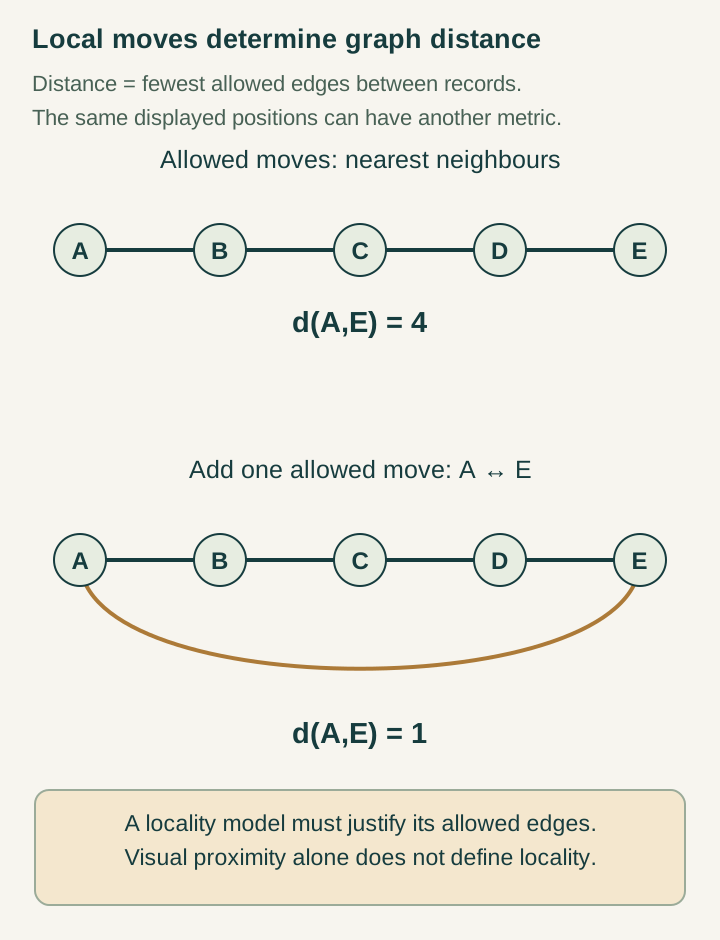
Start with completed record labels and declared reversible operations P₁,…,Pd. Connect two labels when one operation or its inverse relates them. This defines a graph before any drawing in a surrounding Euclidean space. Adjacency expresses an allowed elementary relation in the record archive.
When the operations commute, a signed history depends on its net integer counts. The subgroup Λ of counts returning a reference record to itself records the global identifications. Under a transitive action, the resulting record set is ℤd/Λ. This gives an exact route from compositional relations to a spatial candidate, with the operation law carrying the geometric information.
Worked example: a local cube on a periodic archive
Let three operations increment coordinates modulo seven. There are 7³=343 records. The shortest nonzero return has word length seven. An induced radius-R neighbourhood agrees with the infinite cubic lattice whenever the shortest return exceeds 2R+1.
The radius-two graph ball has 1+6+18=25 vertices.
The count includes the centre, six sites one step away and eighteen sites at Manhattan distance two. A short-distance observer encounters the usual cubic adjacency, although longer paths reveal periodicity. The test concerns local neighbourhoods; it does not identify global topology from a small observed patch.
Open the full-size diagram →
A graph needs compatible dynamics
A later operation could swap arbitrary distant records and destroy the graph's usefulness as a predictor of influence. Locality therefore belongs to the pair consisting of the retained geometry and the permitted update law. For a concrete construction, give each vertex local registers and separate ports for its incident edges.
Let C act only within individual sites. Let E exchange designated ports across graph edges, with disjoint port pairs allowing the edge exchanges to form a single completed layer. One episode has unitary update S=EC. Site identities and port assignments remain part of the retained state. These restrictions make the next proof possible.
Deriving the exact support bound
Take an observable O initially supported on a set of vertices X. Conjugation by an on-site layer cannot introduce a new site into its support. Conjugation by one edge layer can reach only a neighbour of an already supported site. The order of the two layers does not change the one-step upper bound.
Induction proves the statement: apply the one-step rule to the support after k episodes. An observable five edges from X cannot depend on O's initial local disturbance through fewer than five such episodes. This is exact circuit locality under the declared gate structure.
Converting depth into measured speed
Suppose each edge has calibrated length ℓ and each completed episode has independently measured duration Δt. The support bound becomes a maximum propagation slope ℓ/Δt. With ℓ=2 length units and Δt=3 clock units, five episodes reach at most ten length units in fifteen clock units, again giving 2/3.
The physical calibration is essential. A serial source may need many primitive operations to execute one completed episode. Calling the whole episode one tick does not establish how long a material clock takes to register it. The six nested roles can schedule construction and transport, but their completion time must enter the same resource accounting.
The source must not hide a remote bus
A mobile quantum register that visits two distant sites can transfer information between them. If its intervening journey is absent from the declared graph, the graph alone does not bound that transfer. A deterministic address schedule selecting predetermined local gates has a different role from a register carrying unknown physical state.
This distinction is central for SMM: one common active source does not automatically imply local completed influence. The retained source memory must either be included in the interaction graph, reset through an explicit operation or shown unable to mediate the missing channel. Otherwise locality has been drawn into the archive but violated by its controller.
Why preparing locality is a separate achievement
The translation table above is deliberately structured. In a broad ensemble of independent permutation tables, commuting or almost commuting choices can be statistically rare. The linked analysis gives an entropy disadvantage scaling as N log N under its specified labelled ensemble, while fixed-strength local selection contributes only order N.
This does not forbid locality. It identifies what a physical source must supply: structured initial memory, a restricted state space, accounted feedback or another selection mechanism outside those hypotheses. A short algorithm describing a large lattice and a low information cost relative to an unstructured ensemble are different claims. Both should be assessed in a formation model.
A stability test for generated space
The next useful experiment is mathematical: perturb the operation tables, repeat neighbourhood reconstruction and measure how often transport leaves the intended local region. Keep the controller and its memory in the state description. Track both adjacency defects and leakage of influence; one cannot substitute for the other.
A successful SMM/DTT source would repeatedly generate a stable record geometry whose allowed interactions preserve those same relations. A continuum theory would then need to explain how the graph bound, physical clock rate and matter propagation approach a common macroscopic law. The finite construction supplies a controlled starting point for that programme.
Continue with the articles
- Why local geometry can be statistically rare
Lattice-like signed operation tables are rare in the stated permutation ensemble, with an entropy penalty of order N log N. Bounded selection costs cannot overcome that asymptotic disadvantage under the theorem's assumptions.
- The information cost of preparing locality
Preparing a geometric memory with appreciable probability requires relative entropy when geometry is rare in the reference ensemble. The bound quantifies information resources without automatically identifying them with work or elapsed time.
- Programmed geometry and spontaneous selection
A programmed serial source can prepare a periodic lattice and reproduce its local neighborhoods exactly. This establishes feasibility while leaving spontaneous selection, dimension choice, and persistent growth as separate tasks.
- Six inner stages and one publication interface
A six-digit nested counter with paired signed readout realizes ranks 1, 1, 2, 2, 3, 3 before one completion interface. Its exact counts reveal sampling bias and the restricted assumptions behind the six-channel bound.
- Generating a neighborhood and preserving local transport
A generated graph predicts local influence only when later operations respect its edges and retained ports. Guarded transport supplies a finite-update support bound while exposing runtime and controller-memory requirements.
- A finite-update cone
A stated quadratic update bound produces a candidate cone and an integrated speed limit. Its interpretation as physical causality also requires calibrated readings and dynamics that keep every relevant signal inside it.