A stated quadratic update bound produces a candidate cone and an integrated speed limit. Its interpretation as physical causality also requires calibrated readings and dynamics that keep every relevant signal inside it.
A finite generative step supplies a speed bound only after the model states how spatial displacement is limited relative to temporal projection. This effective construction uses a positive horizontal metric and a phase connection to formulate that bound. The calculation establishes a candidate cone; its identification with physical signals remains a separate dynamical and measurement requirement.
02Define the allowed displacement
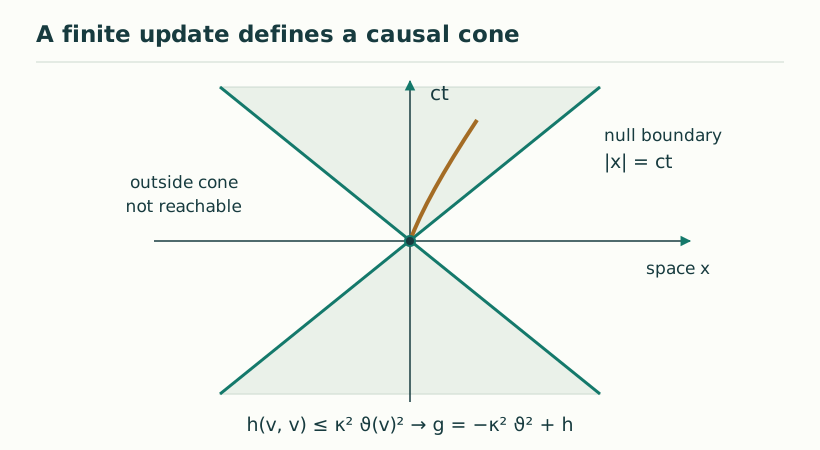
Let ϑ(u) measure the inner-phase advance of a tangent vector u, and let u_H denote its horizontal part. The positive metric h measures the squared spatial displacement associated with u_H. The finite-update postulate says that this spatial amount cannot exceed κ times the phase advance, with κ a positive length per normalized phase unit. Future orientation is selected by ϑ(u)>0. Both the bound and its orientation are physical assumptions of this effective model; finite generation alone does not uniquely imply the particular quadratic inequality.
h(u_H,u_H) ≤ κ²ϑ(u)², ϑ(u)>0
Figure 1. A finite update defines a causal cone. Illustrative finite-update geometry: displacement is bounded by update scale κ times projected inner duration. A Lorentzian metric or a shared light cone still requires the stated readout and field assumptions. View full size ↗
03Integrating the bound along a history
For an allowed curve γ, take the positive square root of the inequality and integrate along its parameter. Spatial path length is the integral of √h(γ̇_H,γ̇_H). Outer duration is the accumulated phase divided by a positive rate ρ. Their ratio is bounded by κρ whenever the duration is nonzero. The argument constrains path length, and therefore also bounds endpoint distance when that distance is no greater than path length. Saturating the bound at every point gives the maximal-speed trajectory.
Δℓ ≤ κ∫ϑ(γ̇)dλ
Δt_out = ρ⁻¹∫ϑ(γ̇)dλ
Δℓ/Δt_out ≤ κρ
04A numerical toy example
Choose κ=2 length units per phase unit and ρ=3 phase units per clock unit. A history accumulating four phase units has duration 4/3 clock units and can traverse at most eight length units. The ratio is at most six length units per clock unit. A history traversing only five units lies inside the cone. These numbers illustrate dimensions and inequalities; they are not estimates of microscopic temporal scales. Measuring only the product six would leave infinitely many possible choices of κ and ρ.
05Which extra assumptions make this a causal cone
The inequality becomes a causal law only when physical disturbances are restricted to its allowed histories. A mathematical state trajectory or a hidden source schedule need not automatically represent a controllable signal. DTT’s account must specify which completed changes can transmit information and prove that their operations respect the bound. If some sector has unconstrained horizontal jumps, the constructed cone does not limit that sector. Conversely, correlations established by a shared inner state need not constitute propagation, provided their observable marginals still obey the required no-signalling condition.
06A cone can bound paths without fixing geodesics
The inequality restricts allowed tangent vectors, but it does not determine which of those vectors an excitation actually follows. Timelike trajectories, accelerated paths and null curves can all satisfy it. A variational principle, Hamiltonian or transport update is still needed to choose motion. Likewise the integrated spatial length can exceed the shortest distance between endpoints; bounding length implies an endpoint bound but does not make the path shortest. A complete DTT dynamics should therefore keep three questions distinct: which histories are admissible, which are dynamically realized, and how their completed endpoints are compared by observers.
07Three levels of the claim
The first level is a mathematical cone obtained from a supplied finite-update inequality. The second is an operational interpretation: lengths and clock intervals must measure the quantities entering that inequality. The third is universality: photons, matter, clocks and other fields must inherit compatible propagation and transformation laws. Each level requires evidence beyond the preceding algebra. Six nested inner stages may motivate the generative architecture, but their existence alone does not determine a clock conversion, a null cone or a field equation. This separation makes the proposed mechanism testable: a mismatch between sectors or a measurable preferred splitting would constrain the model even if its cone construction is mathematically consistent.
The compact phase fiber introduces a global question beyond the local signature proof. If its vertical direction is interpreted literally as physical timelike motion on a circle, a full fiber orbit is a closed timelike curve for the constructed metric. A viable chronology therefore needs a restricted admissible history, a lifted phase or another explicit physical interpretation that prevents identifying recurrent phase with unrestricted closed observable time. Local Lorentzian algebra alone settles neither global causality nor the existence of a single clock function. The completion archive is the natural place to state this missing global information.
KEEP THE CONNECTION
Key ideas
The finite-update inequality is an explicit postulate.
Its integrated form gives a bound on observable path speed.
Physical causality requires the actual allowed operations to respect it.
Scope of the argument. Conditional kinematic construction; a finite source update by itself does not establish universal causality.
Sources & further reading
dtt_limiting_speed_paper_v2(1).pdf — working draftpp. 10–14, §§4–7; pp. 18–19, §12
Source editions and catalogue entries
Working manuscript
DTT limiting-speed construction — working draft v2
Working manuscript. Article-level references identify the consulted sections and the scope of the interpretation. No public URL was supplied for this exact manuscript version.