Removing the scalar center of a quaternionic carrier leaves a three-dimensional readout space. Accessible rotations or a suitable finite acquisition protocol are needed to ensure that detectors actually recover all three directions.
A quaternion q=a+x e₁+y e₂+z e₃ contains one scalar and three imaginary components. The draft considers detectors whose outputs do not change when a scalar multiple of the identity is added. Such detectors are center blind. Their readout can therefore be expressed on the quotient H/R1.
The SMM/DTT interpretation is that a source carrier need not have the same dimension as the public displacement space it supports. What becomes spatial is a selected operational quotient. Removing an invisible scalar direction is a detector statement; it is not an assertion that the scalar channel has no role in generation or memory.
02The quotient calculation
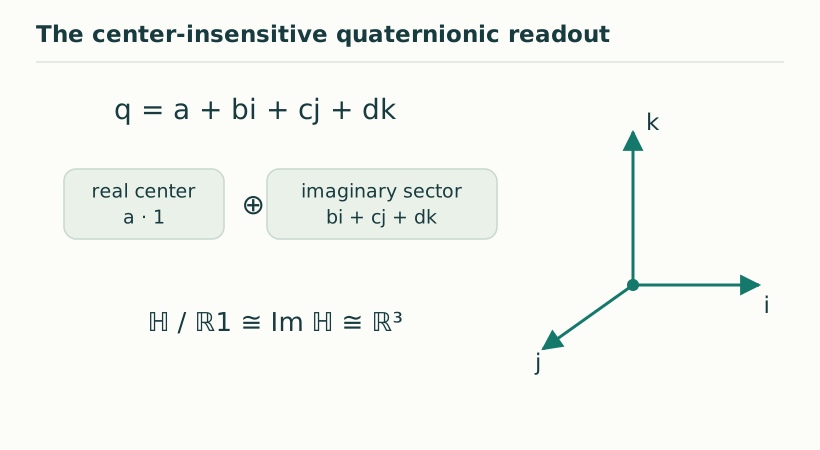
Every quaternion has a unique scalar-plus-imaginary decomposition, so two quaternions differ by a scalar exactly when their imaginary components agree. The quotient H/R1 is therefore naturally isomorphic to Im H and has real dimension three.
A linear readout r with kernel exactly R1 attains this complete quotient. Merely requiring r(1)=0 is weaker: a single detector could see only one imaginary component. The draft therefore needs a completeness or accessibility condition before concluding that all three directions are observable.
q=a+v, v∈Im H
H/R1≅Im H≅R³
Figure 1. The center-insensitive quaternionic readout. Under the stated associative positive-norm and noncommutation hypotheses, the carrier is quaternionic. Quotienting the real center leaves the three-dimensional imaginary sector. This is a conditional readout result, not a standalone spatial dynamics. View full size ↗
03How accessible rotations complete a detector
Suppose a nonzero scalar-blind detector can be reoriented by all conjugations generated by two accessible circular phase subgroups. Under the incompatible-phase hypotheses these subgroups generate the unit quaternions. Their conjugation action covers SO(3) on Im H.
The span of the reoriented detector is a nonzero invariant subspace of the dual three-dimensional rotation module. That module is irreducible, so the span is the entire dual space. The common kernel is then precisely the scalar center. This establishes completeness from a specified operation-access rule rather than by assuming three independent detectors.
04Why isolated phase operations are insufficient
Two quaternionic units i and j generate H as an algebra, but their individual conjugations are only half-turns. Those half-turns preserve the k axis. A detector measuring only the k component can therefore remain confined to a one-dimensional orbit under the discrete operations.
The example separates algebraic generation from operational accessibility. Being able to multiply symbols formally does not guarantee access to arbitrary continuous phase rotations or to all required measurements. A physical dimensional-reconstruction claim must state which operations can actually be performed and which records are retained.
05A finite acquisition protocol and its stability
An alternative sufficient acquisition protocol uses the three words j₁, j₂, and j₁j₂. Their imaginary parts span the three-dimensional module when the phases do not commute. If η is their inner product, the squared singular values of the readout matrix are 1−|η|, 1−η², and 1+|η|.
As |η| approaches one, the phases approach commutation and reconstruction becomes poorly conditioned. A formal rank-three statement can therefore coexist with severe sensitivity to detector error. If |η|≤1−δ, the inverse readout norm is at most δ⁻¹/². This gives a quantitative requirement for stable acquisition.
(1−|η|)‖v‖²≤‖C₃v‖²≤(1+|η|)‖v‖²
06Three dimensions of what?
The theorem establishes a local real readout module with metric and rotation structure. It does not yet create a spatial manifold, assign physical length, or show how records at different locations are related. Those tasks require transport and calibration. Nor does this local count prove that six inner stages are physically necessary.
The center can also matter for prediction even when it is invisible in one instantaneous readout. Later phase evolution may mix scalar information into an imaginary component. Thus a three-dimensional public readout can require a larger retained predictive state. SMM/DTT gains precision by separating source carrier, observable displacement, and predictive memory instead of identifying their dimensions.
KEEP THE CONNECTION
Key ideas
The rank-three readout is a quotient by the invisible scalar center.
Detector accessibility is needed to prove completeness.
Stable dimensional readout depends on conditioning as well as algebraic rank.
Scope of the argument. Local linear readout theorem; global space, physical lengths, and autonomous prediction require additional constructions.
Sources & further reading
smm_dtt_quaternionic_rank3_hopf_reconstruction_v8.pdfWorking draft, pp. 10–12
smm_dtt_alpha0_137_v3.pdfWorking draft, pp. 3–15
Source editions and catalogue entries
Working manuscript
Quaternionic Rank-Three Readout, Hopf Geometry, and a Free Symmetric–Exterior Reconstruction Functor
Working manuscript. Article-level references identify the consulted sections and the scope of the interpretation. No public URL was supplied for this exact manuscript version.