

Correlations can hide a phase locally
A two-path preparation can become correlated with environmental states. When those states retain information about the path, a detector that has no access to the environment sees less interference. The reduced state depends on the overlap of the environmental alternatives. The book uses this standard mechanism to explain what can remain available to a completed observer. [B11]
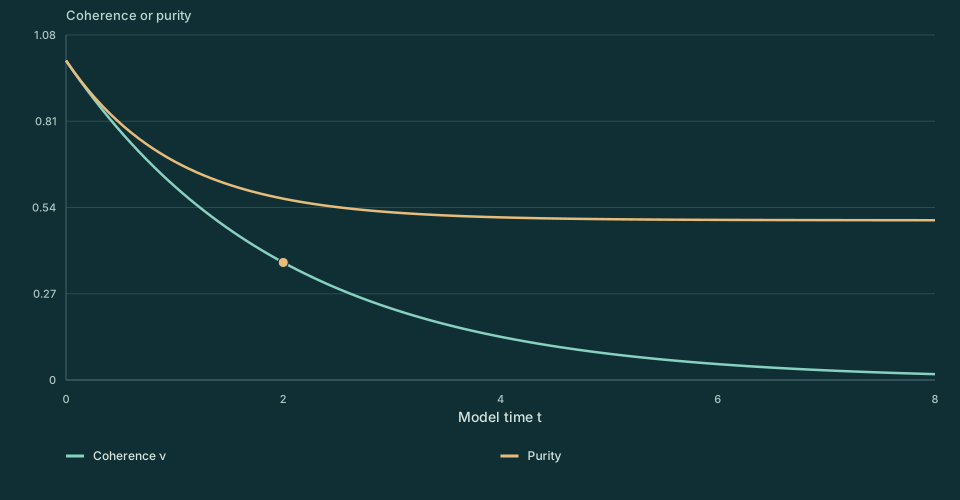
The laboratory begins with an equal coherent superposition and applies a specified dephasing channel. Its retained coherence is ν(t)=exp(−Γt), where Γ≥0. Time t and the rate Γ are model inputs with reciprocal units. Their product is dimensionless. This exponential law is not inferred from the existence of inner and outer temporal roles.
The path populations remain unchanged. Consequently, a path-only detector cannot see the reduction even while a recombining detector loses its fringe contrast. Observation must identify which comparison was actually made; there is no single information content of a state independent of the tests an apparatus can implement.
Separate populations, visibility, and purity
Increase Γ or the elapsed model time. The coherence curve falls, while purity moves from one toward one half. This corresponds to a shorter transverse Bloch vector and a flatter interference fringe. At Γt=ln2, the visibility is 0.5 and the purity is 0.625. At Γ=0, the model preserves full coherence at every time.
Interactive calculation
Play scans Elapsed model time. Step advances it. No animation starts automatically.
Enable JavaScript for adjustable values. The static figure and worked calculation remain available.
The direct path probabilities are always (0.5,0.5). A phase scan instead gives P₊(φ)=[1+ν cosφ]/2, so its largest and smallest values are (1+ν)/2 and (1−ν)/2. At ν=0.5 they are 0.75 and 0.25. The visual contrast therefore measures a different property from population imbalance.
A channel that preserves normalization and positivity
The eigenvalues are (1+ν)/2 and (1−ν)/2. They stay nonnegative for 0≤ν≤1 and sum to one. Squaring and tracing gives trρ²=(1+ν²)/2. The state remains a valid density matrix throughout the scan.
This representation is a probabilistic mixture of two unitary actions, so it is completely positive and trace preserving. It keeps the diagonal entries and multiplies the off-diagonal entries by ν. For exponential ν, composing two elapsed-time channels adds their durations because ν(t+s)=ν(t)ν(s).
The same channel solves dρ/dt=(Γ/2)(σ_zρσ_z−ρ). Its off-diagonal derivative is −Γρ₀₁, fixing the factor-of-two convention. This matters when comparing a displayed decay rate with a master equation written in a different convention.
The relation between visibility and off-diagonal coherence is also developed quantitatively in the book. Here the zero initial relative phase and equal populations are explicit choices. [O01]
A compatible pure joint description is (|0⟩|E₀⟩+|1⟩|E₁⟩)/√2 with real overlap ⟨E₁|E₀⟩=ν. Tracing the environment gives the displayed matrix. The total state can remain pure while the local state becomes mixed, because purity has moved into correlations rather than being a separately conserved local property. Recovering interference would require an appropriate intervention on those correlations and the relevant conditioning information; simply choosing to ignore fewer words in a description does not implement that physical operation.
A reduced arrow is not every arrow
For this unital dephasing semigroup, reduced-state entropy increases from zero toward ln2 in dimensionless units. General open dynamics need not make the system entropy increase: cooling can lower it, and a finite environment can return coherence. A thermodynamic account must track the reduction and the environmental exchange. [O03]
The published temporal-asymmetry model motivates examining elimination, memory, and irreversible descriptions with their assumptions visible. It does not make this laboratory's adjustable Γ an independently derived universal constant. [P04] [A04]
Dephasing also does not, by itself, select a unique outcome from the full entangled state. It predicts which interference is inaccessible to the restricted observer. The next chapter asks how a classical outcome, once retained, can be protected against later corruption.