
The selected free grammar yields 137 distinguishable records. Obtaining an ideal inverse-rank coupling also requires a normalized response and a common action–clock dictionary.
What you will learn
- Calculate the branch ranks and continuation recurrence.
- Explain how record loss changes the free count.
- Compute a simple response capacity and distinguish it from receiver dimension.
Before you begin: Lessons 01–10. You should understand a record count, a probability and a supplied Coulomb coupling as different quantities.
Define the records before counting them
At depth d, choose d independent innovation labels and retain every nonempty subset. Each label may be present or absent, producing 2d subsets before the empty one is removed. The branch ranks are therefore bd=2d−1. At depths one, two and three the counts are one, three and seven.
An exterior-algebra realization uses alternating products of distinct innovations; repeated labels vanish. That supplies a precise grammar, not a probability distribution over branches. The three algebraic depths are also distinct from the six nested inner roles introduced earlier. A source theory must connect these choices through its actual architecture rather than treating similar small integers as interchangeable descriptions.
Worked example: trace every contribution to 137
Supply a receiver with ten independent continuation labels. At depth d a record either terminates with one of bd branches or attaches one continuation label to a previous-depth record. Keep these alternatives and combinations distinct. Starting with r0=0 gives rd=10rd−1+bd.
The final sectors have sizes 100,30 and seven: two continuations before a depth-one terminal, one continuation before a depth-two terminal, or immediate depth-three termination. Distinct continuation and terminal tags make the words uniquely readable. The ten-mode receiver can itself be selected as symmetric quadratic combinations of a four-component envelope, with count 4×5/2=10; selecting that receiver is substantive input.
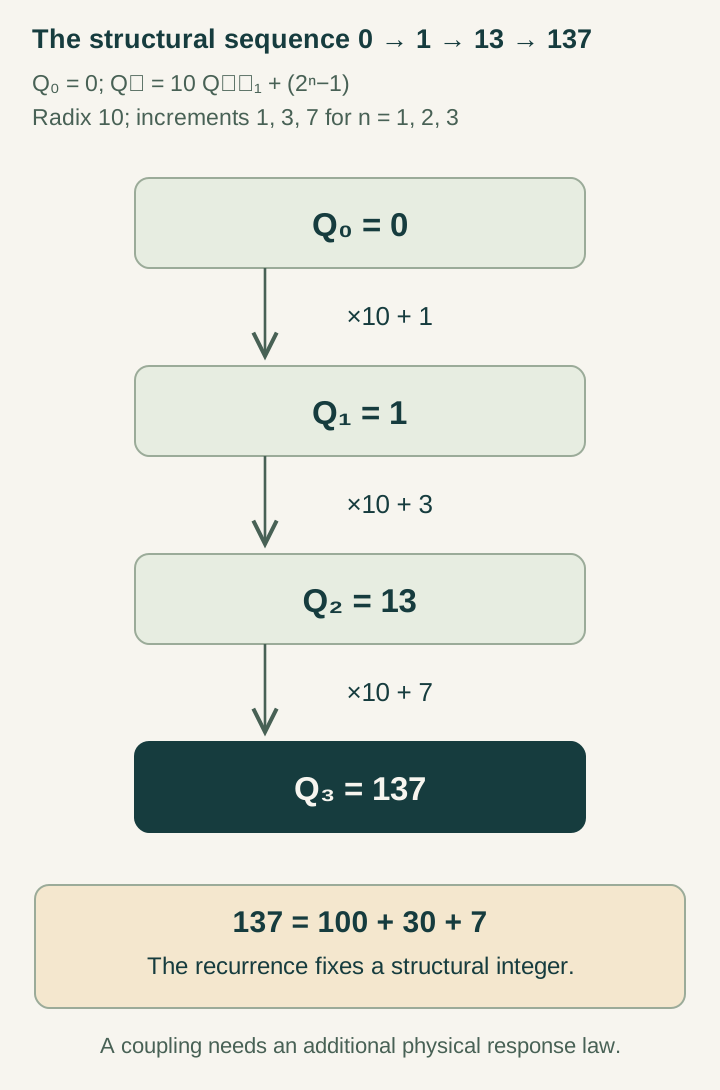
Open the full-size diagram →
Faithful storage and probability are separate
If each legal word must be distinguished without error in a single quantum readout, their encoded pure states must be orthogonal. The declared task therefore needs at least 137 dimensions, and the free word basis attains that count. Allowing errors, asking fewer questions or using additional sequential resources changes the task and its minimum.
The count does not enforce equal final probabilities. An explicitly uniform sampler assigns 1/137 to each word; locally uniform decisions generally give another law. Nor does a lossy implementation retain the free count automatically. If one independent combination disappears at depth two, each of the ten later continuation labels loses that possibility, so the final count becomes 137−10=127.
The same dimension can respond differently
Let a positive response operator K assign energetic cost to receiver amplitudes and let f be a fixed source direction. Minimizing quadratic energy subject to a prescribed source reading gives capacity Cresp=⟨f,K−1f⟩. The inverse operator and source weights, not dimension alone, determine this number.
For two real modes, take f=(1,1) and K=diag(2,4). Then K−1f=(1/2,1/4), so the capacity is 3/4. Doubling K leaves two modes but halves capacity to 3/8. The same logic applies to 137 records: stiffnesses κ1,κ2,κ3 on the sectors give capacity 100/κ1+30/κ2+7/κ3. Equal rank does not imply equal response.
Locate the physical normalization
Under ordinary trace coupling and a particular continuum matching, the proposed dimensionless coupling has the form gN=scont/(4πacN). Here a is an action scale, c a propagation scale and scont the effective continuum stiffness. Both scont and ac have dimensions of energy times length.
With N=137, obtaining the ideal value gN=1/137 requires scont=4πac as an additional physical relation. Since their ratio is dimensionless, changing units cannot impose it. The source must independently identify the current, derive response normalization and use the same action and clock dictionary as the matter dynamics. Only then can the resulting g be compared with the coupling entering Lesson 10's Hamiltonian.
Keep the exact result and its next bridge visible
The exact structural result is useful: a transparent selected grammar has 137 freely retained records. A proposed ideal inverse-rank value belongs to that model after further normalization. It is not automatically the measured inverse fine-structure constant, a running coupling at another energy or a prediction of uncalculated corrections.
To improve the argument, derive the grammar, stiffnesses and matter propagation from one source, then freeze their parameters before an additional measurement is predicted. The full structural derivation also separates dimension from determinant phase weight. The response guide derives the constrained minimization. Lesson 12 combines these distinctions into an evaluation of what a source model actually predicts.
Try the exercises
Work through each question, then open the answer to compare the steps.
Exercise 1
Replace the ten continuation labels by eight while keeping branch ranks one, three and seven. Calculate r₁, r₂ and r₃.
Show the worked answer
The recurrence is now r_d=8r_(d−1)+b_d with r₀=0. It gives r₁=1, r₂=8×1+3=11 and r₃=8×11+7=95. Expanding by terminal depth gives 8²×1+8×3+7=64+24+7=95. The changed answer makes the continuation receiver's role explicit; 137 does not follow from branch ranks alone.
Exercise 2
For N=137, let sector stiffnesses be (2κ,κ,κ). Find the capacity and compare it with equal stiffness κ in every sector.
Show the worked answer
The capacity is 100/(2κ)+30/κ+7/κ=(50+30+7)/κ=87/κ. Equal stiffness gives (100+30+7)/κ=137/κ. Both receivers have 137 states, but the first has capacity smaller by the factor 87/137. Fixing the count therefore does not fix the physical response; one must also derive the stiffness assignment and source normalization.
Continue with the articles
- From three-dimensional readout to retained records
A quaternionic readout, ten-mode pair memory, and a selected stopping grammar produce 137 distinguishable records. The construction makes its retention assumptions explicit and leaves physical coupling as a separate problem.
- Why a record count is not yet a coupling
A receiver's static response depends on its source and inverse stiffness, as well as its size. Exact minimization shows why counting 137 records does not by itself determine an electromagnetic coupling.
- The conditional ideal value one over 137
The ideal model value 1/137 requires a selected record count, a trace-response law, and an additional absolute normalization. A hydrogen-like calculation checks their consistency without deriving the measured fine-structure constant.
- Why the symmetric receiver has ten modes
The symmetric square of a four-component envelope contains four diagonal and six off-diagonal pair modes. Retaining all ten requires genuine pair memory, beyond the information in a quaternionic product.
- Alternating branches and the ranks one, three, seven
Positive-degree exterior combinations give branch ranks 1, 3, and 7. Combining them with ten-mode continuation memory yields 137 records under a free-retention rule whose losses can be calculated explicitly.
- Prediction after calibration
Calibration produces a prediction only when the proposed output is fixed across the remaining admissible models, or constrained to a stated range. This criterion distinguishes cross-sector consequences from reuse of a fitted target.