
A positive quadratic response has capacity C=⟨f,K⁻¹f⟩. Ordinary trace coupling gives C=N/s after hidden-sector relaxation, so a physical coupling contains both an inverse rank and a primitive normalization.
Which part of a completed record resists change?
In DTT, a public interaction should arise from the response of the same process that generates and completes spatial records. Imagine imposing a small source on a retained receiver. The source asks for an observable output; the inner field can distribute that request among available directions. Its least energy defines an effective stiffness visible at completion.
This question goes beyond counting records. Two receivers of equal dimension may assign different energetic costs to their modes. Conversely, different internal receivers may have the same net static response. The required mathematical objects are therefore a positive response operator, an independently normalized source and a rule relating their output to physical fields.
Derive the capacity by minimizing energy
Let F be a Hermitian receiver field with real inner product ⟨X,Y⟩=Tr(XY). Let K be positive and self-adjoint, and let f be the Hermitian source direction. The quadratic energy is E(F)=½⟨F,KF⟩. Fix the scalar current j=⟨f,F⟩.
A Lagrange multiplier gives KF=λf. Therefore F=λK⁻¹f and j=λC, where C is the source capacity. The unique minimizer and its cost follow immediately.
Emin=j²/(2C)
Uniqueness follows from positivity: adding any Z with ⟨f,Z⟩=0 makes the cross term vanish and adds ½⟨Z,KZ⟩. The operator K here is a stiffness, not the phase generator used elsewhere.
An exact example with the same 137 records
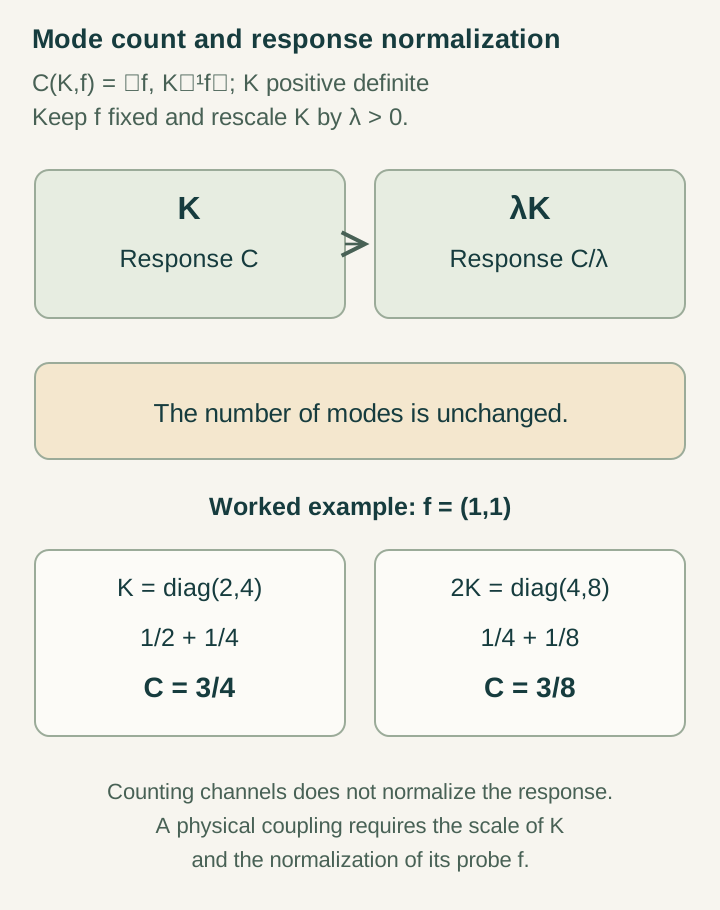
For ordinary trace coupling f=IN and isotropic stiffness K=κI, the capacity is N/κ. The structural receiver has sectors of ranks 100, 30 and 7. Giving them positive stiffnesses κ1, κ2 and κ3 yields a different but equally well-defined response.
Open the full-size diagram →
If all stiffnesses equal κ, C=137/κ. If κ1=2κ while the others remain κ, C=87/κ. The number of retained states has not changed. A derivation of the inverse-rank law must therefore explain the stiffness relation, not just preserve the receiver dimension or require frame covariance.
Where the physical normalization enters
On a supplied spatial graph, current conservation and the minimized edge energy produce a Laplacian response. A controlled three-dimensional continuum limit then supplies the inverse-distance Green function. With the stated flux convention, write the attractive potential as V(r)=−AN/r, where AN=scont/(4πN).
The continuum stiffness scont has units of energy times length, as does ac when a is an action scale and c a speed. Thus scont/(4πac) is a genuine dimensionless physical ratio. Setting it to one is a proposed source law, not a choice of units. Under that additional condition N=137 gives the ideal value gN=1/137.
Connect the coupling to the hydrogen speed statistic
Supply the nonrelativistic relative Hamiltonian H=−a²∇²/(2mred)−AN/r. Its ground energy is −mredAN²/(2a²). The Coulomb virial theorem gives ⟨p²⟩/(2mred)=−E1, so the relative root-mean-square speed obeys:
After electromagnetic matching, gN is the coupling denoted α. The electron speed about the center of mass has an additional factor mred/me. The mean velocity vector of the stationary ground state is zero. This calculation connects response and atomic motion consistently, but the coupling entered through the Hamiltonian; binding does not select its value.
The common-source result to pursue
A stronger SMM/DTT construction would derive the receiver, f, K, the continuum scaling and the matter action from one autonomous update. Its six nested inner roles should constrain these quantities together before outer completion. The decisive relation would fix the primitive response relative to the independently measured action and propagation scales.
The alpha workbench also contains a compact-phase response route. Fitting that route to α can select a completion parameter; a subsequently calculated nonlinear response is a conditional new output. Reconstructing the fitted α is not an independent prediction. The useful next test is an additional response or spectral observable that cannot be retuned while keeping the calibration fixed.
Continue with the articles
- Why a record count is not yet a coupling
A receiver's static response depends on its source and inverse stiffness, as well as its size. Exact minimization shows why counting 137 records does not by itself determine an electromagnetic coupling.
- Trace-sector response and the Schur complement
Allowing hidden traceless modes to relax changes the stiffness seen by a trace source. The Schur complement gives the exact reduced capacity and exposes the normalization still needed for an inverse-rank coupling.
- The conditional ideal value one over 137
The ideal model value 1/137 requires a selected record count, a trace-response law, and an additional absolute normalization. A hydrogen-like calculation checks their consistency without deriving the measured fine-structure constant.
- A flag-independent response without one fixed rotation action
A response can be transported consistently between construction flags even when the natural stabilizer action cannot extend to one fixed rotation representation. Its invariant capacity still leaves different stiffness laws possible.
- A dependency map for physical constants
A common constants program must connect dimensionless source outputs to response, matter, and geometry through one physical dictionary. A dependency map separates those deductions from supplied scales and empirical calibration.
- Prediction after calibration
Calibration produces a prediction only when the proposed output is fixed across the remaining admissible models, or constrained to a stated range. This criterion distinguishes cross-sector consequences from reuse of a fitted target.
- A normalizable hydrogen-like ground state
Square completion gives the exact normalized ground state of the supplied nonrelativistic Coulomb Hamiltonian. Its spectrum and relative root-mean-square speed provide precise atomic benchmarks without selecting the coupling itself.
- Why binding does not fix the coupling
Dilation shows that every positive Coulomb coupling admits binding and the same type of ground-state filter. A source derivation of a particular coupling must therefore fix field, matter, action and clock normalization beyond the existence of an atom.