
Ten continuation modes and nonempty exterior branches of ranks 1,3,7 give a free receiver of dimension 137. Unique parsing, normalized samplers and phase weights make the conditional construction fully auditable.
Inputs: two different retention operations
Let Q be a complex receiver of dimension ten, with a specified orthonormal basis of continuation labels. At depth d=1,2,3, let Id be a d-dimensional complex innovation space. Select the branch receiver Bd=⊕k=1dΛkId. The degree-zero empty branch is excluded.
Define R0=0 and Rd=(Q⊗Rd−1)⊕Bd. The direct sum keeps terminal branches distinct from continued records, and the tensor product retains every combination with a continuation label. These free-retention and stopping rules are inputs. In SMM/DTT they model how one source can preserve distinguishable generated histories; the three algebraic depths are not a replacement for the six nested inner roles.
Step 1: prove the branch ranks
Exterior multiplication imposes v∧v=0. Expanding the same identity for u+v gives u∧v=−v∧u. A basis of ΛkId consists of products with k strictly increasing basis indices, so its dimension is binom(d,k).
For d=1 there is one singleton. For d=2 there are two singletons and one pair. For d=3 there are three singletons, three pairs and one triple. Thus b1=1, b2=3 and b3=7. The binary count concerns whether an innovation appears in a basis monomial; amplitudes over those monomials remain complex. Including the empty branch would change the recurrence and therefore the final count.
Step 2: derive and expand the recurrence
Dimensions multiply under a tensor product and add under a direct sum. Hence rd=10rd−1+bd. Starting with zero gives r1=1, r2=13 and r3=137.
dim R3=100+30+7=137
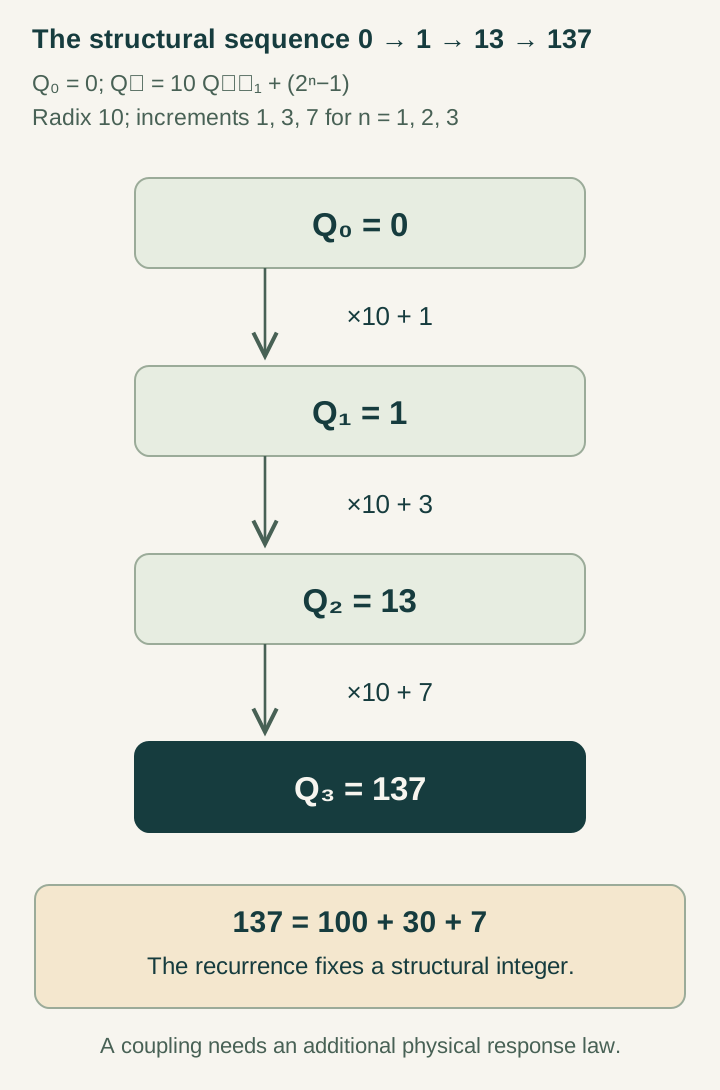
Open the full-size diagram →
The sectors correspond to two continuations before termination, one continuation, and immediate termination. A formal variable t that counts continuation labels gives F3(t)=100t²+30t+7. Evaluating at t=1 counts all records. It does not count physical duration unless each continuation has separately been assigned and justified as a temporal resource.
Step 3: prove that no legal words were counted twice
Tag continuation symbols as Q symbols and terminal symbols by their branch depth. A full record has exactly one of the forms q1q2b1, q1b2, or b3. Its first terminal symbol ends the word. Distinct symbol types and depth tags make the parsing unique.
Within each form, independent basis labels distinguish tensor products; the direct-sum tag distinguishes the three forms. Therefore the free construction really contains 137 independent records. If a realization introduces new relations of dimensions δd at successive stages, its rank instead obeys xd=10xd−1+bd−δd. Expanding yields x3=137−100δ1−10δ2−δ3. Earlier information losses are amplified by later continuation factors.
Step 4: state the precise discrimination minimum
Suppose one error-free readout must identify every legal record from its encoded pure state ψi. Let Ei be the positive measurement effect reporting i, with effects summing to I. Perfect discrimination requires ⟨ψi,Eiψi⟩=1 and ⟨ψj,Eiψj⟩=0 for j≠i.
Positivity implies Eiψi=ψi and Eiψj=0. Thus ⟨ψi,ψj⟩=⟨ψi,Eiψj⟩=0. The receiver needs 137 orthogonal states, and the free basis attains this bound. This proves minimum dimension for the declared one-shot task; allowing errors, restricted questions or additional sequential resources changes the task.
Step 5: normalize two different sampling laws
A uniform final-record sampler gives each word probability 1/137. It can be implemented recursively by choosing each immediate terminal symbol with probability 1/rd and each continuation symbol with probability rd−1/rd, then sampling the previous-depth record uniformly. The probabilities sum to [bd+10rd−1]/rd=1, and every final word has the required equal probability.
A different sampler chooses uniformly among the available local terminal and continuation symbols. At depth three there are 17 choices; at depth two there are 13. It gives each immediate terminal word probability 1/17 and each longer word 1/221. Normalization is 7/17+130/221=1. The same 137-dimensional receiver thus supports unequal final probabilities.
Under uniform final sampling, the average continuation count is F′3(1)/F3(1)=230/137. That is a grammar statistic, not a derived electron delay or clock law.
Step 6: distinguish dimension from determinant degree
Give each original envelope vector and innovation phase weight one. Then Q has weight two, while an exterior k-product has weight k. The branch weight polynomials are z, 2z+z² and 3z+3z²+z³. Propagating them through the same recurrence yields:
P(1)=137, P′(1)=612
The dimension is the sum of multiplicities, while the determinant exponent is the sum of weights: the inherited phase action has determinant z612. A separately selected common output action zI137 instead has determinant z137. Requiring determinant one then gives 137th roots of unity and the least positive phase fraction 1/137. That closure rule and output action are additional selections, not consequences of forgetting the grading.
Result and the exact physical bridge still required
The result is an exact free record dimension with a discrimination minimum and explicit probability and phase distinctions. Its notation in decimal does not derive a human numeral system. Nor are receiver dimension, probability, determinant fraction and interaction strength the same observable.
For ordinary trace response, a separately derived continuum model can give gN=scont/(4πacN). With N=137, the ideal-model value gN=1/137 still requires scont=4πac and identification of the current and matter sector. That dimensionless normalization cannot be supplied by changing units.
SMM/DTT’s constructive task is to derive the memory grammar, its response weights and its clock–action dictionary from one source. The normalized-coupling problem names this missing theorem. The structural integer should remain distinct from measured electromagnetic values and from any uncalculated holonomy or mass corrections.
Continue with the articles
- From three-dimensional readout to retained records
A quaternionic readout, ten-mode pair memory, and a selected stopping grammar produce 137 distinguishable records. The construction makes its retention assumptions explicit and leaves physical coupling as a separate problem.
- Why a record count is not yet a coupling
A receiver's static response depends on its source and inverse stiffness, as well as its size. Exact minimization shows why counting 137 records does not by itself determine an electromagnetic coupling.
- Trace-sector response and the Schur complement
Allowing hidden traceless modes to relax changes the stiffness seen by a trace source. The Schur complement gives the exact reduced capacity and exposes the normalization still needed for an inverse-rank coupling.
- The conditional ideal value one over 137
The ideal model value 1/137 requires a selected record count, a trace-response law, and an additional absolute normalization. A hydrogen-like calculation checks their consistency without deriving the measured fine-structure constant.
- Why the symmetric receiver has ten modes
The symmetric square of a four-component envelope contains four diagonal and six off-diagonal pair modes. Retaining all ten requires genuine pair memory, beyond the information in a quaternionic product.
- Alternating branches and the ranks one, three, seven
Positive-degree exterior combinations give branch ranks 1, 3, and 7. Combining them with ten-mode continuation memory yields 137 records under a free-retention rule whose losses can be calculated explicitly.
- Two phase actions and determinant closure
The inherited polynomial phase and a selected common output phase act differently on the same receiver. Their determinant exponents are 612 and 137, so closure claims depend on which action and physical source are chosen.