
An explicit completion instrument predicts accepted and failed outcomes and their state changes. Its physical significance comes from how source dynamics creates and retains the certificate, not from naming one branch complete.
Which part of measurement does completion address?
DTT separates inner work from a completed record available to an observer. This gives a natural question about measurement: when has an apparatus actually produced a result, and what makes that result usable for a subsequent operation? A flag can answer that question only if it is correlated with the required work by an explicit dynamics.
The wider measurement problem includes further questions about probabilities, the status of individual outcomes and the persistence of records. A source model can make progress on one without having solved all of them. The useful comparison is between a certificate merely appended by definition and one generated autonomously from a work register, a fresh apparatus state and a specified interaction. The latter makes quantitative predictions about errors, delays and retained information.
An instrument describes every outcome
Within standard quantum mechanics, an instrument consists of completely positive outcome maps Iₖ whose sum preserves trace. For one Kraus operator per outcome, Iₖ(ρ)=MₖρMₖ† and ΣMₖ†Mₖ=I. The trace pₖ is the outcome probability; Iₖ(ρ)/pₖ is its conditional state when pₖ is positive.
Take projectors P₀ and P₁ onto a two-level basis. On |+⟩=(|0⟩+|1⟩)/√2, the two outcomes each have probability one half. Keeping both outcomes without reading the label gives P₀ρP₀+P₁ρP₁=I/2. Keeping only P₀ρP₀ has trace one half and represents a selected branch. A completion account must retain that success frequency rather than describe the normalized accepted state as the whole process.
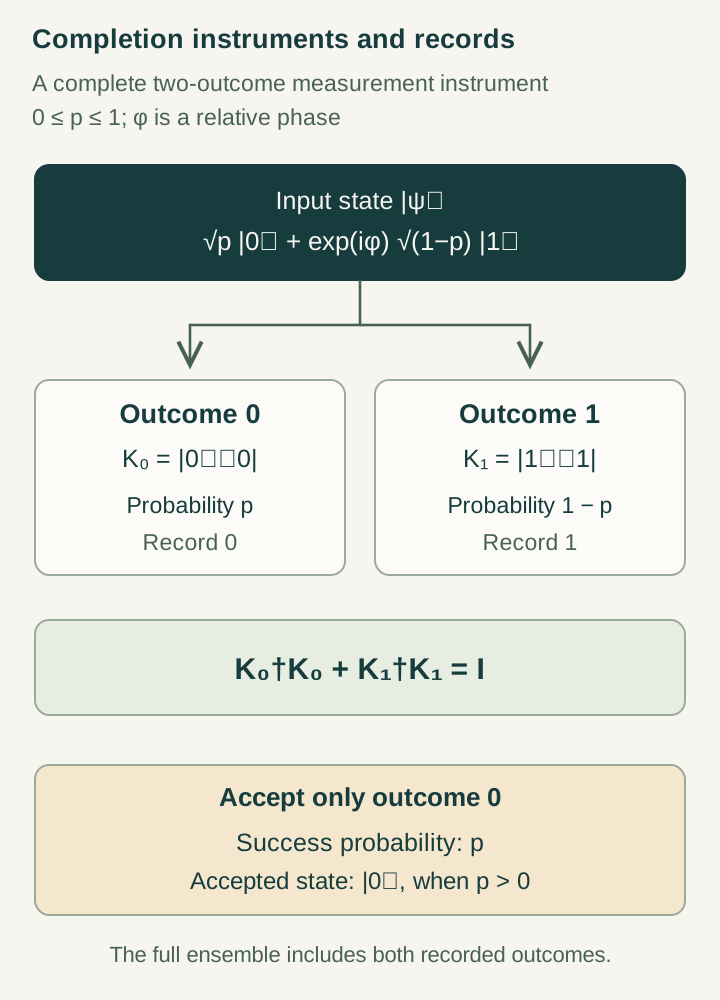
Open the full-size diagram →
Can work complete without measuring the payload?
Yes, in an explicit quantum model. Let V be a fixed unitary operation on an unknown payload and define the accepted map Iacc(ρ)=pVρV† with fixed 0<p≤1. Its trace is p for every input. The acceptance flag therefore does not preferentially choose payload states. The same identity holds when the payload is entangled with an untouched reference.
This separates certification of work from identification of the unknown input. A mechanism could make the controlled work equal V throughout an accepted region of source states. Then source preparation and its acceptance test determine p. The positive task is to derive that channel from the interaction, including its duration and energy budget. Payload independence does not imply independence from the apparatus preparation or clock: those remain measurable aspects of the completion process.
What would make repeated attempts legitimate?
Complete the example with Macc=√p V and Mfail=√(1−p)W, where W is another known unitary. Their effects sum to identity. After recorded failure, W† restores the unknown payload, including correlations with a passive reference. With fresh independent apparatus preparations, restored retries have the same success probability.
The first success on trial n has probability (1−p)n−1p. If p=1/4, the mean number of attempts is four, and success within five attempts has probability 1−(3/4)⁵=781/1024, about 0.763. These numbers depend on recovery and fresh preparation. An irreversible failed branch need not permit the same retry law. A physical clock counting all attempts also differs from a record index counting only successes, so elapsed time must include failures and recovery.
Why registration can change later generation
Compare two protocols on |+⟩ using the same Hadamard operation H and unread Z measurement D. If D comes first, the state becomes I/2 and remains I/2 under H. A final Z measurement is balanced. If H comes first, |+⟩ becomes |0⟩; D leaves it unchanged and the final result is certainly zero.
This is an exact ordinary quantum effect of operation order. It makes a useful benchmark for source models because an intermediate registration can erase coherence used by later work. To make it a distinctive DTT prediction, the source law must determine what physical operation implements registration and constrain its joint relation to completion probability, duration or energy. The half-versus-certain outcome alone is already explained by the supplied quantum comparator.
What must a completed record retain?
A certificate written at one instant does not guarantee later readability. The source can re-entangle the register, overwrite its label or allow a control to reveal information omitted from the public state. A completion model should therefore specify retention time, permitted interrogation and the error probability after declared delays. Predictive sufficiency must be checked under the future operations actually allowed.
Quantum correlations expose the issue sharply. The coherent state (|00⟩+|11⟩)/√2 and the equal mixture of |00⟩ and |11⟩ give the same matching Z labels. Their X⊗X expectations differ: one for the coherent state and zero for the mixture. A record that preserves only the Z correlations cannot predict both tests. The model must say whether completion retains the coherence, physically destroys it or restricts the future test family.
What would amount to a fuller measurement explanation?
The instrument examples adopt the Born probability rule and quantum state space. They make completion precise inside that framework; they do not derive the rule or establish an interpretation of individual outcomes. A stronger reconstruction would obtain the allowed positive states and effects from source principles and explain how the apparatus acquires stable accessible correlations.
A concrete next result is still substantial: derive one autonomous source instrument, prove its certificate accuracy and payload disturbance bounds, calculate every outcome frequency, and predict the lifetime of its records using the same parameters. Compare it with a conventional apparatus model under equal resources. The six nested roles can organize the dependent work, while the seventh exposes its result. Completion then contributes a physical mechanism for available records, with its remaining explanatory tasks stated precisely.
Continue with the articles
- A quantum source for generation and completion
A positive phase–dilation Hamiltonian ties one phase encoder to a powered coordinate and controlled work. It gives an explicit quantum realization of generation and completion while retaining its constitutive interfaces as inputs.
- Completion without biasing an unknown input
A factorized accepted channel gives the same success probability for every admitted unknown input, including inputs entangled with a reference. The failure channel and the amplification of errors by conditioning require separate checks.
- Undoing rejected partial work
A failed completion attempt can be coherently undone by reversing its actual source-controlled work prefix. The recovery restores an unknown payload under explicit inverse-access, memory, and control assumptions.
- Reliable completion by repeated attempts
Fresh recoverable attempts produce a geometric success law and an explicit reliability bound for a finite archive. Improved completion probability consumes prepared sources, flags, control, and runtime.
- A record that carries its own completion certificate
An autonomous history Hamiltonian can generate both a data record and a flag tied to its completed write. The exact construction retains incomplete outcomes, coherent intermediate stages, and finite observation windows.
- What spatial readout forgets
Different inner states can share one spatial readout and still have different successors. A concrete counterexample and a kernel-preservation criterion identify the memory needed for autonomous completed evolution.