


The answer in brief
Rejected work is exactly recoverable when the actual failed channel has a physically accessible inverse that preserves the unknown payload. Lost history information and input-dependent filtering create additional limits.
Go to the research challengeA failed attempt is a physical transformation
A completion attempt can fail to produce its intended result while leaving recoverable partial work. It can also leak information into an inaccessible apparatus, in which case reversing the payload alone may be impossible. The useful question is not whether failure is called incomplete, but which joint state remains after its flag has been read and which controls are still available.
This distinction matters in DTT because successful outer records need not count every inner attempt. If rejected work is quietly discarded, the model can undercount elapsed time, prepared resources and disturbance of an unknown input. The partial-work recovery article treats reversal as an explicit operation on the actual work history. A reliable retry mechanism must specify that operation before applying a repeated-trial success formula.
The exact recoverable case
Let an instrument have Kraus operators Macc=√p V and Mfail=√(1−p)W, where V and W are known unitaries and 0<p<1. The effects sum to identity. Acceptance performs the desired work V with probability p for every input. Failure applies W with probability 1−p, also independently of the unknown payload.
After dividing by the failure probability, W† restores the input exactly. The same identity holds with an untouched reference included, because W acts only on the payload. Recovery therefore preserves entanglement as well as isolated input states. This is a genuine positive result: a failed flag need not constitute a measurement of the unknown data.
Physical implementation adds concrete conditions. The inverse W† must be reachable by the allowed controls; the apparatus must not retain an uncontrolled input-dependent record; and another attempt must start from a suitable preparation. Knowing a matrix inverse on paper does not establish that an autonomous source can apply it at the required moment with a fixed energy and memory budget.
Why information leakage can defeat reversal
Consider a payload and an apparatus bit initially in |0⟩. A controlled-NOT interaction sends |0⟩|0⟩ to |0⟩|0⟩ and |1⟩|0⟩ to |1⟩|1⟩. If the apparatus remains available, the same controlled-NOT reverses the entire interaction. If it is discarded, the payload undergoes dephasing: its off-diagonal matrix entries disappear.
The two different inputs |+⟩ and |−⟩ then produce the same payload state I/2. No operation on that state alone can deterministically recover both original states. A single input to a recovery map has one output, whereas the requested inverse would need two. This elementary counterexample locates the obstruction in inaccessible information, not in the mere presence of a failure label.
Reading a coarse apparatus label can itself remove the history information needed for coherent undoing. A source-controlled inverse may need the actual prefix register that specifies which partial gates occurred. Replacing that register by a simple failure bit is justified only if every failed prefix induces the same recoverable channel or a suitable correction can be selected without destroying the relevant coherence.
Some filters admit only probabilistic reversal
Take a recorded branch K=diag(1,1/2) on a two-level system. Its probability is one on |0⟩ and one quarter on |1⟩, so the flag contains information about the input. Applying the formal inverse diag(1,2) is not a deterministic quantum operation: it can increase probabilities beyond one. A valid reversing filter is instead R=diag(1/2,1).
The combined original branch and successful reversal restore any input with total probability one quarter. Conditional on K having occurred, the reversal succeeds with probability 1/[4 Tr(KρK†)]. That conditional probability depends on the input through the branch frequency. A report that shows only successfully recovered states misses this cost.
More generally, for an invertible finite filter K, a reversing branch cK⁻¹ is admissible when its largest singular value is at most one. The maximal c² equals the smallest eigenvalue of K†K. If K has a kernel, information about vectors in that kernel is absent from the branch; a universal exact inverse on the full input space cannot be constructed this way. This calculation gives a sharp finite test for a proposed rejection mechanism.
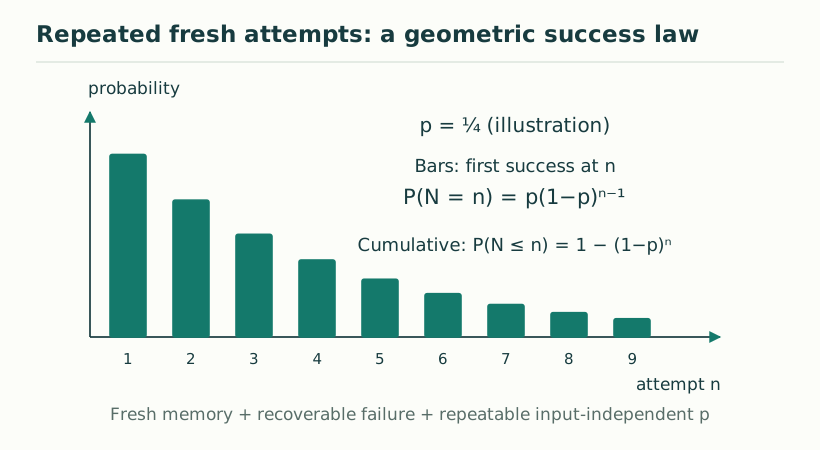
Count the failed attempts in the clock
When each attempt is freshly prepared and every failure is recovered, first success on attempt n has probability (1−p)n−1p. The mean number of attempts is 1/p, and the mean number of failures before success is (1−p)/p. These results depend on the stated reset and independence conditions. Reusing a disturbed source can change both the probabilities and their correlations.
If each attempt takes time τ and each failure needs an additional recovery time r, the mean elapsed duration is τ/p+r(1−p)/p, before adding any separately required preparation delays. At p=1/4, τ=2 milliseconds and r=1 millisecond, this gives eleven milliseconds. Calling the final success a single outer record does not make its preparation take two milliseconds.
A finite attempt budget also changes reliability. With at most n attempts, the failure probability remains (1−p)ⁿ. Correlated source fluctuations can invalidate that expression even when the average single-attempt probability is p. For example, a source that is permanently good or permanently blocked within a run has very different repeated-trial performance from independently refreshed apparatus states with the same first-attempt statistics.
What a source-level reversal should demonstrate
Reversing a controlled unitary is not the same claim as reversing physical time. A laboratory sequence may synthesize W† by another Hamiltonian or by reversing control order. A fundamental source proposal should identify the available operation and explain whether its clock, memory and preparation resources are also restored. Restoring a payload while consuming a fresh low-entropy apparatus is operationally useful, but it is not a free cycle of the complete system.
A constructive contribution could use a finite prefix register, two noncommuting work gates and a noisy completion flag. Derive the recovery map for each allowed flag, including any unobserved prefix coherence. Then test a basis of payload states and an entangled reference preparation. Compare the declared retry law with the actual joint dynamics under a fixed number of fresh apparatus states.
The resulting theorem can be modest and decisive: identify a class of rejected histories that admits exact recovery with stated controls, or establish a lower bound on unavoidable disturbance when some history information is inaccessible. That makes repeated completion a resource-accounted mechanism rather than an assumption hidden inside a success probability.
Develop the argument
Questions to take further
- Which failed prefixes remain coherently accessible after the completion flag is read?
- Does the retry clock include recovery, preparation and correlations between attempts?
A concrete next step
Classify recoverable rejection branches
Specify a finite source-controlled work sequence and all failure maps. Restrict the allowed inverse controls and the history registers that remain accessible.
What to share
A recovery construction or impossibility proof, including entangled inputs, total success probabilities and a complete time and preparation budget.
I welcome collaboration with experts in physics, mathematics and philosophy. Get in touch with a question or proposal.