Fresh recoverable attempts produce a geometric success law and an explicit reliability bound for a finite archive. Improved completion probability consumes prepared sources, flags, control, and runtime.
A single completion attempt may succeed with probability p<1. If failure exactly restores the unknown payload and each new attempt uses a fresh prepared source, repeated attempts can make logical failure rare. The resulting reliability is calculated rather than assumed.
For SMM/DTT this is a useful distinction between a generative architecture and an operationally usable record. A public record should carry a known completion probability and error account. Making that probability close to one consumes preparation, memory, control, and runtime.
02The first-success distribution
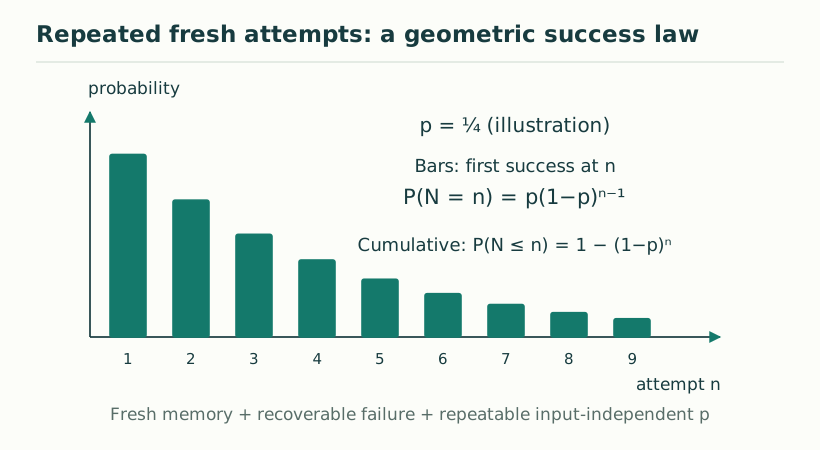
Suppose every attempt succeeds with the same input-independent probability p, and no successful payload is acted on again. To succeed first on attempt k, the device must fail k−1 times and then succeed. Thus Pr(T=k)=p(1−p)^(k−1).
With at most K attempts, the all-failure probability is (1−p)^K. The failure payload remains the original input, while every successful payload is VρV†. The retained attempt flags distinguish these cases, so no branch is silently discarded.
Pr(T=k)=p(1−p)^(k−1), 1≤k≤K
Pr(all fail)=(1−p)^K
Figure 1. Repeated fresh attempts: a geometric success law. When a failed attempt restores the input and fresh attempts have the same independent success probability p, P(first success at n) = (1−p)ⁿ⁻¹p. The plotted example uses p = 0.25 and is not experimental data. View full size ↗
03An elementary numerical example
For p=1/4, twenty fresh recoverable attempts reduce the all-failure probability to (3/4)^20, approximately 0.00317. The successful logical operation is still applied once. The improvement comes from additional prepared trials, not from changing the operation’s physical meaning.
The expected number of activated attempts in an untruncated sequence is 1/p=4. A finite allocation can require space for more attempts than are usually used. Worst-case capacity and average consumption are therefore different resource figures.
04Reliability across an archive
Suppose M successive logical cartridges each have success probability at least p*>0. Allocate K attempts to each and halt if any cartridge exhausts its allocation. The probability that any cartridge fails is at most M(1−p*)^K by the union bound.
To make this at most δ, it suffices to choose K≥ceil[log(M/δ)/(−log(1−p*))]. For M=1000, p*=1/4, and δ=0.01, K=41 suffices. This illustrative calculation shows how a modest per-attempt probability can support a finite archive when the attempt budget grows logarithmically with the desired reliability ratio.
The result relies on fresh preparations, input-independent success, and exact recovery on failure. Reference entanglement is allowed because the successful map is a scalar multiple of the intended channel and the failed map is the identity. The next cartridge’s success probability is therefore not secretly altered by earlier payload information.
Correlated source noise, a drifting apparatus, imperfect recovery, or reuse of a spent source can invalidate the simple geometric law. Those effects require explicit channel-error bounds or a different stochastic model. Observing a similar success fraction on a few trials does not establish all the required independence properties.
06Compiling retries into one autonomous device
The draft explains how the finite retry program, controls, and export can be embedded in a positive autonomous history Hamiltonian. This is an enlarged device whose gates and blank registers are supplied at initialization. It is not a claim that the original loaded source already retries and halts without those additions.
Padding can create a useful readout window with small unfinished-work probability, but at fixed spectral bandwidth it also lengthens runtime and increases sensitivity to static Hamiltonian error. Reliability therefore involves a tradeoff among attempt count, clock capacity, initialization quality, and coupling accuracy.
07The temporal interpretation
Logical activity recorded after recovery can differ from all physical activity spent during failed attempts. A clock running throughout preparation, reversal, and export measures those durations even if a successful archive records only the net completed operations.
The DTT distinction between inner work and outer completion is meaningful when both accounts are kept. The geometric success law does not identify one with proper time or explain universal clock rates. It provides a controlled finite mechanism for obtaining reliable completed records from a source whose individual attempts are probabilistic.
KEEP THE CONNECTION
Key ideas
Fresh recoverable attempts obey a geometric first-success law.
Archive reliability requires an explicit finite attempt budget.
Logical completion activity and total physical runtime are different quantities.
Scope of the argument. Reliability theorem under fresh preparation, input-independent acceptance, and coherent failure recovery.
Sources & further reading
quantum_relativity_temporal_generation_v10.pdfWorking draft, pp. 26–30
Source editions and catalogue entries
Working manuscript
Quantum relativity and temporal generation — working draft v10
Working manuscript. Article-level references identify the consulted sections and the scope of the interpretation. No public URL was supplied for this exact manuscript version.