A factorized accepted channel gives the same success probability for every admitted unknown input, including inputs entangled with a reference. The failure channel and the amplification of errors by conditioning require separate checks.
01Why completion probability must not secretly select the input
Suppose a device accepts some unknown quantum inputs more readily than others. Conditioning on success then changes the input ensemble. The successful output may look well behaved even though the acceptance step has biased the sample. A completion architecture should therefore state whether its success probability depends on the payload.
The finite source construction proves a useful factorization: on the admitted initialized sector, the accepted subchannel is p times a trace-preserving work channel, with the same p for every unknown matter input. This makes successful completion operationally clean while retaining failure as an explicit result.
02The factorization mechanism
Let C denote the source and comparison system and D the work payload. A source-controlled unitary G stores the partial work. In an appropriate representation the evolution is source motion followed by G. The acceptance projector P acts on C and commutes with G.
On the accepted source region, G has completed all work and acts as the same unitary V on D, independent of the remaining source coordinate. Projecting onto that region therefore leaves a source amplitude multiplied by V|ψ⟩ for every admitted input |ψ⟩. Tracing the source gives the required factorization.
P G(|η⟩⊗|ψ⟩)=P|η⟩⊗V|ψ⟩
Iacc(ρ)=p VρV†
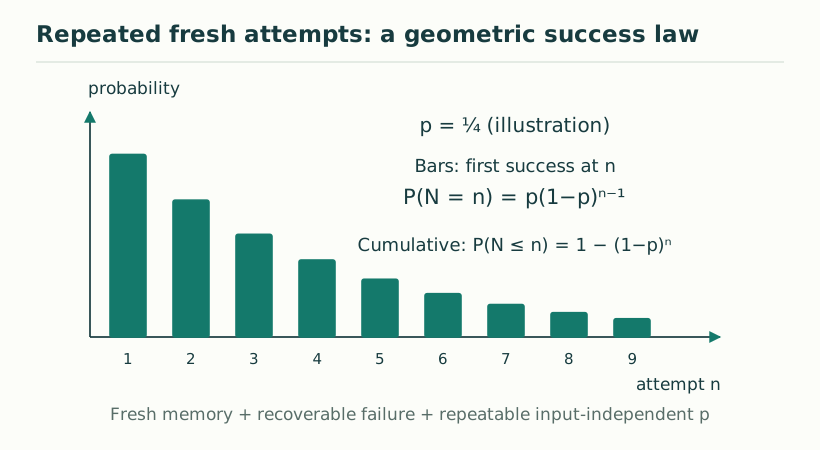
Figure 1. Repeated fresh attempts: a geometric success law. When a failed attempt restores the input and fresh attempts have the same independent success probability p, P(first success at n) = (1−p)ⁿ⁻¹p. The plotted example uses p = 0.25 and is not experimental data. View full size ↗
03The loaded comparison remains in the probability
The factor p is calculated from the actual source–caliper dynamics and the acceptance projector. A comparison load can change the source wavefunction and therefore p. It is not replaced by an unloaded free-packet estimate when the loaded Hamiltonian is different.
The key independence is from the unknown payload and phase-quadrature choice on the admitted sector. It is not independence from every apparatus parameter. Preparation, contact placement, caliper tolerance, and source energy can all affect the probability. These dependencies belong in the resource and calibration account.
04Why the statement extends to entangled inputs
An input may be entangled with a passive reference that the device does not control. A correct channel statement acts as the identity on that reference. Because the factorization is linear and the work operation is fixed, the accepted map becomes p(V⊗I)ρDR(V†⊗I).
The success flag therefore does not reveal information about the unknown input through its probability in this model. This is stronger than checking a few pure states with equal observed acceptance rates. It is an operator identity on the specified legal sector. Inputs outside that sector require their own behavior and cannot inherit the result by assertion.
05Input-independent acceptance does not mean no disturbance
The accepted output intentionally applies V, so it generally changes the payload. Moreover, knowing only the accepted map pVρV† says nothing sufficient about the failed map. A failure could irreversibly disturb the input or leak information to an environment.
This distinction is crucial for retrying. Repeating a heralded operation on a failed unknown state is justified only if failure is recoverable in the required sense. The draft supplies a separate inverse-prefix construction for that purpose; it is not a consequence of the acceptance probability alone.
06Error after conditioning
If the implemented full output law differs from the reference by total variation at most ε and the reference success probability is at least p*>ε, then implementation acceptance is at least p*−ε. A reference joint accepted-bad probability δ₀ gives a conditional bad bound (δ₀+ε)/(p*−ε).
The denominator shows why rare acceptance magnifies errors. Reporting only the conditional successful distribution can hide this sensitivity. A complete test should retain accepted, rejected, and incomplete outcomes and compare their joint frequencies before conditioning.
pimpl≥p*−ε
Primpl(bad|acc)≤(δ₀+ε)/(p*−ε)
07The SMM/DTT connection
A completed outer record should be derived from the same inner process that generated it, while preserving a declared operational meaning for the unknown matter state. The factorized instrument provides one precise version of that requirement.
It does not identify the output index with proper time or make completion physically universal. It supplies a reusable channel interface that later constructions can rely on. Its value lies in making success, failure, input dependence, and conditioning explicit rather than assuming that a selected successful branch represents the whole process.
KEEP THE CONNECTION
Key ideas
A factorized accepted subchannel prevents input-dependent sampling bias.
The loaded apparatus still determines the success probability.
Recoverable failure and robust conditioning require separate checks.
Scope of the argument. Exact factorization on the initialized legal sector of the supplied finite model.
Sources & further reading
quantum_relativity_temporal_generation_v10.pdfWorking draft, pp. 23–27
Source editions and catalogue entries
Working manuscript
Quantum relativity and temporal generation — working draft v10
Working manuscript. Article-level references identify the consulted sections and the scope of the interpretation. No public URL was supplied for this exact manuscript version.