
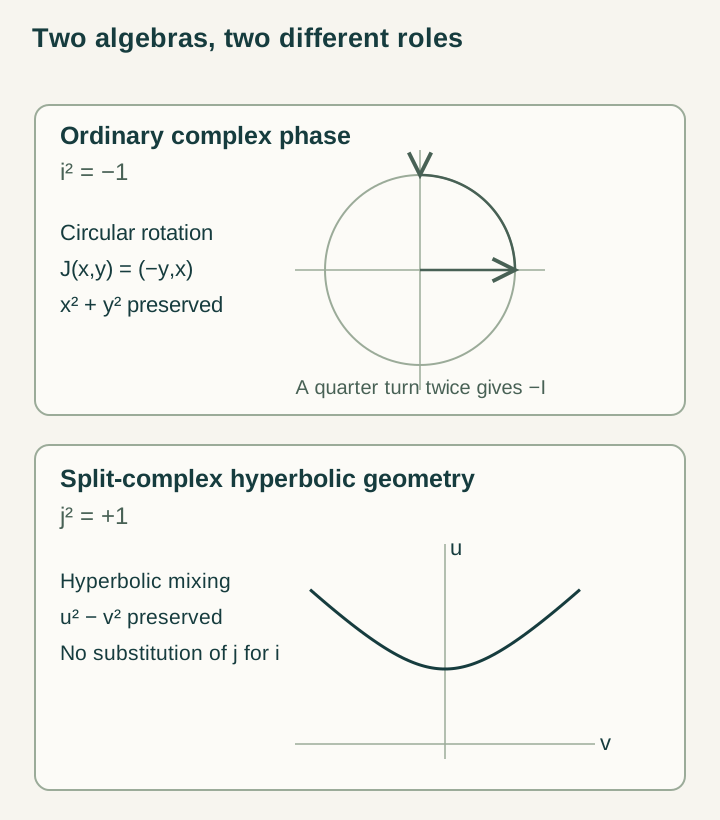
Ordinary complex phase uses J²=−I; split-complex geometry uses j²=+1. Both can be useful in one source programme, but their relation requires an explicit interface.
Why similar notation can describe different mathematics
Circular phase asks how coherent states rotate while preserving a positive norm. Hyperbolic geometry asks how calibrated temporal and spatial components transform while preserving an indefinite interval. Ordinary complex numbers answer the first algebraic question with i²=−1. Split-complex numbers answer the second with j²=+1.
Neither a two-component notation nor the word complex decides which task is being performed. A source model should specify the carrier, multiplication, invariant form and observation map before interpreting its variables. The DTT distinction between inner generation and outer completion does not itself choose either algebra. Six nested inner roles are dependencies in generating records; they are not six imaginary coordinates. Keeping these meanings separate permits a substantive connection between coherent generation and completed spacetime measurements.
Open the full-size diagram →
How a real flow selects circular phase
Take an invertible real skew-symmetric matrix A, so Aᵀ=−A, and the forward flow U(t)=exp(tA). Its norm is preserved because the derivative of UᵀU is Uᵀ(Aᵀ+A)U=0. Define Ω=(−A²)¹ᐟ². Since −A²=AᵀA is positive, Ω exists, is positive and commutes with A.
The identities follow by squaring and transposing, using commutation. J supplies a compatible quarter-turn, while Ω retains the rotation rates. For A=diag(2J₀,−3J₀), with J₀(x,y)=(−y,x), the result is Ω=diag(2I,3I) and J=diag(J₀,−J₀). The dynamics chooses opposite phase orientations on the two planes without confusing their rates with new time coordinates.
Which sign gives positive Schrödinger energy?
The real equation is ψ̇=JΩψ. Choose a positive action scale a. If multiplication by the ordinary imaginary unit means i=J, multiplying the equation by ia gives iaψ̇=−aΩψ. Under that convention the associated Hamiltonian is negative. The sign cannot be changed silently while retaining the same forward flow.
This convention reproduces exp(−itH/a)=exp(tA). The polar phase and conventional imaginary scalar can thus differ by a sign for positive-energy forward evolution. The calculation fixes a consistency issue, not the physical value of a. A source model still needs an action–phase calibration before its generator frequencies can be read as measured energies.
What split-complex multiplication establishes
Let z=T+jx with j²=+1 and conjugate z̄=T−jx. Then zz̄=T²−x². Multiplication by exp(−jη)=coshη−j sinhη gives T′=T coshη−x sinhη and x′=x coshη−T sinhη. Direct expansion preserves T²−x² because cosh²η−sinh²η=1.
For η=log2, coshη=5/4 and sinhη=3/4. The input T=5,x=3 becomes T′=4,x′=0, and both intervals equal sixteen. With a supplied identification T=ct, the boost speed is v/c=tanhη=3/5. This is an exact one-space-direction Lorentz representation. It does not turn j into the ordinary scalar used in quantum amplitudes, nor establish that the source variables already are physical clock and ruler readings.
What stationary sectors and reversal reveal
If A has zero modes, Ω cannot be inverted on them. The polar construction applies to the orthogonal complement of the kernel. A stationary real plane allows either quarter-turn orientation; its zero evolution chooses neither. A stationary real line admits no operator squaring to −I at all. Thus existence on the whole carrier and selection on its dynamic sector are different claims.
For an orthogonal reversal K satisfying KAK⁻¹=−A, Ω is unchanged and J changes sign. Relative to the selected ordinary complex scalar, K is antilinear. Reflection K(x,y)=(x,−y) supplies the simplest example. This result explains a mathematical origin of antiunitary reversal, while the transformation of actual matter and apparatus needs a physical identification of K.
Does local phase already give quantum composition?
Two real planes with selected quarter-turns have a four-real-dimensional tensor product. Two complex lines have a complex tensor product of only two real dimensions. The standard complex composite is obtained by imposing the balancing relation (J₁x)⊗y=x⊗(J₂y). Applying that relation twice gives (J₁x)⊗(J₂y)=−x⊗y.
The relation is exact algebra, but local phase selection alone does not impose it. An SMM construction should explain why those joint histories are observationally equivalent under all allowed continuations. It must also select admissible states, effects and completion probabilities. A source can possess circular phase without yet reproducing the operational content of quantum theory. This is a productive target because composition constrains what a common source can preserve across independently controlled subsystems.
A useful joint check compares a coherent two-level pair with a mixture carrying the same classical labels. The coherent state (|00⟩+|11⟩)/√2 has X⊗X expectation one; the equal mixture of |00⟩ and |11⟩ has expectation zero. Both give the same correlated Z outcomes. Thus a completion interface retaining only the labels loses a phase-sensitive prediction. A proposed shared source must identify which preparation and later test preserve that distinction.
How could both algebras belong to one model?
A clear candidate would derive a real phase-bearing carrier and its allowed joint operations from source dynamics, then define completed displacement and delay readings separately. It would prove that one interface preserves coherent ordinary complex phase and that another yields the desired hyperbolic cone or interval. Shared calibration and transport laws would connect their parameters.
The comparator is a model with exactly the same circular phase but an arbitrary completion delay, or the same cone but unrelated matter clocks. Excluding such alternatives would show that the proposed common origin does more than place two familiar algebras side by side. The constructive answer is therefore to use both structures where their identities apply, and seek the source law that makes their independently defined physical outputs agree.
Continue with the articles
- Split-complex time and ordinary quantum phase
Split-complex temporal pairing and ordinary complex quantum phase use different algebraic units. The record construction keeps those roles distinct and obtains its Lorentzian determinant only after additional completion assumptions.
- Selecting phase by polar decomposition
Polar decomposition of an oriented real dynamical generator selects an ordinary complex structure on its nonzero-frequency sector. Zero modes, symmetry compatibility, and discrete logarithm branches remain separate inputs.
- When geometric symmetries become physical boosts
A geometry can admit Lorentz transformations that its material observers cannot realize. The frame-richness argument identifies the extra reachability and clock-calibration conditions needed to turn geometric automorphisms into physical boosts.
- Completion, commutants, and positive frequency
This guide follows completion, compatible complex structures and positive-frequency selection through their separate mathematical roles. Finite examples connect the framework to SMM/DTT while keeping causal readout and physical calibration as additional constructions.
- Real-commutant phase selection: a paper guide
An oriented real orthogonal flow can select an ordinary complex structure on its dynamic sector. Planar examples explain residual zero-mode freedom, time-reversal antilinearity and the extra balancing rule needed for composite systems.