
An accepted channel pVρV† has payload-independent success probability when p is fixed and V is unitary. A complete instrument must also retain the failed outcomes; neither a projector nor a completion label derives the probability rule.
From inner work to a usable record
DTT separates generative work from the completed record available to an observer. In a quantum realization, the source may remain coherent while performing several nested operations, then interact with an apparatus that stores a result and a completion flag. The flag is meaningful only if its value is tied to the actual completed work.
A label written by definition does not establish that tie. A model should identify the work register, its initialization, the source evolution, the acceptance condition, and the memory that keeps the result readable. The six inner stages can organize nested prerequisites within this process; the outer interface certifies and exposes a record rather than adding another independent clock coordinate.
An instrument includes every outcome
Within supplied quantum mechanics, an instrument is a collection of completely positive maps Ik. Each map describes one outcome, its trace gives that outcome's probability, and the sum is trace preserving. For Kraus operators Mk, a simple instrument has Ik(ρ)=MkρMk† with ΣMk†Mk=I.
The probability assignment is part of the quantum framework used here. Naming an operation completion does not derive it. The distinction between the unnormalized map, its probability, and the conditional state is essential whenever unsuccessful trials are possible.
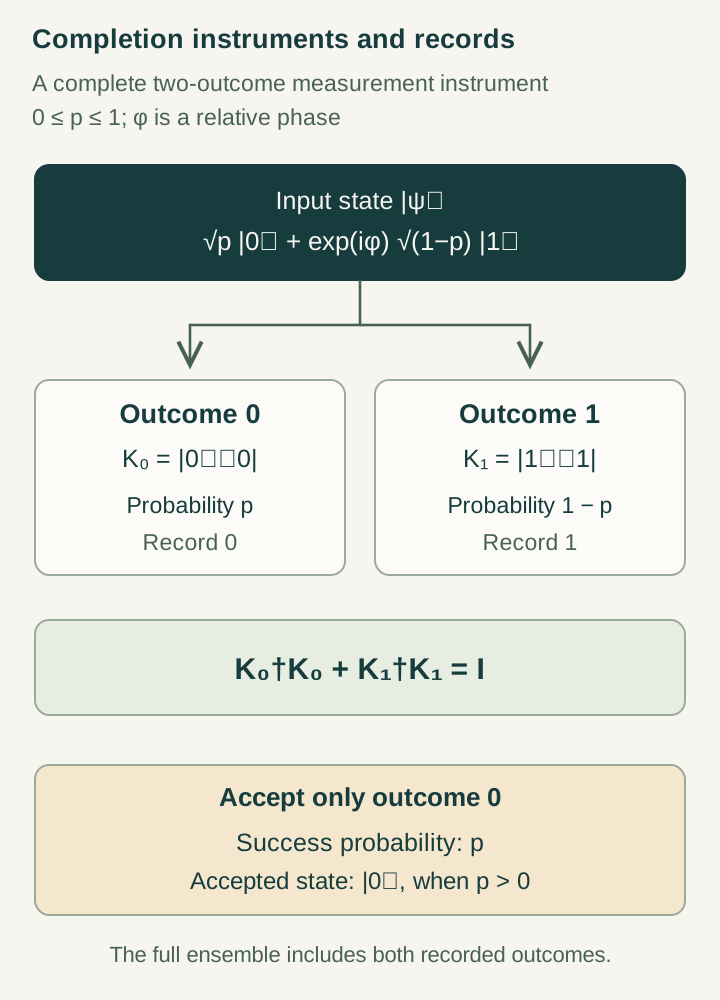
Open the full-size diagram →
A projection is one branch, not the whole process
Consider a two-level system and projectors P₀=|0⟩⟨0| and P₁=|1⟩⟨1|. The map ρ↦P₀ρP₀ keeps only outcome zero and usually reduces the trace. Keeping both outcomes gives the unread measurement channel P₀ρP₀+P₁ρP₁, which preserves the trace but removes off-diagonal coherence in that basis.
For |+⟩=(|0⟩+|1⟩)/√2, either recorded result has probability one half. Ignoring the result leaves I/2. This is different from an information projection that merely reports one coordinate of a classical vector. Confusing these operations can make a completion theorem appear to establish a physical measurement mechanism that it has not specified.
Completion without selecting the unknown payload
A particularly useful accepted map is Iacc(ρ)=pVρV†, where V is a fixed unitary and 0<p≤1 does not depend on the unknown payload. Its trace is p for every normalized input. The acceptance flag therefore does not preferentially sample one payload state over another, even when the input is entangled with an untouched reference.
One sufficient mechanism is source-controlled work that becomes the same V everywhere in the accepted source region. The loaded source and comparison apparatus determine p. Independence from the payload does not imply independence from source energy, preparation, detector tolerance, or completion time.
A retry requires recoverable failure
The accepted map does not specify what a failed attempt does. As a simple complete model, take Macc=√p V and Mfail=√(1−p)W with known unitaries V and W. Their squared operators sum to I. When failure is recorded, applying W† restores the unknown payload, including its correlations with a passive reference.
With fresh independent apparatus preparations, each restored retry can have the same success probability p. The first success then occurs on attempt n with probability (1−p)n−1p, and the mean number of attempts is 1/p. These conclusions depend on recovery, fresh preparation, and fixed p. A general failed branch can irreversibly leak information, in which case the geometric retry law is unjustified.
Registration order changes later statistics
Prepare |+⟩ and compare two protocols using the same Hadamard operation H and the same unread Z measurement D. Applying D first gives I/2; H leaves it unchanged, so a final Z measurement is balanced. Applying H first gives |0⟩, which D leaves unchanged; the final result is then certainly zero.
This illustrates how registering an intermediate distinction can remove coherence needed by later generation. The effect is ordinary quantum measurement physics. A specific SMM/DTT model gains additional content only when its source dynamics determines which operation corresponds to registration and predicts its relation to completed work or clock readings.
Completion also needs a memory lifetime
After a result is written, another question begins: how long can it be read reliably? A record that immediately re-entangles with the source or is overwritten does not provide the same operational resource as a protected memory. Certification of a write, successful recovery, and retention are separate physical tasks with separate error budgets.
A complete source model should therefore report joint frequencies for accepted, failed, and incomplete outcomes before conditioning, and should test later readout at declared delays. Its next theorem might bound both payload disturbance and record error using the same finite source dynamics. This would connect inner work to outer accessibility without assuming that successful postselection represents the entire process.
Continue with the articles
- A quantum source for generation and completion
A positive phase–dilation Hamiltonian ties one phase encoder to a powered coordinate and controlled work. It gives an explicit quantum realization of generation and completion while retaining its constitutive interfaces as inputs.
- Completion without biasing an unknown input
A factorized accepted channel gives the same success probability for every admitted unknown input, including inputs entangled with a reference. The failure channel and the amplification of errors by conditioning require separate checks.
- Undoing rejected partial work
A failed completion attempt can be coherently undone by reversing its actual source-controlled work prefix. The recovery restores an unknown payload under explicit inverse-access, memory, and control assumptions.
- Reliable completion by repeated attempts
Fresh recoverable attempts produce a geometric success law and an explicit reliability bound for a finite archive. Improved completion probability consumes prepared sources, flags, control, and runtime.
- A phase-sensitive registration experiment
Registering a completion flag before or after further source evolution changes later phase-sensitive acceptance statistics. The proposed protocol measures that order effect and compares it with an ordinary qubit baseline.
- A record that carries its own completion certificate
An autonomous history Hamiltonian can generate both a data record and a flag tied to its completed write. The exact construction retains incomplete outcomes, coherent intermediate stages, and finite observation windows.
- Keeping an observed label stable
A transported record can preserve an already observed label under a declared class of later readings. Exact projector identities and channel-error bounds distinguish genuine retention from unchanged one-time statistics.