Registering a completion flag before or after further source evolution changes later phase-sensitive acceptance statistics. The proposed protocol measures that order effect and compares it with an ordinary qubit baseline.
01An experiment can test the order of generation and registration
The current reduced record may not contain the phase information that controls a future completion probability. The draft proposes comparing the same registration operation before and after the same further source evolution. The two protocols use identical durations and differ only in order.
This operationally connects inner coherence to later outer completion statistics. It remains an ordinary quantum measurement effect. The purpose is to test the specified source-and-record architecture, not to claim a new probability rule or a unique signature of dual time.
02Calibrate a partial registration channel
Let ZF distinguish the two completion-flag sectors. A real-strength unread registration channel is Dν(ρ)=[(1+ν)/2]ρ+[(1−ν)/2]ZFρZF, with 0≤ν≤1. It preserves flag populations and multiplies off-diagonal coherence by ν.
A fresh qubit and a calibrated unitary coupling realize this channel. Flag eigenstates calibrate its distinguishability, and a prepared coherent flag state checks its coherence multiplier. The same independently calibrated operation is used in early and late protocols; ν is not fitted from the completion contrast being tested.
Dν(ρ)=(1+ν)ρ/2+(1−ν)ZFρZF/2
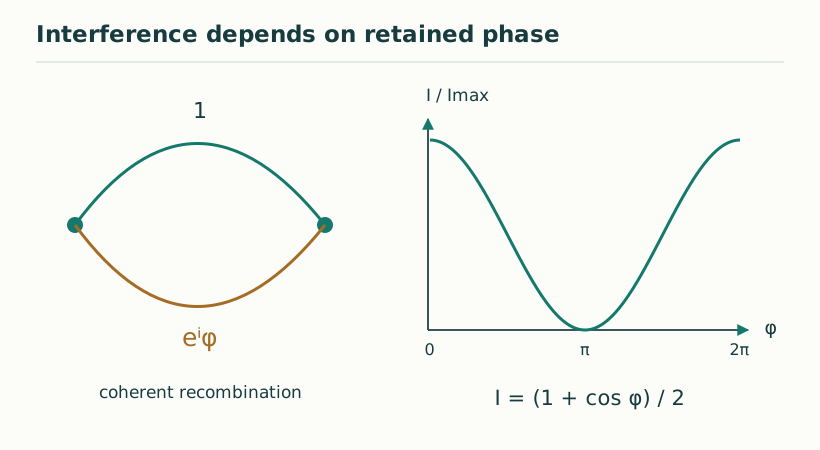
Figure 1. Interference depends on retained phase. The ideal two-path law I(φ) = |1 + eⁱφ|²/4 = (1 + cos φ)/2 is an illustrative quantum baseline. A temporal interpretation must specify which histories retain coherence and how the phase is controlled. View full size ↗
03The simple order law
Prepare two legal source states with equal current record statistics but opposite relative current phases. Let Δ₀(v) be their acceptance-probability difference after further evolution v without early registration. Early registration reduces that difference to νΔ₀(v). Late registration leaves it at Δ₀(v) because the final acceptance effect is flag diagonal.
The effect is read from full accepted and failed outcome frequencies. No rare-success conditioning is needed for this contrast. The source preparation and the final acceptance projector are part of the specified protocol.
Δearly(ν,v)=νΔ₀(v)
Δlate(ν,v)=Δ₀(v)
04Measure coherent phase errors as well as dephasing
A general population-preserving registration can multiply coherence by c=a+ib with |c|≤1. Prepare four relative phases 0,π,π/2,−π/2 and form two acceptance contrasts dx and dy. The early and late contrast vectors obey a two-dimensional rotation-and-contraction law.
The norm shrinks by |c|, while the phase of c rotates the contrast vector. Measuring only one visibility would miss this coherent phase error. The model also predicts opposite initial mean-energy shifts δE±=∓γQ Im c for the two current preparations.
dearly=[a −b; b a]dlate
‖dearly‖₂=|c|‖dlate‖₂; δE±=∓γQ Im c
05Information and retained contrast
For the pure-register implementation, the best single-copy probability of guessing the input flag is gν=[1+√(1−ν²)]/2. The normalized completion contrast and flag distinguishability satisfy [Δearly/Δlate]²+(2gν−1)²=1 whenever the late contrast is nonzero.
This is a familiar two-alternative measurement tradeoff applied to the loaded source’s completion readout. Mixed probes, excess dephasing, or an uncalibrated phase require their own analysis and need not satisfy the equality. Recovering the original source coherence after discarding the register is generally impossible; retaining the enlarged unitary system permits reversal under suitable control.
06A qubit baseline limits the novelty claim
The same elementary order law occurs in a positive two-level Hamiltonian Href=γ(I−X), with source states (|0⟩±i|1⟩)/√2 and a Z-basis acceptance effect. Their contrast is sin(2γv/ℏ), and early Z-registration multiplies it by ν.
The loaded SMM/DTT model adds independently checked refinement, a caliper, a work channel, generated completion flags, and retained output. The generic dephasing effect alone does not establish any of that additional structure. Comparing with the baseline is necessary to identify which observations test the architecture rather than ordinary coherence.
07Errors and the physical interpretation
Preparation, source-evolution, registration, and final-instrument errors can be added through channel-distance bounds. Hamiltonian error over duration v contributes at most |v|δH/ℏ in the stated bounded setting. All eight probabilities used for the two contrast vectors need statistical and systematic intervals.
The special unchanged-initial-energy statement applies only to the specified real-registration inputs, not to arbitrary states or cost-free measurement. SMM/DTT gains a concrete test of generation–registration order here, while the existence of six nested stages or a universal outer clock must be tested through additional observables.
KEEP THE CONNECTION
Key ideas
Early and late registration give distinct completion contrasts in the specified protocol.
Four phase preparations test a full rotation-and-contraction response matrix.
A simple qubit baseline shows that the generic effect is ordinary quantum coherence.
Scope of the argument. Model-specific quantum-control test, not unique evidence for DTT or a new measurement law.
Sources & further reading
quantum_relativity_temporal_generation_v10.pdfWorking draft, pp. 30–34
Source editions and catalogue entries
Working manuscript
Quantum relativity and temporal generation — working draft v10
Working manuscript. Article-level references identify the consulted sections and the scope of the interpretation. No public URL was supplied for this exact manuscript version.