Quantum causal discovery: testing a common source with interventions
Correlations alone can leave a common cause and a direct influence observationally indistinguishable. This guide demonstrates the difference with an intervention, explains the quantum role of instruments and memory, and develops an operational route for asking whether DTT’s single-source architecture imposes a distinctive causal structure.
Two records can agree because one causes the other, because both depend on a common source or because the experiment selects a special subset. A causal model makes these possibilities explicit through variables, operations and independence assumptions. Quantum causal modelling extends that task to states, channels and instruments, where measurement can disturb what is later observed.
This is central to SMM/DTT. A Single Monad is a proposed common origin, but a common origin does not determine which interventions can affect which records. A useful source model must translate its inner update into a family of operational causal relations that can be compared with alternatives. [2][3]
02The source and its two temporal roles
The Single Monad Model begins with one nonspatial generative source. The Duality of Time Theory distinguishes the source’s inner production from the outer order in which completed records become accessible. Its six inner levels are nested functional roles of one process: a higher role organizes lower-level work. The seventh is the completion or observation interface. They are neither six independent clocks nor six additional time coordinates.
This distinction supplies a useful research question: which features of an observed world can follow from the way a source produces, retains and releases information? A concrete answer needs a state space, an autonomous update, retained memory and a rule connecting completion to an accessible measurement. In the constructions discussed here, those mathematical ingredients are stated explicitly. A successful finite example establishes what its specified mechanism can do; further arguments connect it to physical particles, spacetime or universal laws. [1]
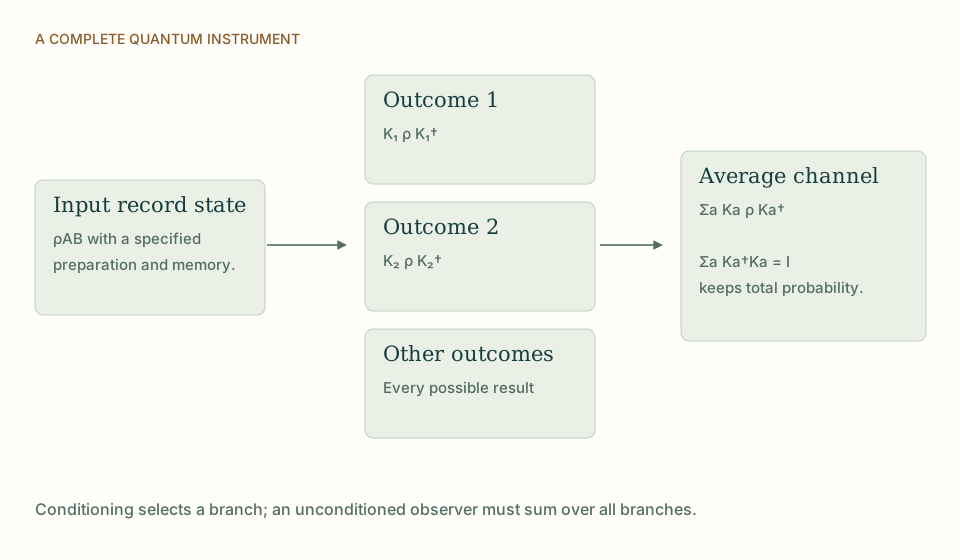
From a source process to a complete record instrument. Outcome probabilities, retained conditional states, and the outcome-averaged channel belong to the same instrument. Keeping every outcome prevents postselection from being mistaken for a signal. View full size ↗
03Worked classical ambiguity and its resolution
Let a fair hidden bit C be copied into observed bits A and B. Then p(A=0,B=0)=p(A=1,B=1)=1/2. The same observed distribution arises if A is itself a fair bit and a direct channel copies A into B. Passive observation of A and B cannot distinguish these two mechanisms.
Now intervene by setting A to one while leaving other mechanisms unchanged. In the common-cause model, B still equals C and remains equally likely to be zero or one. In the direct-copy model, B becomes one with certainty. The difference is a property of the intervention, not of the original correlation. A DTT account needs an analogous statement about what it means physically to change one completed input while keeping the source law fixed. [2]
Common cause: P(B=1|do(A=1))=1/2; direct copy: P(B=1|do(A=1))=1
Illustrative causal models with an ideal intervention replacing A’s mechanism. Conditioning on observed A=1 is a different operation.
04Quantum operations include disturbance and outcomes
In quantum theory an instrument specifies both the probability of an outcome and the conditional output state. Replacing an instrument with another can alter later statistics through ordinary disturbance, even when no hidden memory is present. A causal comparison must therefore control the full operation, not merely a label attached to it.
Entanglement adds another restriction: a classical factorization model may fail to reproduce the joint statistics even when no controllable remote influence exists. The causal structure and the nonclassical state structure have to be distinguished. Quantum causal frameworks provide the appropriate language for that distinction, while a source ontology must supply its own concrete maps within or beyond the chosen framework. [2][4][5]
05Memory can hide behind the same visible state
The two-swap process gives a useful quantum example. A first swap transfers an arbitrary input state into hidden memory and leaves the visible system in a fixed state. Even after the visible system is discarded and reprepared, a second swap can return the original input. A causal break on the visible system has not erased the common memory.
DTT can use this construction to make inner retention operational. Earlier interventions affect later records through a register absent from the intermediate archive. But the effect itself is standard quantum mechanics. The source programme becomes distinctive when its architecture restricts the possible memory or its causal access in a way that a freely chosen environment does not. [3]
06Identifiability limits the inference
Many hidden implementations can produce the same complete input-output process for a given set of tests. No analysis of that dataset alone can identify which implementation is ontologically fundamental. Adding new interventions can shrink the equivalence class, but it cannot justify claims about inaccessible details that never affect any allowed operation.
This is a useful discipline for DTT. A source model should identify what evidence could distinguish its constrained architecture from another common-cause or direct-influence account. If it allows an arbitrary source state that also encodes every later measurement setting, the apparent explanatory power may come from an unconstrained hidden dependence rather than a derived law. Independence assumptions should therefore be stated rather than silently removed when a comparison becomes difficult. [2][3]
07A constructive causal signature for DTT
A promising model would derive a restricted process tensor from one autonomous update and a finite retained memory, then calculate how a causal-break intervention changes later records. A linked dependence on completion accuracy, source phase and memory depth could be compared across protocols using one parameter set. This would test the architecture’s causal content without requiring direct access to a metaphysical source.
The six inner levels can organize the implementation, but they must have a role in the derived restriction. Renaming six arbitrary channel steps as generative levels would not explain their agreement. A genuine result would show why certain intervention responses are impossible or related because of the source law. The comparison thus provides a practical definition of progress: fewer operational freedoms, clearer causal assumptions and a measurable difference among otherwise plausible models. [2][3][1]
THE SAME QUESTION, DIFFERENT STARTING POINTS
The comparison at a glance
Question
SMM/DTT
Quantum causal modelling
Common origin
DTT must specify how interventions alter records under a fixed source law.
A common cause and a direct channel can have identical passive correlations.
Hidden retention
Source memory can survive a reset of the visible system.
Multi-time causal-break tests reveal memory beyond one-time states.
Distinctive evidence
A constrained source model should exclude or relate possible intervention responses.
Operationally equivalent hidden realizations cannot be distinguished by the same test set.
KEEP THE CONNECTION
Key ideas
DTT must specify how interventions alter records under a fixed source law.
Source memory can survive a reset of the visible system.
The source interpretation becomes additional physics when it constrains an independently measurable process.
Connects the comparison to the programme’s current statement of results and assumptions.
Sources and further reading
References support the comparator and the specific mathematical or interpretive claims indicated. SMM/DTT connections are developed in the analysis above.