Eliminating a relaxing hidden sector yields an exact memory equation for the retained variables. The resulting kernel and initial-state term preserve causal dependence while exposing information absent from the current readout.
The present visible state may not determine its own future when a hidden variable continues to act on it. Solving the hidden equation makes that missing information explicit as a memory kernel and an initial-state term. The calculation is exact for the supplied coupled equations and gives SMM/DTT a precise reduced-dynamics example without deriving the hidden relaxation law from its ontology.
02Start with coupled, time-local equations
Write the observable evolution as q̇=F(q)+Kr and the hidden evolution as ṙ=−Λr−Kᵀ∇Ψ(q). Here K couples retained and hidden variables, Λ is a stable hidden relaxation operator, and Ψ is the selected structural functional. Both equations depend on the present enlarged state. The observable q alone is generally insufficient because the same q can coexist with different hidden r. Eliminating r exposes that dependence rather than removing its physical effect.
q̇=F(q)+Kr
ṙ=−Λr−Kᵀ∇Ψ(q)
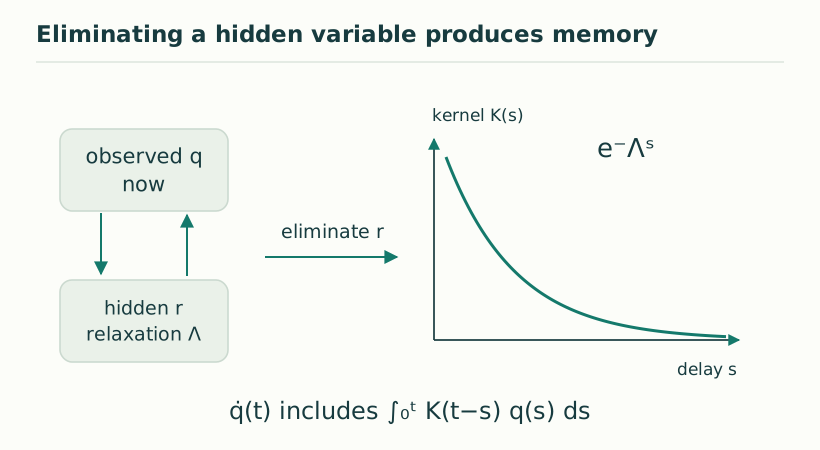
Figure 1. Eliminating a hidden variable produces memory. For a linear relaxing hidden sector, substitution produces a Volterra memory term. An exponentially decaying kernel is the simplest example; its fast limit can yield local effective dissipation under additional assumptions. View full size ↗
03Solve the hidden equation exactly
Variation of constants gives a freely decaying hidden initial state plus a convolution of the past observable gradient. Substituting into q̇ yields an exact Volterra equation. The memory kernel is K exp[−Λ(t−s)]Kᵀ, and the term K exp(−Λt)r₀ records the initially hidden preparation. It cannot be discarded before its decay is justified. No short-memory approximation is needed for this algebraic elimination.
r(t)=e^(−Λt)r₀−∫₀ᵗe^(−Λ(t−s))Kᵀ∇Ψ(q(s))ds
q̇=F(q)+Ke^(−Λt)r₀−∫₀ᵗKe^(−Λ(t−s))Kᵀ∇Ψ(q(s))ds
04A scalar worked example
For one observable and one hidden mode, let Ψ=kq²/2, K=g and Λ=λ>0. The memory term becomes −g²k∫₀ᵗe^(−λ(t−s))q(s)ds. Two preparations with the same q₀ but different r₀ have initial derivatives differing by gΔr₀. An experiment measuring only q₀ would therefore see apparently nonunique evolution unless it retains a history or specifies how r₀ was prepared. The exact kernel provides a systematic way to include that missing information.
05What the source interpretation contributes
DTT interprets r as a hidden generative sector and q as a completed readout. The elimination calculation itself is a standard dynamical mechanism and does not uniquely select that interpretation. Its value for the programme is diagnostic: a proposed completion map should say which variables disappear, which couplings survive, and which initial conditions remain relevant. A future autonomous source law could calculate K and Λ and thereby predict a specific memory response. Without that step, the article demonstrates a conditional mechanism rather than a unique temporal ontology.
06Memory is not the same as information flowing backward
The convolution integrates only over earlier times s≤t. Its nonlocality is temporal in the sense that a reduced state needs its past, not in the sense that later observations alter prior causes. A hidden initial state supplies another ordinary causal contribution. This distinction helps explain why eliminating variables can produce an equation that looks unfamiliar while remaining compatible with a well-posed enlarged initial-value problem. For DTT the physical question is whether the required hidden state is a generative completion variable, an ordinary environment, or an effective combination of both; the Volterra form alone does not decide that ontology.
07Interpretation of an irreversible reduced law
A reduced equation can lose predictive information because several larger states share one observed state. That does not make projection alone a universal source of thermodynamic entropy. Positive hidden relaxation, a chosen initial condition or reservoir, and a condition on the reversible flow do essential work in this model. The structural functional Ψ is not automatically Boltzmann, Gibbs or von Neumann entropy. Connecting its decay to a laboratory second law requires an operational coarse-graining, thermodynamic variables and calibrated coefficients. This qualification preserves the useful mechanism while preventing a model-level monotonicity theorem from being mistaken for an unconditional derivation of time’s arrow.
A finite closed Hamiltonian system preserves information globally and can display recurrences. Replacing some of its degrees of freedom by a permanently relaxing operator requires a specified approximation, reservoir or limiting regime. The exactness claimed for hidden-variable elimination is exactness relative to the supplied coupled equations, including their positive relaxation operator. It is not an independent proof that those equations follow from a conservative temporal action. A source-based derivation should track where the discarded information resides and over which interval the reduced dissipative description remains accurate.
KEEP THE CONNECTION
Key ideas
Exact elimination produces both a memory kernel and an initial-slip term.
A time-local enlarged model can be non-Markovian after reduction.
The source interpretation must specify hidden preparation and coupling.
Scope of the argument. Exact reduction of the stated linear hidden-sector equations; relaxation and coupling are supplied assumptions.
Sources & further reading
dual_time_entropy_v4.pdf — working draftpp. 16–19 and 21–23, §§6.6–6.11
Source editions and catalogue entries
Working manuscript
A Dual-Time Gauge Model for Projection-Induced Memory and Irreversibility
Working manuscript. Article-level references identify the consulted sections and the scope of the interpretation. No public URL was supplied for this exact manuscript version.