A069Public article topicExpanded article4 min read
Causality and Induction
Causality concerns dependence, while induction concerns inference from observed cases. Their distinction clarifies why temporal order and repeated records need a lawful generative relation before they support explanation and prediction.
The source distinguishes ultimate creative dependence from the regular intermediate causes used in ordinary life. It also questions the certainty obtained by induction from repeated observations. These are two related but different issues: causality concerns how changes depend on one another, while induction concerns how past observations support expectations about unobserved cases. A temporal ontology should address both without treating them as the same problem.
02Correlation does not identify a causal arrow
Suppose a room's thermometer reading and a metal rod's length rise together during the day. Their correlation does not show that the thermometer causes the rod to expand. A shared environmental temperature can influence both. To identify the effect of changing one variable, one needs a model of interventions or controlled comparisons.
This example is relevant to SMM because a common source can produce correlated outcomes without direct interaction between the observed variables. But the existence of a common source must itself be specified sufficiently to calculate those correlations.
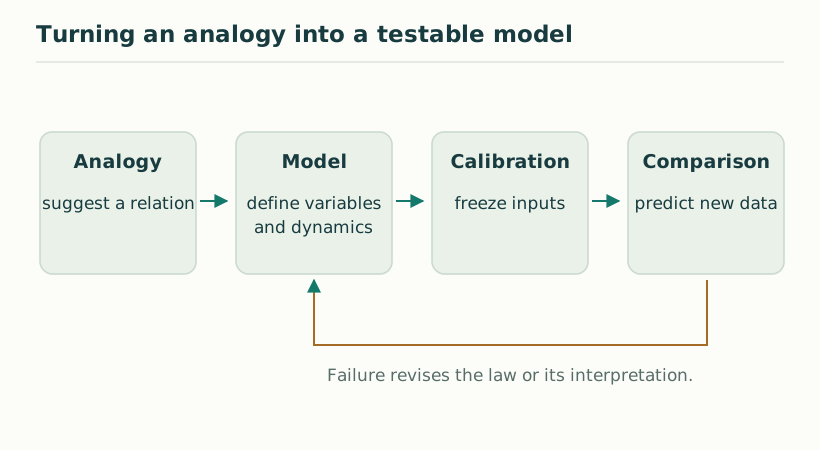
Figure 1. Turning an analogy into a testable model. A numerical or symbolic correspondence motivates a question. A physical claim needs a specified model, independent calibration, and a result that could disagree with observation. View full size ↗
03Temporal order is necessary but not sufficient
If A is recorded before B, that alone does not establish that A causes B. Both may depend on an earlier event, or the order may reflect delays in measurement. A causal model specifies which changes in A would alter the distribution of B when other relevant conditions are controlled.
A generating sequence can therefore contain more ordering information than the observer's causal description. Conversely, an observed causal relation can be stable even when its deeper mechanism is described in different ontological terms.
04Induction and uncertainty
Repeated success supports a model without logically proving its universal truth. If a process has a stable but unknown probability p, observed frequencies can estimate p with uncertainty. The inference depends on assumptions about sampling, independence or a specified dependence structure. It is stronger when predictions succeed in conditions not used to construct the model.
This does not make induction useless. It explains why scientific claims carry domains of validity and why independent tests matter. Fallibility is compatible with reliable, progressively improved knowledge.
05SMM/DTT and lawful dependence
A recreation account must explain why completed records exhibit stable conditional relationships. If sₙ₊₁=F(sₙ), then the law F carries dependence across renewal. If records are generated probabilistically, a transition rule specifies their conditional distribution. The law may be deterministic or stochastic; either way, its restrictions make prediction possible.
DTT then asks which parts of the generating dependence are visible through completion. Some internal details may be inaccessible while robust causal relations emerge among records. Demonstrating that emergence is more informative than simply calling ordinary causes appearances.
06Stable laws do not require identical events
Two experiments need not reproduce every detail of the universe to support the same effective law. They must control the variables relevant within the model’s domain and account for residual uncertainty. This explains how novelty of each complete event can coexist with reproducible science. The law concerns an invariant relation across a class of situations, not exact duplication of all circumstances. SMM’s emphasis on renewed manifestation therefore need not undermine ordinary prediction. The constructive challenge is to derive why certain relations remain stable across different completions and to identify the conditions under which those effective relations cease to be reliable.
07An explanatory hierarchy
Source dependence, dynamical dependence and operational causal inference are different levels. The first concerns a proposed origin, the second an update law and the third what interventions and records establish. A shared source can correlate outcomes, while a controlled intervention can help distinguish causal influence from passive association. SMM/DTT must derive the stable dependencies that make those practical inferences reliable.
KEEP THE CONNECTION
Key ideas
Causality and induction address different questions.
Temporal order and correlation do not establish causation alone.
Renewed records need lawful dependence to support prediction.
Scope of the argument. Source-based conceptual interpretation with original worked examples; physical conclusions are stated with their assumptions.
Historical public topic address, redirected to this edition’s revised explanation. It identifies the topic’s provenance; the revised page supplies its own reading locators and claim scope.