Quantum error correction and the protection of source memory
Quantum error correction preserves an unknown state by encoding it in correlations and learning only the error syndrome. This guide works through a three-qubit code, calculates its logical failure rate, and asks how DTT’s nested source architecture could protect coherent inner memory while publishing stable outer records.
A physical source that retains coherence must confront noise. Simply keeping several independent copies of an unknown quantum state is not available, because quantum information cannot be universally cloned. Error correction instead encodes the logical state into a larger space so that selected errors can be diagnosed and reversed without revealing the logical amplitudes.
This gives SMM/DTT a concrete way to discuss reliable inner memory. The source’s hidden information need not be an abstract perfect archive; it can have a physical code, an error model and a recovery operation. Those ingredients also make it possible to calculate the resources and limitations of completion. [2]
02The source and its two temporal roles
The Single Monad Model begins with one nonspatial generative source. The Duality of Time Theory distinguishes the source’s inner production from the outer order in which completed records become accessible. Its six inner levels are nested functional roles of one process: a higher role organizes lower-level work. The seventh is the completion or observation interface. They are neither six independent clocks nor six additional time coordinates.
This distinction supplies a useful research question: which features of an observed world can follow from the way a source produces, retains and releases information? A concrete answer needs a state space, an autonomous update, retained memory and a rule connecting completion to an accessible measurement. In the constructions discussed here, those mathematical ingredients are stated explicitly. A successful finite example establishes what its specified mechanism can do; further arguments connect it to physical particles, spacetime or universal laws. [1]
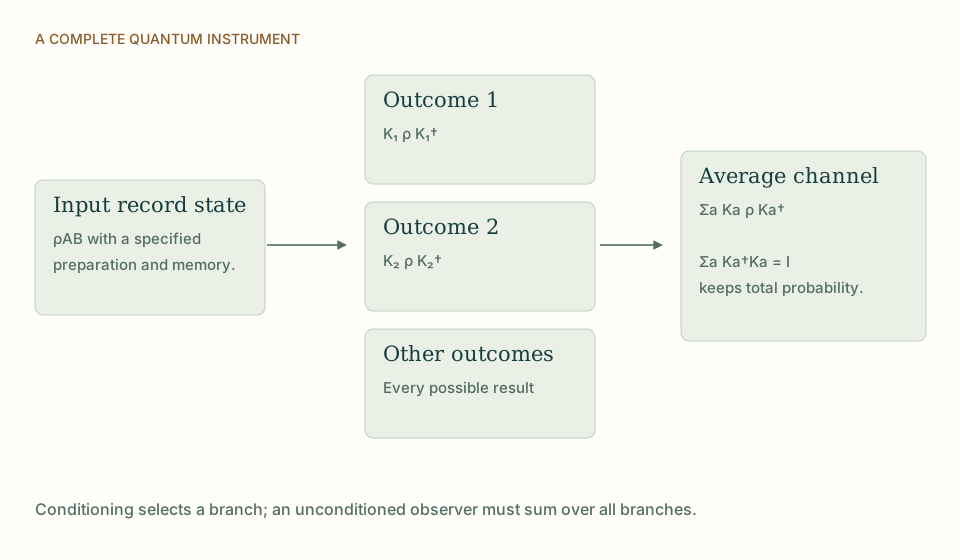
From a source process to a complete record instrument. Outcome probabilities, retained conditional states, and the outcome-averaged channel belong to the same instrument. Keeping every outcome prevents postselection from being mistaken for a signal. View full size ↗
03Worked three-qubit bit-flip code
Encode α|0⟩+β|1⟩ as α|000⟩+β|111⟩. The stabilizer checks Z₁Z₂ and Z₂Z₃ both have value +1 on either logical basis state. A bit flip X₁ changes their signs to (−,+); X₂ gives (−,−); X₃ gives (+,−). The syndrome identifies which single qubit flipped without measuring whether the logical state was zero or one.
Applying the corresponding X restores the encoded superposition. The coefficients α and β remain unknown and coherent. This code corrects the specified single bit-flip errors; it does not correct arbitrary single-qubit errors, because a phase flip can act directly on the logical phase. The distinction between a proved code property and a broader claim of protection is essential for any source-memory model. [2]
|0L⟩=|000⟩; |1L⟩=|111⟩; syndrome checks Z₁Z₂ and Z₂Z₃
Ideal syndrome measurement and recovery, with at most one X error for exact correction.
04Worked logical error probability
Assume independent bit flips, each with probability p, followed by ideal majority recovery. Logical failure occurs when at least two physical bits flip, giving pL=3p²(1−p)+p³=3p²−2p³. For p=0.01, the logical error probability is 0.000298, compared with a physical bit-flip probability of 0.01.
This improvement depends on the error model and ideal recovery. Correlated source errors, inaccurate checks or noisy recovery can change the conclusion. The calculation is a useful benchmark because it exposes the actual assumptions behind reliable memory. An account that attributes perfect record retention to the source without an error mechanism has skipped precisely the physics that the code makes explicit. [2]
pL=3p²−2p³; at p=0.01, pL=2.98×10⁻⁴
Independent X-error model and ideal correction. No threshold claim for general hardware or arbitrary noise is implied.
05The general correction condition
For a code projector P and a specified error set {Ea}, the Knill–Laflamme condition is PEa†EbP=cabP. It states that the errors do not reveal distinguishing information about the logical state beyond a syndrome that can be handled by recovery. The coefficients cab describe overlaps among error effects, not independently measured values of the logical amplitudes.
DTT can use this condition to test a proposed protected source sector. If completion reads too much information about that sector, it can destroy the very coherence the model claims to retain. A valid interface must say which classical certificate is released and why that certificate does not expose an unknown logical state. This connects error correction directly to the programme’s distinction between inner work and outer accessible records. [2][3]
PEa†EbP=cabP
Necessary and sufficient exact-correction condition for the specified code and error set in the standard finite-dimensional setting.
06How a nested source can add explanatory structure
The six inner functions could implement a sequence of encoding, interaction, syndrome extraction, recovery and completion within one autonomous architecture. But arranging a familiar code into six boxes does not show that six levels are necessary or that nature uses that code. The source theory needs a selection principle for the code subspace, noise and permitted operations.
A meaningful advance would link error protection to another feature the source is intended to generate, such as stable neighbourhoods or a physical clock. If the same symmetry protects a logical state and fixes a completion criterion, fewer independently chosen rules are needed. Such a theorem would be stronger than a programmable demonstration. Its observable consequences could include correlated failure patterns or a derived relation between memory lifetime and record accuracy. [2][4][1]
07The physical scope of the analogy
Error-correcting descriptions also appear in holographic research, but the existence of a code does not automatically establish a spacetime geometry. The code’s logical observables must be connected to physical regions and transport through a separate reconstruction. Likewise, a source memory can be mathematically protected without having derived its energy scale or cosmological origin.
The comparison is valuable because it replaces an idealized omniscient archive with a checkable mechanism. A DTT model can state exactly what information survives, which errors are corrected and what completion reveals. That is a useful contribution to a functional theory even before the full source-to-space programme is complete. Broader claims should follow only when the same construction supplies the physical dictionary and independent observable restrictions. [2][5]
THE SAME QUESTION, DIFFERENT STARTING POINTS
The comparison at a glance
Question
SMM/DTT
Quantum error correction
Coherent retention
A source can encode unknown quantum information in protected correlations.
Quantum error correction preserves a logical subspace for a specified error model.
Completion certificate
An outer syndrome can identify an error without measuring logical amplitudes.
The three-qubit code corrects single X errors while retaining α and β.
Unified mechanism
DTT needs a source law that selects the code and links it to other physical outputs.
A freely chosen code does not itself derive spacetime or a universal clock.
KEEP THE CONNECTION
Key ideas
A source can encode unknown quantum information in protected correlations.
An outer syndrome can identify an error without measuring logical amplitudes.
The source interpretation becomes additional physics when it constrains an independently measurable process.
Connects the comparison to the programme’s current statement of results and assumptions.
Sources and further reading
References support the comparator and the specific mathematical or interpretive claims indicated. SMM/DTT connections are developed in the analysis above.