
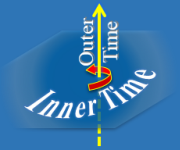

THE CENTRAL CONCEPT
A world that forms within time
and appears through completion.
The duality-of-time proposal distinguishes the activity that constitutes an observable configuration from the completed record through which that configuration is experienced and measured. Its potential is to connect physical problems through the origin of their shared structures.
Two temporal roles in one physical account
Ordinary dynamics describes changes in a state whose spatial organization and physical observables have already been specified. SMM/DTT asks a prior constructive question: what process forms the relations that make a spatial configuration, a material object or an observable event possible? The Single Monad supplies the proposed common origin; the duality of time distinguishes formation from its outward availability.
Inner-time generation
The generative side carries operations, phase relations, internal dependencies and retained memory. In a concrete model these must be identifiable states and transformations, not an unexplained label attached to an ordinary calculation.
Outer-time completion
The outward side concerns the availability of a record to other physical systems. An actual completion rule must specify what is registered, how long it remains readable and how its duration is measured by a physical clock.
The distinction is not simply between a hidden fast clock and a visible slow clock. A model may use an operation index, an internal flow parameter and a measured duration with different meanings. Their relationship must be calculated. Nor does an internal order alone establish a second observable time coordinate, instantaneous communication or a universal minimum interval.
Six nested inner roles, then outward completion
In the proposed SMM/DTT architecture, the six inner roles describe dependent levels of formation: higher operations use what lower operations have supplied. The seventh role is outward completion. Nesting matters because a collection of independent axes or separately programmed clocks would not explain why their outputs agree.
A useful schematic is:
Here z is the source state, m the retained memory, G the dependent generative operations, C the completion rule and r the outward record. This is an organizational schematic, not a uniquely derived Hamiltonian or a claim that every physical process consists of six identical laboratory gates. A successful construction must specify the meaning, interaction and resource use of the roles. For probabilistic records, C must also specify all outcome probabilities and the corresponding retained states.
The same account must include failed or unfinished completions, preparation, memory maintenance and subsequent readout. Counting only accepted records can hide time or energy costs that change the proposed law.
Why this distinction could address many problems
Quantum behavior: inner alternatives can retain phase until a detector interaction completes a record. This gives a concrete interpretation of coherent waves and localized events. To become a physical derivation, the source must also explain the phase, composition and outcome rules used in the calculation.
Space and relativity: locality, distance and clock readings could be different outputs of the same generative process. Their agreement would then be a dynamical restriction. The decisive task is to measure them independently and prove that their relations survive changes in preparation and material realization.
Matter and interactions: persistent generative modes could carry mass, charge and internal transport. Completion could determine accessible gauge-invariant records. A unified source would gain predictive content by fixing a spectrum or coupling relation that cannot be adjusted independently for every species.
Cosmology: shared preparation and a structured vacuum could connect large-scale correlations, expansion and the gravitating content of the world. Those proposals require calculations of stress, fluctuations, conservation and observable evolution; a common-origin description supplies the research direction, not those numerical results by itself.
The strongest opportunity is a cross-domain relation. If the same independently fixed source interaction determines a clock response and a spectral shift, their agreement becomes a meaningful test of the shared mechanism.
From an interpretation to a model another researcher can test
- Specify the source. Give a state space, retained memory and one autonomous update with declared symmetries and interactions.
- Specify the records. Define the completion instrument, accessible observables and treatment of every outcome.
- Keep measurements independent. Define geometric scale, material duration, energy, momentum and charge through their own operational readouts.
- Account for resources. Include storage, initialization, control, rejection, reset and readout costs in the same physical description.
- Derive the shared restriction. Identify which relation follows from the source law and which parameters remain free.
- Reserve a prediction. Use fixed calibration and an explicit comparator to test a new setting, transition or material device.
The joint-source problem makes these requirements concrete. A single controller executing unrelated recipes is not enough: the interaction must constrain why the outputs agree.
A joint geometry–clock–matter target
For a specified refinement family, record count and scale can obey Nn = Bn and ℓn = Lrn, giving D = log B / log(1/r). This geometric scaling relation is distinct from a physical clock law.
Here u must be an independently defined inner activity, T a physical clock reading, and vg a transport coefficient per unit u. Their units and calibrations must make the equations meaningful. The target is to derive the equalities over a family of settings from the same interaction. Defining a clock to make the ratio equal D would not establish that result. Identifying c with a universal causal speed additionally requires a propagation theorem.
Compare the independent quantities in the geometry workbench →
Published foundations with distinct scopes
The programme has published mathematical components that help turn the temporal idea into precise questions. The completion paper develops conditional operator and geometric constructions; the phase-selection paper relates an oriented inner flow to compatible complex kinematics; the temporal-asymmetry paper studies memory in reduced evolution. Their hypotheses and conclusions should be used at the level actually established in each work.
- Completion principles, real commutants, and positive-frequency geometry — completion and representation structures under explicit mathematical assumptions.
- Real-commutant phase selection from real Hilbert representations — phase selection on the dynamic sector; composite-system rules require additional input.
- Dual-Time Topological Geometry and the Emergence of Temporal Asymmetry — coupled temporal descriptions and memory-bearing reduced dynamics.
The conceptual architecture is developed in Duality of Time and the postulate guide. The mathematical modules do not yet supply a single validated derivation of all the phenomena below.
ONE CONCEPT · DIFFERENT PHYSICAL DEMANDS
See what the temporal distinction contributes to a problem
The arrow of time: generation, memory and irreversibility
01 / INNER GENERATION
How the source forms relations
Inner generation carries the source state and the correlations needed for its next operation. Reversibility of this full description can coexist with information inaccessible in a reduced record.
02 / OUTER COMPLETION
What becomes observable
Outer completion leaves a retained event whose order can be compared with later records and with a physical clock.
03 / EXPLANATORY POTENTIAL
How this could help
This distinction could connect microscopic evolution, memory and macroscopic direction through one account of how records are produced.
Next result: Specify the source, record and environment dynamics; derive their entropy and energy balance including reset and rejected events.
Causality: from sequential creation to physical influence
01 / INNER GENERATION
How the source forms relations
Inner operations depend on retained outputs of preceding operations. Those actual dependencies define which changes can influence other changes.
02 / OUTER COMPLETION
What becomes observable
Completion exposes a spatial arrangement and a sequence of records in which an intervention has a measurable effect.
03 / EXPLANATORY POTENTIAL
How this could help
A common source could generate both the causal ordering and the geometry used to measure propagation.
Next result: Derive a persistent neighbourhood and a uniform influence bound from the same autonomous update.
A temporal interpretation of quantum mechanics
01 / INNER GENERATION
How the source forms relations
Alternative inner generative routes retain relative phase and can contribute coherently to the same final record.
02 / OUTER COMPLETION
What becomes observable
A detector interaction produces a localized outward event; many events reveal the distribution set by those coherent routes.
03 / EXPLANATORY POTENTIAL
How this could help
Wave-like formation and particle-like detection could be two temporal roles of a single process, giving complementarity a concrete physical interpretation.
Next result: Derive the admitted phase operations and completion instrument together, then test a shared relation among visibility, memory and completion delay.
Physical information: what recreation preserves
01 / INNER GENERATION
How the source forms relations
The source retains distinctions between possible continuations, including correlations absent from an observer’s current record.
02 / OUTER COMPLETION
What becomes observable
Completion makes selected distinctions accessible and stores a record that can be used again.
03 / EXPLANATORY POTENTIAL
How this could help
The same temporal architecture could explain how information is preserved globally, hidden locally and consumed as a physical memory resource.
Next result: Construct a source memory sufficient for all admitted future operations and calculate the energetic cost of maintaining it.
EPR and nonlocality: a joint source with local observations
01 / INNER GENERATION
How the source forms relations
A joint inner state can encode relations between parts that appear far apart only in the completed spatial readout.
02 / OUTER COMPLETION
What becomes observable
Separated apparatuses register local outcomes whose joint statistics reflect the preparation, while local control must preserve no-signalling.
03 / EXPLANATORY POTENTIAL
How this could help
Shared generation offers a way to interpret entanglement without treating observed distance as a measure of independent origin.
Next result: Calculate a complete joint preparation and all local outcomes, and identify the precise assumptions the proposed source satisfies.
The Planck scale: granularity, refinement and physical resolution
01 / INNER GENERATION
How the source forms relations
Nested generation permits a family of resolutions rather than identifying every construction stage with one universal smallest cell.
02 / OUTER COMPLETION
What becomes observable
A completed apparatus resolves distances and durations only through its calibrated records and available resources.
03 / EXPLANATORY POTENTIAL
How this could help
The proposal could explain a scale-dependent relation between geometric resolution, clock response and accessible energy.
Next result: Calculate the cost and accuracy of a refinement family while measuring length and duration independently.
Quantum gravity: generating the geometry that matter reads
01 / INNER GENERATION
How the source forms relations
The source generates quantum relations, adjacency and transport before a smooth background geometry is assumed.
02 / OUTER COMPLETION
What becomes observable
Completed rods, clocks and matter records define the effective geometry seen by observers.
03 / EXPLANATORY POTENTIAL
How this could help
Generating geometry and matter together could reconcile their descriptions and make gravitational response part of the same dynamics.
Next result: Use one finite source model to compute a geometric response and several independent matter/clock responses.
The hierarchy problem
01 / INNER GENERATION
How the source forms relations
A shared source may contain sectors with different overlaps, symmetry constraints and responses to its internal operations.
02 / OUTER COMPLETION
What becomes observable
Outward instruments access particular channels, so an effective visible coupling may be suppressed relative to internal scales.
03 / EXPLANATORY POTENTIAL
How this could help
Temporal organization could provide a dynamical reason for weak visible interactions if the suppression is selected and protected.
Next result: Derive the mixing from source symmetries and bound radiative or effective corrections under allowed perturbations.
Unification of the fundamental interactions
01 / INNER GENERATION
How the source forms relations
The same generative history supplies internal comparison states and the operations relating neighbouring records.
02 / OUTER COMPLETION
What becomes observable
Completion retains gauge-invariant relations; different interaction channels would appear as distinct responses of the same source.
03 / EXPLANATORY POTENTIAL
How this could help
This could explain why several forces share geometric structures and could eventually constrain their groups, representations and strengths together.
Next result: Find one operation algebra that fixes a carrier, its allowed transport and a cross-channel coupling relation.
Magnetic monopoles: source topology and observable charge
01 / INNER GENERATION
How the source forms relations
Inner phase and transport relations can support nontrivial winding or topological sectors.
02 / OUTER COMPLETION
What becomes observable
An observable monopole requires a completed flux measurement on a surrounding surface and a physical magnetic coupling.
03 / EXPLANATORY POTENTIAL
How this could help
A source-topology account could explain which magnetic sectors exist and why isolated magnetic charge is accessible or excluded.
Next result: Construct the physical connection and admissible sectors, then compute flux, energy and a detection channel.
Mass generation: inertia from sequential coupling
01 / INNER GENERATION
How the source forms relations
Coordinated internal formation can create persistent modes whose phases and couplings carry an energy scale.
02 / OUTER COMPLETION
What becomes observable
Outer clocks and momentum measurements reveal a mode’s dispersion, inertia and transition energies.
03 / EXPLANATORY POTENTIAL
How this could help
Mass could become a calculable cost of maintaining a coherent generative structure and its response to motion.
Next result: Track one stable mode through formation, dispersion and an independently calculated acceleration response.
Neutrino masses: open chains and coherent flavour change
01 / INNER GENERATION
How the source forms relations
An open generative chain suggests coherent collective modes with different eigenvalues and boundary responses.
02 / OUTER COMPLETION
What becomes observable
Flavor preparation and detection sample superpositions of those modes after propagation.
03 / EXPLANATORY POTENTIAL
How this could help
One formation rule could potentially connect mass splittings, mixing and coherence instead of assigning them independently.
Next result: Derive one spectrum and mixing matrix, calibrate a declared subset and reserve independent observables for testing.
Color confinement: from inner constituents to completed singlets
01 / INNER GENERATION
How the source forms relations
Internal color labels belong to coherently generated constituents and the transport connecting them.
02 / OUTER COMPLETION
What becomes observable
A neutral-completion rule can restrict outward records to gauge singlets.
03 / EXPLANATORY POTENTIAL
How this could help
Combining neutral completion with a growing separation cost could explain both observable color neutrality and energetic confinement.
Next result: Derive the completion projector and source-separation energy from the same interacting model.
Yang–Mills theory: from discrete formation to a physical mass gap
01 / INNER GENERATION
How the source forms relations
A continuously generated vacuum must support interacting gauge transport and a well-defined physical constraint space.
02 / OUTER COMPLETION
What becomes observable
Completed gauge-invariant correlations reveal the energies of physical excitations above that vacuum.
03 / EXPLANATORY POTENTIAL
How this could help
The temporal picture could turn minimum formation requirements into a spectral theorem if the same dynamics controls large scales.
Next result: First prove Gauss-law preservation and a size-uniform bound in a precisely specified regime, then investigate regulator removal.
Baryon asymmetry: temporal orientation and sector balance
01 / INNER GENERATION
How the source forms relations
Complementary source sectors can carry opposite charges while an oriented interaction transfers population between them.
02 / OUTER COMPLETION
What becomes observable
Visible records sample one physically specified sector and its abundance after production and washout.
03 / EXPLANATORY POTENTIAL
How this could help
A globally balanced source could still produce a visible excess if its dynamics selects the sector, sign and surviving amount.
Next result: Derive the charges, transfer rates and cosmological evolution, then calculate the surviving abundance with fixed parameters.
Supersymmetry: temporal sectors and graded dynamics
01 / INNER GENERATION
How the source forms relations
Complementary inner sectors motivate paired states and transformations that exchange them.
02 / OUTER COMPLETION
What becomes observable
Outward completion determines which states and couplings can be prepared or observed.
03 / EXPLANATORY POTENTIAL
How this could help
If a physical graded symmetry follows from the source, it could relate apparently different particle sectors and their spectra.
Next result: Identify admissible supercharges and physical representations, then derive an observable relation surviving symmetry breaking.
Homogeneity and the horizon problem
01 / INNER GENERATION
How the source forms relations
Regions may share generative preparation before their separation is defined by the outward spatial readout.
02 / OUTER COMPLETION
What becomes observable
Completed observations compare temperatures and correlations across the resulting sky.
03 / EXPLANATORY POTENTIAL
How this could help
A common origin could supply correlated initial conditions while subsequent observable propagation remains local.
Next result: Calculate primordial correlations from one preparation law and propagate them through a specified cosmological model.
Cosmic inflation and perpetual generation
01 / INNER GENERATION
How the source forms relations
Repeated inner generation changes record number and physical scale through a specified refinement or growth law.
02 / OUTER COMPLETION
What becomes observable
Outer clocks measure whether the completed physical distances accelerate and for how long.
03 / EXPLANATORY POTENTIAL
How this could help
Generation could supply an origin for early expansion if the same source also accounts for perturbations and the transition to ordinary evolution.
Next result: Derive a calibrated expansion history, its perturbations and its exit from one model.
Dark matter and the persistent source ground state
01 / INNER GENERATION
How the source forms relations
Persistent collective source modes could store energy without coupling strongly to ordinary electromagnetic records.
02 / OUTER COMPLETION
What becomes observable
Their gravitational response would appear through clustering, lensing and structure formation.
03 / EXPLANATORY POTENTIAL
How this could help
The structured source could potentially supply an unseen gravitating component with properties tied to its formation dynamics.
Next result: Derive the mode, stress tensor and production history, then test background evolution and perturbations together.
Dark energy and complementary temporal structure
01 / INNER GENERATION
How the source forms relations
A complementary source sector could contribute energy whose response depends on the generated physical volume.
02 / OUTER COMPLETION
What becomes observable
Completed clocks and distances measure the resulting pressure, expansion and any time variation.
03 / EXPLANATORY POTENTIAL
How this could help
A source-selected volume response could explain accelerated expansion while linking it to other vacuum properties.
Next result: Derive energy and pressure from one source functional and check conservation, stability and cosmological observables.
The cosmological constant: source averaging and gravitational response
01 / INNER GENERATION
How the source forms relations
Different source labels may represent alternatives within one normalized state rather than independent physical copies.
02 / OUTER COMPLETION
What becomes observable
Gravity responds to the completed energy–momentum content and its dependence on the metric.
03 / EXPLANATORY POTENTIAL
How this could help
Source averaging could correct an inappropriate state count, while a deeper selection law could determine the gravitating residual.
Next result: Construct a metric-sensitive vacuum functional and prove that its selected residual is stable under admissible microscopic changes.
The measurement problem: when does an inner process become a record?
01 / INNER GENERATION
How the source forms relations
The source and apparatus evolve together, retaining phase and correlations before a stable record is available.
02 / OUTER COMPLETION
What becomes observable
Completion must have an operational criterion: an outcome is registered, can be read again and enters later predictions.
03 / EXPLANATORY POTENTIAL
How this could help
This could replace an unexplained observer boundary with a physical account of when a generative process becomes a usable event.
Next result: Specify the complete instrument, including unfinished/rejected trials, and derive record stability and any proposed delay relation.
Black-hole information: retained memory and outward release
01 / INNER GENERATION
How the source forms relations
The full source state can retain correlations absent from the outward description of a black hole.
02 / OUTER COMPLETION
What becomes observable
Successive completions could transfer those correlations into emitted radiation and accessible records.
03 / EXPLANATORY POTENTIAL
How this could help
The distinction between hidden generation and accessible completion offers a language for information storage and release within one evolution.
Next result: Couple a memory-preserving radiation map to a source-derived energy and causal model, and calculate their joint consistency.
Lorentz symmetry from completed records
01 / INNER GENERATION
How the source forms relations
Inner generation supplies transport and the interactions from which matter and physical clocks are built.
02 / OUTER COMPLETION
What becomes observable
Observers compare completed displacements and clock readings, so a shared cone must govern those measurements.
03 / EXPLANATORY POTENTIAL
How this could help
A single source could explain why clock and matter laws agree on the same limiting speed and transformation structure.
Next result: Derive a common propagation and clock law across multiple material realizations without separate frequency tuning.
Why three spatial dimensions?
01 / INNER GENERATION
How the source forms relations
Six nested inner roles represent dependent formation stages whose completed relations may admit several distinguishable directions.
02 / OUTER COMPLETION
What becomes observable
An outward readout defines position; volume growth and propagation provide independent measurements of effective dimension.
03 / EXPLANATORY POTENTIAL
How this could help
A generation law could explain three-dimensional space if it selects and stabilizes agreement between these different measurements.
Next result: Calculate readout rank, neighbourhood growth and propagation dimension from one stable family of source states.
From a proposed mechanism to a testable prediction
01 / INNER GENERATION
How the source forms relations
One source law should restrict several internal responses with a fixed set of parameters.
02 / OUTER COMPLETION
What becomes observable
Completed experiments measure independently calibrated observables at settings reserved before comparison.
03 / EXPLANATORY POTENTIAL
How this could help
The shared temporal origin gains predictive power when a calibration in one channel fixes a relation in another.
Next result: Declare one source-derived relation, a conventional comparator, nuisance effects and a held-out measurement protocol.
Open problem: one dynamics for geometry, clocks and matter
01 / INNER GENERATION
How the source forms relations
A single autonomous interaction must create record relations, retain memory and drive the matter and clock sectors.
02 / OUTER COMPLETION
What becomes observable
Independent instruments read geometry, physical duration and propagation after completion.
03 / EXPLANATORY POTENTIAL
How this could help
This is the central opportunity: agreement among space, time and matter could become a consequence of shared generation.
Next result: Construct a nonempty source family and prove a joint relation stable under admitted perturbations and all completion branches.
Open problem: selecting and preserving spatial locality
01 / INNER GENERATION
How the source forms relations
Source operations must prepare and preserve the relations that define neighbouring records.
02 / OUTER COMPLETION
What becomes observable
Controllable influence measured between completed records must obey a bound in the generated distance.
03 / EXPLANATORY POTENTIAL
How this could help
Locality could be a stable outcome of temporal generation, explaining why a common source appears as an extended world.
Next result: Prove a preparation-and-stability theorem with accounted memory, operation range and size-independent constants.
Open problem: why material clocks should share one law
01 / INNER GENERATION
How the source forms relations
Different material clocks contain internal processes that may couple differently to inner generative activity.
02 / OUTER COMPLETION
What becomes observable
A universal outward time law requires independently built clocks to agree after fixed calibration.
03 / EXPLANATORY POTENTIAL
How this could help
DTT could explain physical clock universality if completion selects or protects the same response across a real class of devices.
Next result: Derive the allowed clock interactions for at least two material realizations and test delayed as well as immediate readouts.
Open problem: deriving phase-compatible quantum composition
01 / INNER GENERATION
How the source forms relations
Oriented inner dynamics can select a compatible phase structure on its dynamic sector under the representation hypotheses.
02 / OUTER COMPLETION
What becomes observable
Joint preparations and completed instruments must use a consistent composition and probability rule.
03 / EXPLANATORY POTENTIAL
How this could help
A common source might connect quantum phase, entanglement and records through one operational structure.
Next result: Derive a physically admitted operation algebra whose joint evolution preserves the required composition and completion rules.
Open problem: fixing a normalized physical coupling
01 / INNER GENERATION
How the source forms relations
Generative structure fixes candidate record sectors, while the same source must also determine their stiffness and response to charge.
02 / OUTER COMPLETION
What becomes observable
Outward force, phase and spectroscopic measurements identify a dimensionless physical coupling.
03 / EXPLANATORY POTENTIAL
How this could help
Structural counts could become physical constants if source dynamics fixes the response normalization and electromagnetic identification.
Next result: Compute normalized charge, action and field response from one model, then reserve an independent atomic observable.
Open problem: a source-derived spectrum of matter
01 / INNER GENERATION
How the source forms relations
Persistent formation patterns and their interactions define candidate excitations of the source.
02 / OUTER COMPLETION
What becomes observable
Completed energy, momentum, charge and transition measurements identify the properties attributed to particles.
03 / EXPLANATORY POTENTIAL
How this could help
One spectral law could connect particle identities and mass relations to the same structure that generates space and clocks.
Next result: Follow one mode through preparation, dispersion and an independently predicted transition, then extend to a second species.
Open problem: a gravitational limit of temporal generation
01 / INNER GENERATION
How the source forms relations
The source must generate geometric response and the interactions read by matter and clocks.
02 / OUTER COMPLETION
What becomes observable
Completed weak-field and propagation measurements identify a common effective metric and gravitational strength.
03 / EXPLANATORY POTENTIAL
How this could help
Gravitation could follow from the response of the same formation process that supplies material measurements.
Next result: Derive one weak-field source response and compare its effects on several independently defined probes.
Open problem: selecting a gravitating vacuum contribution
01 / INNER GENERATION
How the source forms relations
The source vacuum has retained states and responses whose absolute contribution must be selected by a physical rule.
02 / OUTER COMPLETION
What becomes observable
Completed gravitational measurements depend on metric variation, including the vacuum’s constant contribution.
03 / EXPLANATORY POTENTIAL
How this could help
A source-derived selection mechanism could connect a small gravitating vacuum term to the same dynamics fixing other responses.
Next result: Specify the metric-dependent functional and test its selected residual under constant shifts and microscopic perturbations.
The route to that explanation is to make generation and completion constrain physical outputs together. The research roadmap identifies what a new theorem, model or experiment would need to deliver.