


The postulate distinguishes nested generation from completed observation. A functional model must specify the update, memory, readout, clock, and resource budget that make those roles concrete.
The compact presentation
DoT: The Duality of Time Postulate and Its Consequences on General Relativity and Quantum Mechanics presents the bridge from SMM to a temporal account of spatial formation. Its public introduction and A220 are the basis of this companion; the guide does not assign material to uninspected chapters.
In working language, the postulate proposes that the spatial configuration available at an outer moment is generated through nested inner activity. That sentence identifies an explanatory direction. The next step is to define the process and the condition under which its output becomes an observable record.
Write the minimal objects down
Let X be a source state space containing retained memory. Let U be its autonomous update, C a completion condition or instrument, and Π an observable readout of completed states. Specify how source histories compose and which observer procedures are allowed.
where nₖ marks a completion selected by C.
The integer n is an update index, not yet a measured time. Likewise r may be a symbol rather than a spatial location. The definitions keep these differences visible while giving the postulate something concrete to act on.
A finite completion cycle
Take a four-state cycle q=0,1,2,3 with U(q)=q+1 modulo four. Suppose only q=0 publishes a record. The source makes four updates between publications, while the observer sees a sequence of completed events.
This establishes the logical possibility of an inner/outer distinction, but the bare cycle has no counter that distinguishes successive publications. To retain event number k, the state must include memory and a rule that increments it. An unbounded perfect record requires correspondingly unbounded capacity in this idealization. The source’s resource budget cannot disappear merely because its microscopic cycle is simple.
Place the six inner roles inside the update
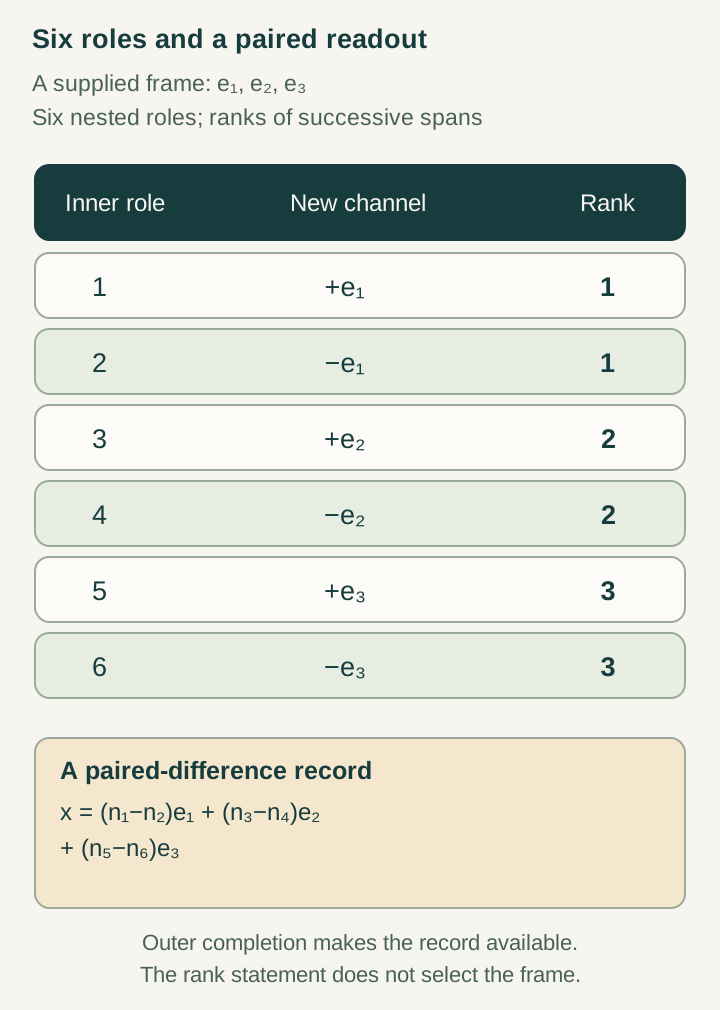
A richer update may contain nested dependencies associated with paired spatial ranks 1,1,2,2,3,3. The lower-level results should be retained and used by later roles, while completion certifies that the required relations are mutually consistent.
Listing six operations does not force their ranks or their geometry. A necessity argument must restrict the admissible operations enough that alternative rank patterns fail. An explicit finite construction is already useful as an existence result, provided its chosen frame, memory, and completion rules are stated honestly.
Open the full-size diagram →
Ask three independent measuring questions
What operation measures distance between completed records? What material process supplies elapsed time? What source dynamics propagates a matter excitation? These can be independently chosen in a toy model, so their agreement is the central physical task.
A hidden order also needs an observable compatibility argument if the resulting theory is to be relativistic. Calling the order inaccessible does not prove it cannot influence detector statistics. The source and observation map must jointly establish the required covariance and causal restrictions for the actual allowed procedures.
Build one result, then connect it to the next
Read A220 with A81–A83 for histories and predictive quotients, A111–A121 for autonomous completion, A126–A128 for spatial relations, and A105–A115 for material clocks and joint constraints. This route makes the postulate a practical research agenda.
A strong next theorem would use one fixed source to derive geometry, a physical clock response, and a matter propagation bound across a nonempty family of settings. Which relation becomes unavoidable because all three arise together? Which new observable remains after calibration? These are the questions that can convert the short postulate from an organizing hypothesis into a progressively more explanatory theory.
Continue with the articles
- The DoT postulate: a compact reading route
The DoT postulate connects nested inner generation with completed outer observation. This guide turns that statement into explicit requirements for histories, updates, retained records, spatial readout and covariant physical clocks.
- One action, two temporal roles
Inner generation and outer record order can be roles of one process. A completed return becomes an observable advance only when its action respects the retained records and their tests.
- When two histories count as the same observation
Completion identifies histories that leave the same record, while observation identifies records that available tests cannot distinguish. Their combined quotient is consistent only with the declared operations and contexts.
- A quantum source for generation and completion
A positive phase–dilation Hamiltonian ties one phase encoder to a powered coordinate and controlled work. It gives an explicit quantum realization of generation and completion while retaining its constitutive interfaces as inputs.
- A record that carries its own completion certificate
An autonomous history Hamiltonian can generate both a data record and a flag tied to its completed write. The exact construction retains incomplete outcomes, coherent intermediate stages, and finite observation windows.
- Six inner stages and one publication interface
A six-digit nested counter with paired signed readout realizes ranks 1, 1, 2, 2, 3, 3 before one completion interface. Its exact counts reveal sampling bias and the restricted assumptions behind the six-channel bound.
- What spatial readout forgets
Different inner states can share one spatial readout and still have different successors. A concrete counterexample and a kernel-preservation criterion identify the memory needed for autonomous completed evolution.
- What makes a clock insensitive to branching?
A material clock ignores branching exactly when the branch generator commutes with its full delayed-observation algebra. Immediate readouts alone can miss hidden motion that later resolution exposes.
- From record refinement to a joint clock–band relation
Independent count, scale, phase, clock, and band measurements can satisfy a joint refinement relation under the supplied interfaces. The ungated-clock alternative identifies why the protected-clock premise remains essential.
Sources and reading
Read the original source for its exact formulation and edition. The examples on this page are explanatory reconstructions.