

Choose an application
06 / Generation & readout
Build a record.
Examine its geometry.
Move from nested roles to spatial addresses, then compare readout rank, a refinement exponent and calibrated clock ratios without identifying them by definition.
Conditional constructions with independently defined observablesSix nested roles and outer completion
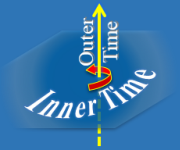
The six inner roles organize a proposed construction; outer completion publishes its record. The nesting diagram does not represent seven independent observable time axes.
Role 7: 6 inner roles included; affine readout rank 3; 64 addresses in this radix-2 block. The seventh role publishes the completed six-role archive.
Exact rank and address counts for a supplied six-digit paired counter. The widget does not derive a physical spatial frame, clock duration, or necessity of six roles.
Many addresses, fewer spatial sites
The declared paired binary readout maps 64 addresses to 27 sites. Equal address weights give a nonuniform distribution over those sites.
Address 0, digits d₁…d₆ = 0 0 0 0 0 0 → (0, 0, 0). This site has 8 of the 64 addresses: probability 12.5% under uniform address sampling. Total: 64 addresses, 27 distinct sites.
| Site class | Sites | Addresses each |
|---|---|---|
| Centre | 1 | 8 |
| Face centres | 6 | 4 |
| Edge centres | 12 | 2 |
| Corners | 8 | 1 |
Exact binary enumeration and multiplicities for the stated paired map. Probabilities assume uniform address sampling, and the counter scan is not identified with physical transport.
Compare geometry and clock readings
Vary the branching, contraction, resource usage and alternative clock. The comparison makes the extra conditions behind numerical agreement visible.
At role 6, paired rank is 3. B=8 and q=2 give refinement exponent D=3. Four steps produce 4,096 records at relative scale 1/16. The calibrated activities give u/τ=3. The protected clock gives u/Tₚ=3, while the ungated clock gives u/Tₐ=3/4 on exactly the same archive. Agreement with the protected clock assumes r=η=1 and h=0.
- Paired readout rank
- 3independent linear directions
- Refinement exponent D
- 3log B / log q; dimensionless
- Protected conversion u/Tₚ
- 3dimensionless activity ratio
Selected counter prefix: 64 addresses; 27 distinct sites.
Refinement archive: 4,096 records; ℓₙ/L = 0.0625.
| Quantity | Value | Units |
|---|---|---|
| Branch activity u | 8.317766 | reference activity units |
| Resolution activity τ | 2.772589 | reference activity units |
| Extra completion activity hτ | 0 | reference activity units |
| Protected reading Tₚ=(1+h)τ | 2.772589 | reference activity units |
| Ungated reading Tₐ=u+(1+h)τ | 11.09035 | reference activity units |
| u/τ | 3 | dimensionless |
| u/Tₐ | 0.75 | dimensionless |
| Inner role a | Rank | Addresses pᵃ | Sites |
|---|---|---|---|
| 1 | 1 | 2 | 2 |
| 2 | 1 | 4 | 3 |
| 3 | 2 | 8 | 6 |
| 4 | 2 | 16 | 9 |
| 5 | 3 | 32 | 18 |
| 6 (selected) | 3 | 64 | 27 |
Neither a rank-three readout nor a refinement exponent of three proves a spatial manifold or a universal clock law. All controls preserve this distinction.
The joint construction remains the target
A useful next model must produce the spatial records, clock readings and propagation law through the same specified dynamics. Agreement at one calibration point is not a universal derivation.
THE QUESTIONS BEHIND THE CALCULATION
Connect this laboratory to the fundamental problems
Follow inner-time generation and outer-time completion from a worked model to its physical research target.