Six constants.
One connected research program.
Follow each proposed derivation from its starting assumptions to its numerical output. Inspect the shared premises, test parameter changes, and see where physical matching is still required.
and open steps made explicit.
Inner generation. Outer completion.
The Single Monad is the proposed common generative source. DTT distinguishes nested inner formation from completed outer records. The constants program asks how phase response, matter spectra and geometry could follow from the same dynamics.
Begin with the foundations, then open a constant’s Summary derivation for the mathematical steps, illustrations and physical assumptions.
Read the SMM/DTT foundations →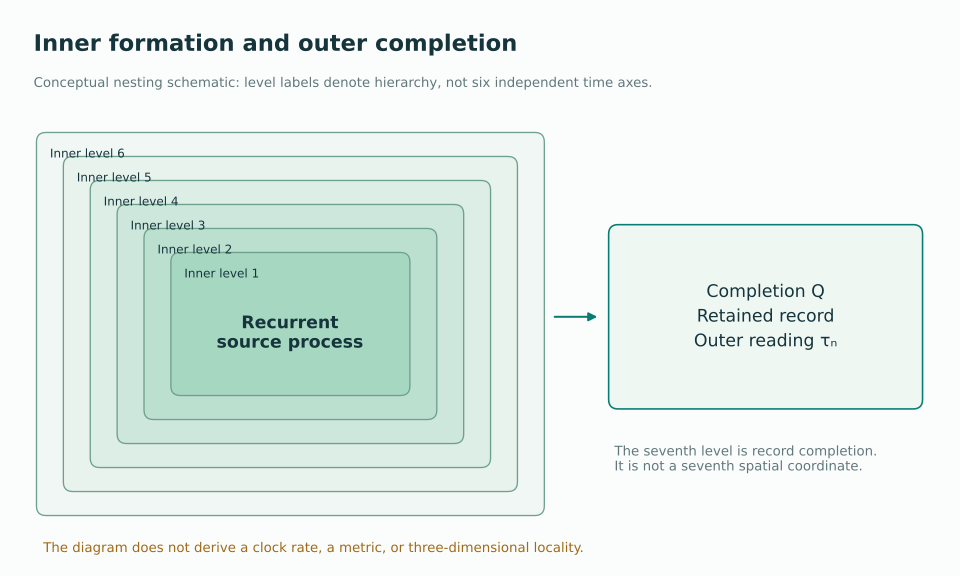
Fine-structure constant
Exact structural ranks and compact-phase response; electromagnetic matching remains an extra assumption.
Reduced Planck constant
A continuous action character fixes the role of an action scale. It permits every positive normalization.
Newtonian constant
Einstein-term matching defines G from κ. No microscopic value of κ is selected in the current program.
Electron mass
A matched charged-sector gap supplies a mass dictionary. A generic harmonic is not an electron.
Proton–electron ratio
The signed-branch ansatz yields 1836; the physical baryon and electron gaps remain to be calculated.
Cosmological constant
Normalized phase response cannot determine an absolute vacuum offset. Horizon quartic scaling fails the illustrative density test.
Trace the links between constants
Select a premise to see which constants depend on it.
Model results and physical predictions
Exact algebra and dimensional consistency are checked within the stated models. Supplied scales, calibrations and unresolved physical identifications remain visible on every constant page.