G
Newtonian constant
Einstein-term matching defines G from κ. No microscopic value of κ is selected in the current program.
Response uncomputedDimension: m³ kg⁻¹ s⁻²
Understand the ideas, follow the mathematics, and inspect the open steps.
Einstein-term matching defines G from κ. No microscopic value of κ is selected in the current program.
The route treats G as the conversion of a dimensionless curvature-response coefficient κ into physical units. Matching one effective action to the Einstein action gives a controlled formula. The central missing calculation is κ itself.
Read the common SMM/DTT foundations and notation →
Jump to the live workbench ↓
If spatial relations are completed readouts of a common generative process, a slowly varying geometric deformation should change the action of that same process. The gravitational program therefore asks for its metric response. The proposal is more specific than saying that “time creates curvature”: it requires an effective action and a reproducible coefficient of the scalar curvature.
Let a be the action scale, ℓ* the length scale and τ* the completion time scale. A dimensionless propagation coefficient υ relates completed displacement to delay:
A universal Lorentzian metric and a common propagation law are physical conditions to establish. A finite propagation bound alone does not derive them.
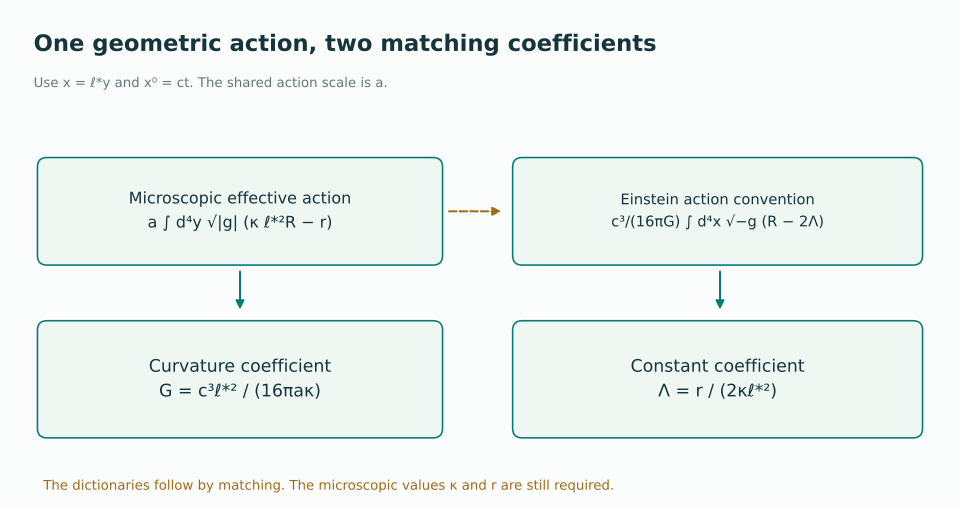
Suppose the long-distance expansion of the same completed model has the form:
κ is the dimensionless coefficient of curvature; r is an absolute vacuum coefficient. Both require a specified state, measure, regulator and normalization. They are independent unknowns in the present calculator.
Since d⁴y = d⁴x/ℓ*⁴, the coefficient of ∫d⁴x√|g|R is aκ/ℓ*². With the Einstein convention SEH = [c³/(16πG)]∫d⁴x√−g(R − 2Λ), equality of the curvature coefficients gives:
This is exact matching under the stated convention. It does not by itself prove that the effective theory has Einstein dynamics or that κ has a unique microscopic value.
The dimensional check passes. A stronger physical target combines G with an identified electron mass and the common action scale:
This uses mₑ = aεₑ/(c²τ*) and the same τ* in both dictionaries. Here gₑ means dimensionless gravitational strength, not the electron magnetic g-factor. Its value remains unknown until the dimensionless response and particle gap are computed.
Specify how the microscopic update responds to a metric source, retain every metric-dependent normalization factor, calculate κ, and control the continuum and regulator limits. Then test the sign, matter coupling, Newtonian limit and higher-derivative stability. Positivity of κ selects one Einstein-term sign; it does not establish all those properties.
At fixed a, ℓ* and c, doubling κ halves G. Changing ℓ* alone also changes c if τ* is held fixed, so use “Set τ* for SI c” when you want a fixed-speed comparison. Activate and remove the G fit to see exactly where the measured target enters.
Source basis: C · §§5, 12, 14; pp. 7–8, 19–23. These explanations summarize the stated models; they do not add a new physical selection theorem.
Open a premise to inspect its role and jump to every constant that uses it.
Specify metric dependence, regulator and finite counterterms, then establish the Newtonian and relativistic limits of the resulting response.