Λ
Cosmological constant
Normalized phase response cannot determine an absolute vacuum offset. Horizon quartic scaling fails the illustrative density test.
Vacuum offset openDimension: m⁻²
Understand the ideas, follow the mathematics, and inspect the open steps.
Normalized phase response cannot determine an absolute vacuum offset. Horizon quartic scaling fails the illustrative density test.
Vacuum curvature depends on an absolute geometric action coefficient r. Normalized phase responses and relative spectra discard a common offset, so they cannot determine it alone. Temporal averaging can reduce fluctuations while leaving the mean unchanged.
Read the common SMM/DTT foundations and notation →
Jump to the live workbench ↓
If vacuum geometry is continuously generated and only completed records are retained, it is natural to ask whether this process changes the gravitating vacuum contribution. The key distinction is between a relative response of completed records and the absolute action that couples to geometry. A successful DTT vacuum mechanism must specify the latter.
After x = ℓ*y, the curvature coefficient is aκ/ℓ*² and the constant coefficient is −ar/ℓ*⁴. Matching both terms to [c³/(16πG)](R − 2Λ) gives:
Λ is a curvature parameter. Its energy-density counterpart is ρE = Λc⁴/(8πG), while its mass density is ρE/c². These quantities have different units.
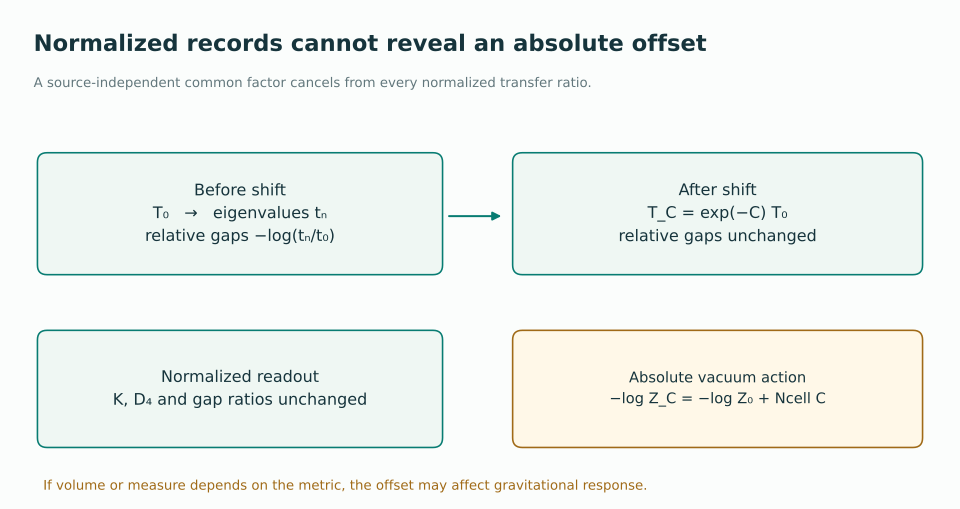
Multiply a transfer operator by a common source-independent factor, TC = exp(−C)T₀. Every eigenvalue acquires that factor, so all eigenvalue ratios and relative gaps are unchanged. Likewise, for Ncell cells:
Normalized expectations and positive-order derivatives with respect to sources independent of the factor do not see C. The absolute action does. If volume or measure depends on the metric, the offset may contribute to metric response. That dependence must be specified; it is not recoverable from normalized phase data alone.
For stationary samples ρₙ with mean ρ̄ and finite variance, the average ρ(M) = M⁻¹Σρₙ has:
More samples can narrow fluctuations without reducing the mean. More generally, any normalized nonnegative weights obey Σpᵢ(ρᵢ + C) = Σpᵢρᵢ + C if the weights are unchanged by the shift. Repeated completion is not, by itself, a cancellation mechanism.
A dimensionally permitted ansatz is ρE = Aac/L⁴. With L = c/H:
At a = ℏ, A = 1 and the illustrative H = 2.27 × 10⁻¹⁸ s⁻¹, it gives about 1.04 × 10⁻¹³⁰ J m⁻³. The comparison density defined by ΩΛ = 0.69 is approximately 5.72 × 10⁻¹⁰ J m⁻³. The ratio is about 1.82 × 10⁻¹²¹. This particular horizon law is far too small for that benchmark. Choosing L ≈ 86 μm to match it is an inverse fit, not a predicted length.
The electron normalization cancels. A parameter-free value for r/κ² from one microscopic model would therefore be a meaningful joint target. The cancellation itself is an algebraic identity, not a new empirical prediction.
Vary r at fixed κ and ℓ*: Λ changes linearly, including its sign. The “Infer r” control uses the illustrative cosmological benchmark and is labeled calibration. The horizon route is a separate stress test; its density conversion imports measured G. A successful dimensional check cannot rescue the failed numerical scale.
Source basis: C · §§12–14; pp. 19–23. These explanations summarize the stated models; they do not add a new physical selection theorem.
Open a premise to inspect its role and jump to every constant that uses it.
Derive r with a specified state and normalization, conservation and protection against radiative shifts. Averaging noise does not select the mean.