μ
Proton–electron ratio
The signed-branch ansatz yields 1836; the physical baryon and electron gaps remain to be calculated.
Ansatz / open spectrumDimension: 1
Understand the ideas, follow the mathematics, and inspect the open steps.
The signed-branch ansatz yields 1836; the physical baryon and electron gaps remain to be calculated.
The mass ratio removes a common dimensional normalization, making it a sharp unification target. A spectral route gives μ = εₚ/εₑ. A separate structural ansatz gives the integer 1836, but its energy rule and fractional correction remain unproved.
Read the common SMM/DTT foundations and notation →
Jump to the live workbench ↓
The common-substrate principle demands that electron and baryon records come from compatible sectors of one dynamics. Their energies should not be normalized with independently fitted clocks. The mass ratio is therefore particularly useful: the shared units cancel and expose the genuinely dimensionless spectral problem.
The same a, c, τ* and vacuum reference must apply to both sectors. A proton sector additionally needs its interacting baryon dynamics, rather than an arbitrary mode labeled “proton.”
This is an exact algebraic consequence of the common dictionary. It avoids an arbitrary overall energy unit, but it does not calculate either gap. Entering measured or fitted gaps would still import the result.
These roots are exact. The negative root is not a positive counting dimension and has no automatic interpretation as antimatter.
The multiplication by 13 and the triangular term 55 are an added baryonic inertia rule. They need a Hamiltonian or transfer-theory derivation. The closeness to the reference μ = 1836.152673426 is a motivation for investigation, not a proof of that rule. The missing residual is 0.152673426.
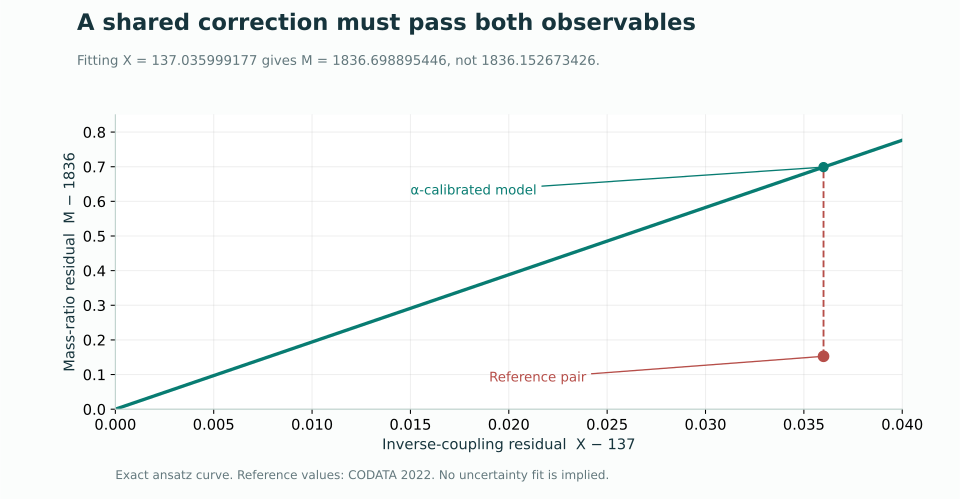
Suppose both α⁻¹ and μ depend only on a continuous effective valuation b:
An exact finite-dimensional rank cannot change continuously, so this deformation is an additional effective ansatz. Fitting X to 137.035999177 yields b ≈ 10.0015650751 and M ≈ 1836.698895446. It misses the mass-ratio reference by about 0.54622202.
A complex three-dimensional color space with a fixed Hermitian form and volume form has SU(3) symmetry, and three fundamentals admit a determinant singlet. Those representation facts do not calculate confinement, proton binding energy, flavor or spin structure. An internal color triplet is also not the same object as the real rank-three spatial readout.
Use the signed-branch route to recover 1836 at b = 10, then run the one-input α cross-check. Switch to the spectral route and scale both gaps by the same factor: their ratio stays fixed. This cancellation is the reason the ratio is a good dimensionless target, while the gap values still need a derivation.
Source basis: C · §11 and §§14–15; pp. 18–19, 22–25. These explanations summarize the stated models; they do not add a new physical selection theorem.
Open a premise to inspect its role and jump to every constant that uses it.
Replace the signed inertia ansatz by physical transfer sectors and confinement dynamics; compute the residual rather than naming it a correction.