
A constrained quadratic mediator produces an exact inverse-Laplacian interaction on a supplied graph. A three-dimensional continuum limit gives the Coulomb shape, while kinetic and response normalizations set binding.
Neutrality is a label; binding is an energy comparison
Place positive and negative source labels far apart. Their total charge is zero, but they need not remain close. A bound atom requires a normalizable relative state below the energy of separated constituents. This gives the SMM/DTT matter program a definite target: outer completion should retain a stable composite pattern whose internal dynamics explains localization.
A finite box can make even a free particle’s levels discrete. Consequently, a finite spectral spacing alone does not demonstrate attraction or binding. The comparison must use a stated separation threshold and explain what happens as the available spatial region grows.
Write one local flux problem
Choose a connected record graph and arbitrarily orient its edges. Let B map vertex values to edge differences, so L=BTB is the graph Laplacian. A neutral source at vertices 0 and x is ρ=δ0−δx. Edge flux F obeys the divergence condition BTF=ρ and has positive local energy η‖F‖²/2, with η>0.
Because ρ sums to zero, it lies outside the constant kernel of L. Its response can therefore be written using the pseudoinverse G=L+. The graph, source constraint, and coefficient η are supplied ingredients. Their common derivation from inner generation is the upstream research question.
Eliminate the mediator exactly
Set F*=BGρ. Then BTF*=LGρ=ρ, so this flux satisfies the source condition. Any other solution is F*+z with BTz=0. The cross term vanishes because ⟨F*,z⟩=⟨Gρ,BTz⟩=0. The energy is therefore minimized at F*.
This is a useful constructive mechanism: a global response emerges from a local energy and a compatibility constraint. On a vertex-transitive graph, subtracting the common diagonal self-energy leaves the cross potential −ηG0x. On an irregular graph, the position-dependent self terms must remain in the calculation.
Worked example: one edge and two sources
For two vertices joined by one edge, L has rows (1,−1) and (−1,1), and G=L/4. Take ρ=(1,−1). Since Gρ=(1/2,−1/2), the quadratic form ρTGρ equals one. The minimum mediator energy is therefore η/2. Directly, the divergence condition requires a unit flux through the only edge, giving the same answer.
This small example verifies the sign, normalization, and role of the constraint. It has no large-distance limit and cannot establish a hydrogen atom. On a larger graph, parallel routes share the flux and can lower its minimum energy, connecting the response to the geometry of the entire network.
Why three-dimensional geometry matters
Suppose a refinement family approaches Euclidean three-space and the normalized mediator approaches the inverse of −Δ with decay at infinity. Away from the source a radial Green function obeys (r²G′)′=0, giving G=A/r+B. Decay sets B=0. Unit outward flux through a sphere requires 4πA=1, so G=1/(4πr).
The coefficient C includes source and continuum normalization. Three-dimensional geometry fixes the inverse-distance shape under these assumptions, but does not select C. A two-dimensional Poisson problem instead gives logarithmic behavior, showing why a source-derived spatial readout is relevant to the force law.
A finite graph pseudoinverse has a removed constant mode and typically a zero-mean kernel, which can change sign. It is not already the positive decaying continuum Coulomb kernel. The refinement statement must control edge lengths, vertex measures, boundary conditions, and the source regulator before that interpretation is available.
Combine attraction with coherent motion
Supply a positive kinetic operator −DΔ, with D>0. For a normalized exponential state of size a, the exact expectation is E(a)=D/a²−C/a. Differentiation gives a=2D/C and the minimum −C²/(4D). Kinetic energy dominates at very small a, while the attraction produces a negative minimum below the zero separation threshold.
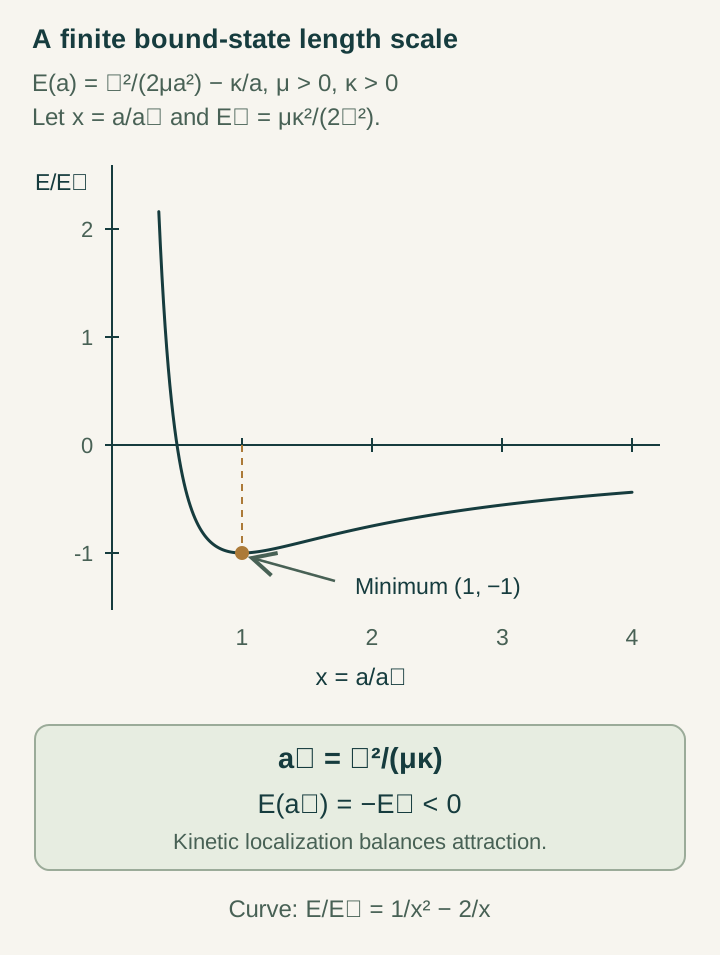
Open the full-size diagram →
Every positive C gives a bound scale in this supplied continuum family. Binding therefore does not select a unique coupling. Doubling C at fixed D halves the radius and quadruples the binding-energy magnitude.
The common-source question
The construction connects several DTT ideas in a calculable order. Completed records supply a geometry; local compatibility coordinates mediator response; coherent matter motion and attraction create a persistent composite. The six inner roles should generate these ingredients as dependent stages, with the seventh completion preserving their shared physical normalization.
The next theorem should obtain the graph Laplacian, its kinetic coefficient D, and its mediator coefficient C from one autonomous update. It should then control their continuum limits with the same clock and action scale. That would make atomic binding a consequence of a common source, while leaving a clear place to calculate spin, radiation, and corrections beyond the scalar quasistatic mediator.
Continue with the articles
- A neutral pair is not yet an atom
Charge neutrality does not establish an atom: binding requires a localized state below a defined dissociation threshold. A minimal Coulomb example separates that requirement from finite-box gaps, classical orbit pictures and source-level selection.
- Eliminating a mediator to obtain attraction
Minimizing a positive flux energy under a neutral divergence constraint gives an exact graph Green-function interaction. The derivation exposes the attractive cross term, the role of self-energies and the response data a source model must supply.
- Why the Coulomb law requires a continuum input
The inverse-distance potential follows from a decaying three-dimensional Poisson kernel. The graph-to-continuum limit fixes its geometric form only under stated assumptions, while the physical interaction strength remains a separate matching question.
- A normalizable hydrogen-like ground state
Square completion gives the exact normalized ground state of the supplied nonrelativistic Coulomb Hamiltonian. Its spectrum and relative root-mean-square speed provide precise atomic benchmarks without selecting the coupling itself.
- Why binding does not fix the coupling
Dilation shows that every positive Coulomb coupling admits binding and the same type of ground-state filter. A source derivation of a particular coupling must therefore fix field, matter, action and clock normalization beyond the existence of an atom.