
Branch invisibility is an observable-algebra condition. Finite calibration additionally needs informative delayed effects and an independent bandwidth bound, while universal physical clock selection remains a separate target.
Declare the dynamics and what the instrument reads
Specify stationary Hermitian generators Kb and Kr, an action scale a, and the admitted initial states. Branch activity u gives Ub=exp(−iuKb/a); resolution activity τ gives Ur=exp(−iτKr/a). A detector effect E predicts probability tr(Eρ). State which effects are accessible and whether all states on the tested sector can be prepared.
These activities are protocol controls before they are physical clock readings. A periodic phase becomes a clock only with calibrated frequency, two readable quadratures and an unwrapping range or cycle counter. A constant detector is perfectly branch insensitive but supplies no duration information. DTT’s outer-clock proposal therefore requires both invisibility to specified inner work and nonzero sensitivity to the intended completed progression.
Use a delayed test to expose a hidden coupling
Take a qubit, E=(I+Z)/2, Kb=aΩZ/2 and Kr=aωX/2. Prepare the +X state. Immediate Z probabilities are one half for every branch excursion because the branch merely changes relative phase. After resolution, direct rotation of the Bloch vector gives:
For the illustrative controls Ωu=π/2 and ωτ=π/2, the probability is one; with no branch it is one half. These are exact model probabilities, not observations. The comparison uses the same preparation and detector, changing only the branch excursion. An immediate null result would have missed the coupling completely. The calculation explains why the test language must include later processing of the record.
Turn the delayed tests into an exact criterion
Move resolution from the state to the effect: Eτ=Ur†EUr. Let Ar be the algebra generated by all admitted delayed effects. Branch probabilities are unchanged for every admitted state and an open interval of activities exactly when Kb commutes with that algebra. Differentiation proves necessity; exponentiating the commutator proves sufficiency.
The same condition controls finite interleavings. Moving the final effect backward through a sequence leaves it in Ar; each branch conjugation disappears, leaving only the sum of resolution activities. Hidden factors may still evolve. This makes a protected logical subsystem possible without requiring the entire material state to stop. The theorem concerns the supplied stationary generators and measurement access, so additional controls require their own enlarged orbit algebra.
Separate conditioning from the danger of revivals
For the qubit, use delayed effects at angles zero and θ. On traceless Hermitian perturbations the smallest commutator-frame singular value is σ*=√(1−|cosθ|). At θ=π/2 it is one; at θ=0.1 it is approximately 0.0707. The latter frame amplifies the same response uncertainty by about fourteen compared with the former.
Even an informative frame can miss a branch generator that completes a full revival at the sampled excursion h. An independently justified spectral-width bound W, with Wh/(2a)<π, prevents that ambiguity in the finite certificate. State tomography, detector uncertainty and preparation error must support bounds over all admitted inputs. Neither a small contrast for one preparation nor a favorable nominal singular value supplies those missing bounds.
One finite reconstruction uses basis-state preparations and the real and imaginary superpositions of each basis pair. Their response differences determine the entries of a Hermitian delayed-effect change. Statistical intervals and systematic calibration intervals then bound its operator norm. This procedure explains what “all-input” certification would require; it does not assume that every physical platform supplies those preparation controls.
Calculate a protected code and its controlled failure
Encode a logical qubit in |01⟩ and |10⟩. The branch generator κ(Z1+Z2) vanishes on this sector. Resolution (aω/4)(Z1−Z2) acts as aωZℓ/2, giving logical quadratures cos(ωτ) and sin(ωτ). The initialized code is invariant under both operations.
Add δ(Z1−Z2)/2 during branching. The phase becomes φ=ωτ+2δu/a. With T=φ/ω and independently established u/τ=D, the exact response is T/τ=1+2δD/(aω). For an illustrative fixed mismatch 2δ/(aω)=1/10, settings D=2 and D=3 give 1.2 and 1.3. This calculation predicts a dependence across settings from one declared imperfection; it does not assign a physical mismatch to an actual clock.
Keep geometry fixed while comparing clock laws
Use the same record count B and contraction q in both models, so D=log B/log q. The protected comparator reads τ, while an ungated oscillator reads u+τ. Their matter conversion factors are D and D/(D+1). Varying D separates these laws without changing the archive’s counting rule.
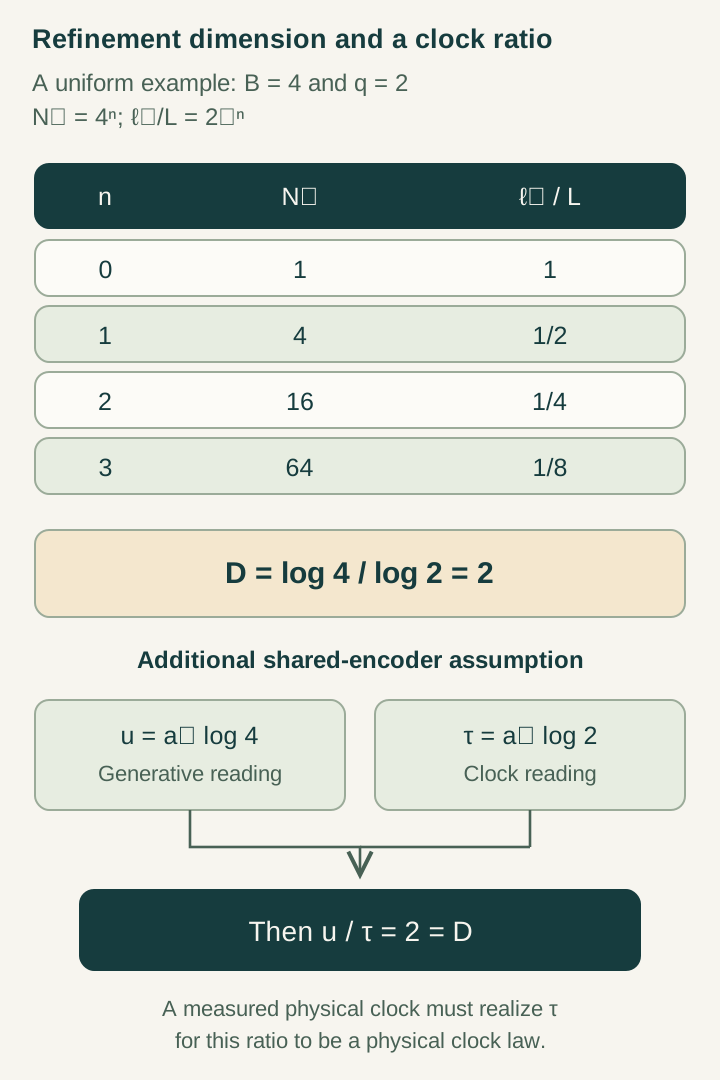
Open the full-size diagram →
The diagram’s D=2 example concerns its specified refinement and encoder. Six nested generative roles are compatible with either clock coupling. Their existence cannot decide which class all physical clocks occupy. A source-selection theorem must exclude or constrain the ungated alternative through a derived interaction law.
Report a finite certificate and its operating range
A mathematical protocol should report the effect frame, lower bound for σ*, bandwidth bound, permitted excursions, leakage assumptions and uncertainty intervals. If the actual branch generator lies within norm δK of a protected one, a sufficient probability-error bound over a finite sequence is min{1,δKΣ|uj|/a}. Total activity matters, including recovery or export when those operations belong to the clock model.
The positive result is a calibrated apparatus law with a stated range. Universal agreement across material species, motion and gravitational conditions requires more. The universal-clock problem identifies that bridge: derive a common physical class of clocks independently of the relation one hopes to verify.
Preserve the independently measured frequency calibration when comparing several refinement settings. Re-fitting a frequency separately for each setting could absorb exactly the branch-sensitive drift that the protocol is intended to reveal.
Continue with the articles
- What makes a clock insensitive to branching?
A material clock ignores branching exactly when the branch generator commutes with its full delayed-observation algebra. Immediate readouts alone can miss hidden motion that later resolution exposes.
- Calibrating a clock with finitely many tests
Finite delayed tests can bound departures from clock protection when their observable frame is complete and an independent bandwidth bound excludes revivals. The resulting certificate controls errors through nested sequences.
- Short clock windows and poor conditioning
Two delayed qubit tests can be exactly complete yet poorly conditioned. The explicit singular-value calculation shows how short observation windows amplify uncertainty in inferred clock couplings.
- A protected material clock
An encoded two-qubit clock can ignore branch activity while responding to resolution. A controlled coupling mismatch produces a calculable failure, making both the protection and its assumptions testable.
- Nested operations and clock independence
Clock independence must survive every admitted interleaving of branch and resolution operations. The orbit-algebra criterion removes branch effects from all such finite sequences and supplies an accumulated-error bound.
- Why one clock model does not prove universality
Protected and ungated clocks can coexist with the same record geometry while assigning different readings to it. This countermodel shows why constructing one desired clock does not establish a universal material-clock law.