
A model passes an internal check when its declared dynamics, completion, memory and dimensional dictionary give compatible answers. Empirical discrimination then requires a comparison model and an additional observable.
Write the model as a reproducible specification
Declare the state space, initialized sector, update, permitted controls, retained memory and accessible effects. If a Hamiltonian is used, identify its domain or finite matrix, its action scale and its evolution parameter. If outcomes are selective, list every branch. These inputs make the phrase “one source” an operational claim: another reader can follow the same state through generation, completion and subsequent observation.
Mark each ingredient as derived, supplied or calibrated. A supplied spatial frame, positive probability rule or Coulomb interaction can support exact calculations without becoming a source-derived result. The six inner roles of DTT describe nested dependencies; the seventh exposes a completed record. Neither the number of roles nor their names supplies a metric, a clock law or a propagation speed.
Check the phase convention against the actual flow
For a finite real skew generator A with no zero modes, form Ω=(−A²)1/2 and J=AΩ−1. Direct multiplication must give J²=−I and A=JΩ. On a plane with J0(x,y)=(−y,x), choose the illustrative input A=2J0. Then Ω=2I, J=J0, and the forward solution is exp(2tJ0).
This sign check matters: with the conventional Schrödinger sign and positive H, the complex unit is −J. Reversing the supplied flow reverses its selected orientation. A kernel of A needs separate treatment because Ω cannot be inverted there. The split-complex unit satisfying j²=+1 is a different algebra and cannot replace J in this test.
Verify a complete instrument before conditioning
Take the explicit comparison instrument Macc=√p V and Mfail=√(1−p)W, with V and W unitary and 0<p<1. Its effects sum to I, so total probability is one. The accepted output is pVρV†; its probability is p for every normalized payload. Applying W† after a recorded failure restores that payload, including correlations with a passive reference.
These statements can be checked by matrix multiplication. They are stronger than equal acceptance on a few chosen inputs. Conversely, the accepted map alone says nothing sufficient about failure recovery. If a source simulation reports only normalized successful states, ask it also to return the rejected and unfinished probabilities. Otherwise a seemingly accurate completed output may conceal a vanishing success rate or an altered input ensemble.
Test whether the proposed record predicts its successor
Let the projection P(x,y)=(x,0) retain x from a state (x,y). For the illustrative completed update M(x,y)=(x+y,y), two legal inputs (0,1) and (0,−1) have the same present record but next records +1 and −1. No autonomous function of the current displayed zero can reproduce both. This is a failure of the proposed record state, not a contradiction in the enlarged dynamics.
Here the hidden-to-visible block equals one, so the criterion fails. Retaining y repairs prediction; restricting the legal preparations might also repair it, but that restriction must be declared. In a quantum model, an unread measurement channel is not this linear information projection. Keeping their mathematical roles separate prevents an apparent closure proof from silently changing the physical process.
Compare independently defined clocks and scales
Suppose independent record and scale contacts establish u/τ=D. A protected clock reads TP=τ; an admissible ungated comparator reads TA=u+τ. For D=2 their reading ratio is three, and for D=3 it is four. One constant change of units cannot identify the devices across both settings.
This exact countermodel isolates a missing common-source restriction. Record geometry may be correct while the clock coupling remains free. Likewise, an action scale used in matter phases must be the same one used to normalize response before a dimensionless coupling is compared. A successful unit audit verifies dimensions; it does not fix a dimensionless coefficient. The joint-source problem asks for laws that constrain these interfaces together.
Follow the dependencies without promoting a partial result
Run the validation in the order required by the claimed observable. Spatial rank needs a readout; distance needs admissible local comparisons; propagation needs an update on those relations; clock-measured propagation needs a material clock. A result at an earlier step can be exact while a later identification is still supplied.
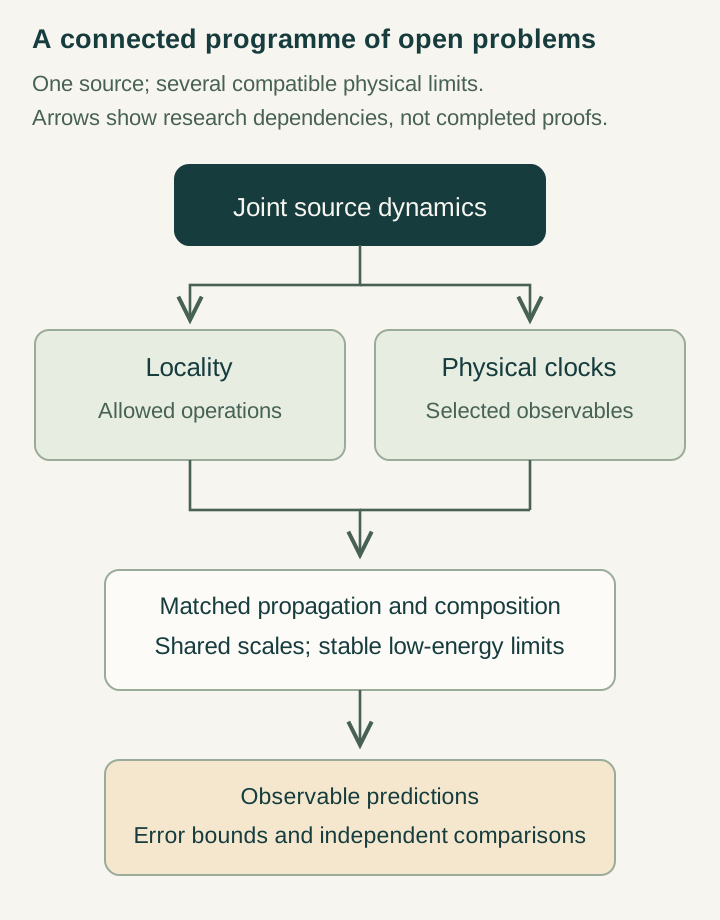
Open the full-size diagram →
For example, a positive bound state establishes binding within its Hamiltonian. It does not determine the Hamiltonian’s coupling, derive the gauge group or prove a field-theory mass gap. This dependency record should preserve positive results as reusable components. It also identifies the precise additional assumption that a competing construction can vary while preserving everything already proved.
Produce a result that can be challenged
Save the declared inputs, exact identities, numerical tolerances, legal preparation class and comparison model together. A finite calculation should include an analytic limiting case and a bound on the quantity actually reported. Refining a grid is useful only when it addresses a named discretization error; additional decimal places do not certify a missing physical interface.
The SMM/DTT payoff is a compact chain from nested generation to a completed, testable relationship. Passing these checks establishes consistency of that chain under its assumptions. A new physical claim begins when the same frozen model predicts an independently matched observable that its relevant comparator does not predict. The prediction guide explains how to preserve that distinction after calibration.
Keep legal state restrictions in the result statement. A matrix identity on one initialized subspace can be enough for a useful apparatus, but it does not extend automatically to arbitrary states. Testing the identity on entangled reference inputs is especially important when the result claims to preserve an unknown quantum payload.
Continue with the articles
- A common dimensional dictionary
A shared dictionary converts source outputs into calibrated actions, lengths, times, masses, and curvature coefficients. Dimensional checks expose missing scales and distinguish coefficient matching from an independent derivation.
- Why one clock model does not prove universality
Protected and ungated clocks can coexist with the same record geometry while assigning different readings to it. This countermodel shows why constructing one desired clock does not establish a universal material-clock law.
- A quantum source for generation and completion
A positive phase–dilation Hamiltonian ties one phase encoder to a powered coordinate and controlled work. It gives an explicit quantum realization of generation and completion while retaining its constitutive interfaces as inputs.
- Completion without biasing an unknown input
A factorized accepted channel gives the same success probability for every admitted unknown input, including inputs entangled with a reference. The failure channel and the amplification of errors by conditioning require separate checks.
- When memory can be represented by one time
Finite auxiliary states can generate memory while evolving in one laboratory time. Rational-kernel realization identifies when that reduction is exact and which additional conditions make the auxiliary system a physical reservoir.
- How a protocol can reveal dual-time structure
A temporal signature must be attached to a preparation, control sequence and readout that exposes retained information. Loop-response and predictive-state examples give exact witnesses while specifying the reduced model classes they can exclude.