
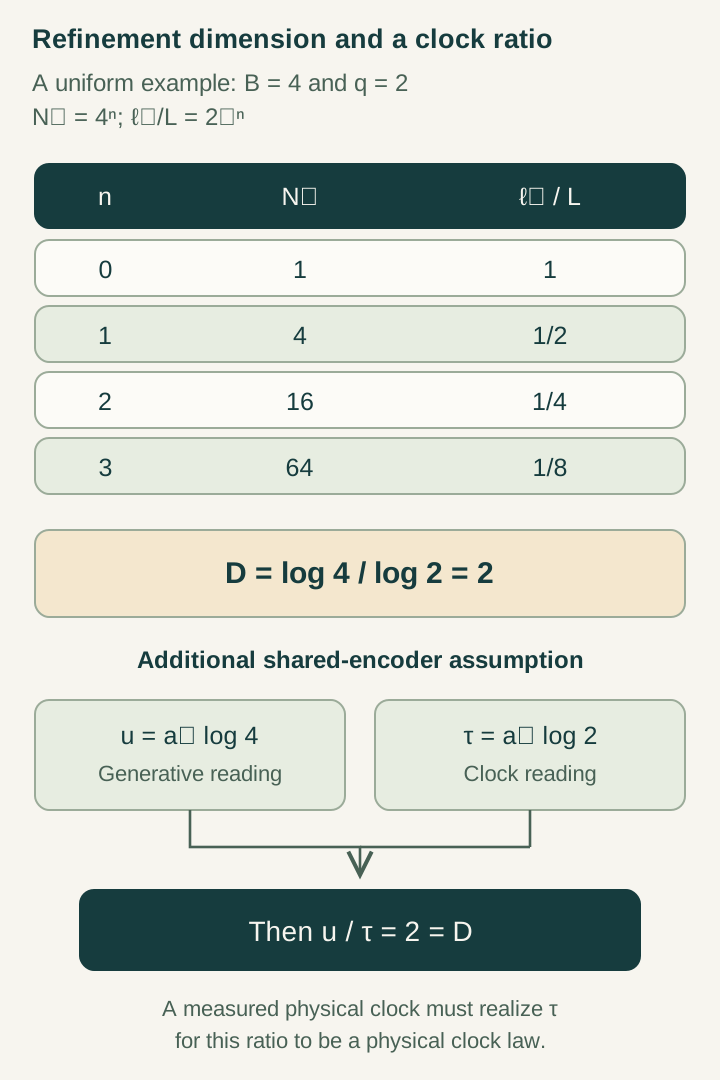
The uniform address space has dimension D=log B/log q by matching cover and probability bounds. A common logarithmic encoder yields u/τ=D; identifying τ with a physical clock is an additional operational condition.
Define the records, scale and metric independently
Let B≥2 be an integer, q>1 and L>0. Each completed record has exactly B distinguishable children, and each refinement reduces a comparison scale by q. A level-n address is a word of length n over an alphabet with B letters. There are Nn=Bn such words, with scale ℓn=Lq−n.
For a limiting geometry use infinite words. If two words first differ after a common prefix of length m, define their distance as Lq−m; identical words have distance zero. Two words each sharing a long prefix with a third also share at least the shorter prefix with each other. Consequently d(x,z)≤max{d(x,y),d(y,z)}, the ultrametric inequality. The distance has now been defined without using a clock.
Step 1: eliminate refinement depth
Taking logarithms gives log Nn=n log B and log(L/ℓn)=n log q. Eliminating n yields:
This proves a counting exponent. To identify it as a geometric dimension, the following steps compare actual covers and a normalized measure in the declared ultrametric. A finite address archive by itself is a finite metric space with Hausdorff dimension zero; the positive exponent belongs to the specified refinement limit or to a declared scaling window.
The distinction fits DTT: nested inner work creates finer distinctions, while completion makes each finite archive available. The number of internal roles is not the exponent. Several different generative architectures can implement the same count-to-scale law.
Open the full-size diagram →
Step 2: prove the dimension upper bound
A level-n cylinder contains all infinite words with one fixed prefix of length n. It has diameter ℓn, and the Bn cylinders cover the whole address space. For any exponent s>D, the sum of their diameter powers is:
The limit follows because B=qD, so Bq−s<1. These covers become arbitrarily fine as n increases. They therefore show that the Hausdorff dimension is at most D. The proof uses the supplied separation encoded by the ultrametric; overlapping geometric pictures with the same formal branching counts would require a new covering analysis.
Step 3: normalize a measure and prove the lower bound
Choose each address letter independently with probability 1/B. Every level-n cylinder then has probability B−n, and the probabilities of its B children sum to its probability. This defines a normalized probability measure μ on infinite addresses.
A closed ball of radius ℓn is exactly a level-n cylinder, so μ(ball)=(ℓn/L)D. For an arbitrary radius r, choose ℓn≤r<qℓn. Then μ(ball)≤(r/L)D. A set lies in a ball of radius equal to its diameter, giving the same upper bound for its mass.
Here the Ei form a cover with diameters at most δ and s<D. Rearranging and sending δ to zero makes the s-dimensional covering cost diverge. Thus the dimension is at least D, completing the proof.
Step 4: compare dimensions without confusing their meanings
For B=8 and q=2, D=3. At depth four, N4=4096 and ℓ4=L/16, with 4096=16³. For B=4 and the same q, D=2. For B=6, D=log₂6. All are exact address-space dimensions.
The B=8 example is still an ultrametric address space, not a proof of a connected three-dimensional spatial manifold. Its cylinders are separated branches, and its topology differs from ordinary continuum space. Linear detector rank, graph volume growth, spectral dimension and this address dimension can disagree. SMM/DTT needs maps and stability conditions connecting those separate measurements before interpreting their shared numerical value as one physical spatial dimension.
Step 5: derive the common logarithmic activity
Let z/z0 be a positive dimensionless displacement ratio and Q=log(z/z0). Suppose Q and a circular phase θ have conjugate momenta K and J. Take a work function W independent of those momenta and the single-charge Hamiltonian H=F(C), with C=K+ηJ+W. Hamilton’s equations give Q̇=F′(C) and θ̇=ηF′(C), hence Δθ=ηΔQ.
Supply independently validated contacts ending at ratios B and q. If both use one phase-to-activity calibration β, their activities are u=βη log B and τ=βη log q. With a*=βη>0:
The endpoint laws and common calibration carry the physical content. The conserved relation alone does not prove the contacts, a monotone quantum traversal or a material clock reading.
Step 6: state which clock measures the ratio
Suppose a protected material clock is insensitive to branch activity and reads T=τ. A matter band evolving as exp(−iuHm/a) can then be written exp(−iTDHm/a). A coefficient vg measured per unit u converts to Dvg per unit T, with the Hamiltonian and physical calibration held fixed.
An equally explicit alternative clock reads TA=u+τ. Its conversion is D/(D+1), so the same D=3 archive gives three for the protected clock and 3/4 for the alternative. No single unit conversion makes those laws agree for every D. The source must select or account for the clock response before treating the ratio as universal.
A band velocity also need not equal a sharp causal-cone slope. Identifying c=vgD requires a separate common propagation result.
Result, verification and remaining obligations
The dimension proof and logarithmic ratio are exact under their declared inputs. The physically strongest test varies B and q while preserving the source interaction, clock mechanism and matter calibration. Count children, measure contraction and read the clock independently; do not infer one quantity from the desired equality.
Finite contact widths, imperfect completion and phase uncertainty must enter an error bound. A source realization should retain the six nested dependencies and seventh completion interface without silently making extra serial work instantaneous. The joint-source problem asks whether those same physical rules can force geometry, clocks and transport to agree, rather than merely demonstrate their compatibility.
Continue with the articles
- Why one clock model does not prove universality
Protected and ungated clocks can coexist with the same record geometry while assigning different readings to it. This countermodel shows why constructing one desired clock does not establish a universal material-clock law.
- A quantum source for generation and completion
A positive phase–dilation Hamiltonian ties one phase encoder to a powered coordinate and controlled work. It gives an explicit quantum realization of generation and completion while retaining its constitutive interfaces as inputs.
- From record refinement to a joint clock–band relation
Independent count, scale, phase, clock, and band measurements can satisfy a joint refinement relation under the supplied interfaces. The ungated-clock alternative identifies why the protected-clock premise remains essential.
- Six inner stages and one publication interface
A six-digit nested counter with paired signed readout realizes ranks 1, 1, 2, 2, 3, 3 before one completion interface. Its exact counts reveal sampling bias and the restricted assumptions behind the six-channel bound.
- Limiting speed as update scale times projection rate
The limiting-speed factorization c=κρ combines a spatial update scale with a phase-to-clock rate. It is dimensionally consistent but does not independently select either microscopic factor or a numerical speed.
- A random clock behind dimensional flow
A renewal clock with heavy-tailed waits accumulates inner events sublinearly in observed duration. The explicit event-count model illustrates temporal intermittency while leaving the waiting law's physical origin open.
- Spectral dimension from return probabilities
A return-probability slope defines a spectral diagnostic only when the return observable is finite. The inverse-stable point-return integral diverges in two or more dimensions, so the broad scaling claim needs a specified finite probe.