
In this article
- The question behind the comparison
- The single-source and nested-time proposal
- The comparator’s explanatory structure
- The precise agreement and difference
- Worked example: what follows and what does not
- What this comparison contributes


Thermal time connects temporal flow to a state, but modular flow is a group of reversible automorphisms. It does not, simply by existing, establish monotonic entropy production. The comparison develops this distinction through a worked example and explains its implications for SMM/DTT’s nested generation, completed records and account of the observable world.
An arrow of time is an asymmetry with a specified meaning. A causal arrow concerns permitted influence; a thermodynamic arrow concerns typical entropy change; a psychological arrow concerns memory and anticipation. SMM/DTT adds a proposed generative orientation: production is organized toward completion, after which a result can participate in later records. These orientations can support one another, but their agreement is an explanatory question. A growing archive by itself says nothing about the entropy of the entire universe, and a time-symmetric microscopic law can still support asymmetric records when supplied with asymmetric conditions.
The phrase dual arrows is most useful when it names the relation between inner completion and outer succession. The inner orientation is functional: unfinished and finished configurations have different roles. The outer orientation is historical: a retained result can constrain later access. They need not be opposite vectors drawn on a plane. Drawing two arrows can obscure the real issue if no criterion identifies what reverses when an arrow is reversed. For example, reversing a movie reverses the displayed order, whereas unmaking its records would also require reversing changes in the storage device and environment.
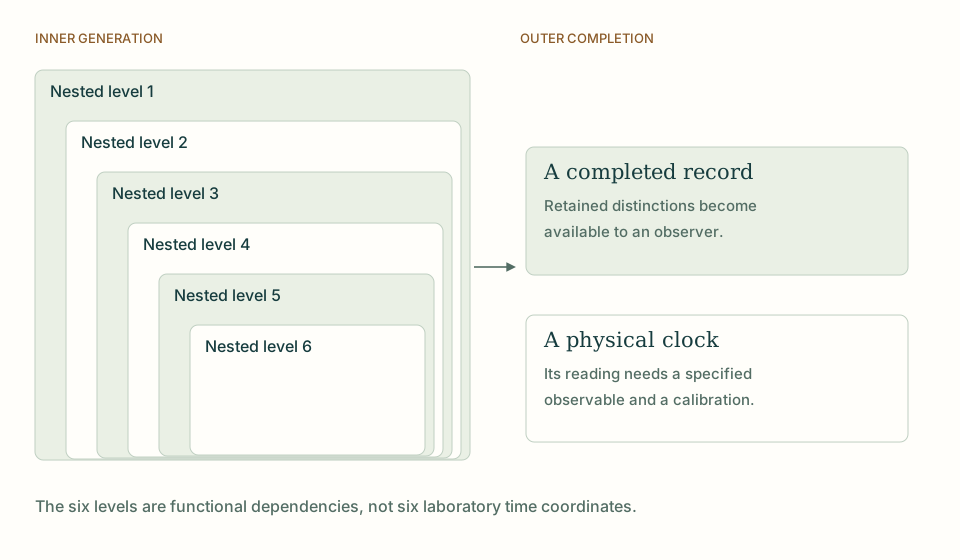
The six nested levels locate completion inside a structured process. Nesting can explain why some operations depend on earlier achievements, but nesting alone does not establish irreversible dynamics. A perfectly reversible circuit also contains dependencies. A physical arrow can arise when a subsystem loses access to correlations, when a boundary state selects one orientation, or when a genuine noninvertible law is posited. These alternatives have different implications for energy, probability conservation and the possibility of recovering a previous state. DTT becomes sharper when it chooses between them in a particular model.
SMM begins with one nonspatial generative source. DTT distinguishes its inner production from the outer order in which completed results become accessible. The six inner levels are nested functional dependencies within that production; the seventh denotes outer completion. They are not six independent clocks, six spatial directions, or six simultaneously occupied temporal axes. This distinction makes the framework more specific than a general claim that everything changes: it asks how a world of persistent relations can be generated before its spatial representation is taken for granted. [2]
Connes and Rovelli propose that an algebra of observables together with a state can determine a temporal flow. In a finite faithful-state illustration, write K = −ln ρ and let observables transform as A(s) = exp(isK)Aexp(−isK). The parameter s is dimensionless. If ρ is a Gibbs state proportional to exp(−βH), then K differs from βH only by a scalar, so s can be related to ordinary Hamiltonian time by t = ℏβs in this convention.
This example explains both the power and the limitation of the comparison. Time need not be an independently supplied universal background, but the observable algebra and state are already doing essential work. A maximally mixed finite state gives a scalar K and hence trivial flow on that full matrix algebra. Different physical states can therefore select different flows. The thermal-time programme is not a claim that every microscopic event dissipates heat, nor does modular evolution alone constitute a thermodynamic arrow. DTT asks the further question of how the relevant state, algebra and accessible records are generated. [1]
Thermal time connects temporal flow to a state, but modular flow is a group of reversible automorphisms. It does not, simply by existing, establish monotonic entropy production. DTT’s proposed direction from generation to completed record is therefore a separate ingredient. The potential connection is that the same source state could determine both a modular flow and a condition for the accumulation of accessible records.
To make that connection precise, one must distinguish the state defining the flow from the nonequilibrium resources that support record formation. An equilibrium Gibbs state can calibrate modular time while a memory-writing subsystem consumes a prepared resource. DTT would gain explanatory power if its nested architecture accounts for both without treating the memory reservoir as external. The comparison also exposes a limit: two arrows cannot be inferred merely from the words thermal and generative. One needs an explicit asymmetry in states, access or dynamics and then a proof that it aligns with the flow seen by the physical clock. [1]
Take a memory initially in a known state 0 and a fair bit X. A reversible copy maps (X,0) to (X,X). Before copying, the two devices are uncorrelated; afterwards they share one bit of mutual information. No information has been erased in this ideal operation. The record points toward the earlier value because of the initially blank memory and the chosen interaction. Restoring only the memory to 0 is a different operation, with a thermodynamic cost under the usual erasure assumptions. This simple distinction shows how a record arrow can depend on preparation without proving a fundamental violation of time-reversal symmetry. It also shows why a source-memory budget belongs inside any physical completion model.
The promising connection is a derivation of aligned orientations from a shared source law and admissible boundary conditions. An inner stage count would then acquire meaning through its relation to records and entropy production, not through the appearance of an arrow in a diagram. The conceptual gain is already useful: it prevents the familiar experience of passage, the ordering of causes and the irreversible loss of accessible information from being silently treated as the same phenomenon.
THE SAME QUESTION, DIFFERENT STARTING POINTS
| Question | SMM/DTT | The thermal-time hypothesis |
|---|---|---|
| Explanatory starting point | The proposed generative arrow leads toward completion, while the record arrow depends on what later states retain about earlier events. | A state and observable algebra determine a modular flow; clock calibration remains a physical question. |
| Key distinction | A completed record needs inherited correlations and memory resources; its existence alone does not prove microscopic time-reversal violation. | Thermal time connects temporal flow to a state, but modular flow is a group of reversible automorphisms. |
KEEP THE CONNECTION
Connects this comparison with the author’s discussion of arrows.
Connects this comparison with the author’s discussion of arrows.
Connects this comparison with the author’s discussion of arrows.
Connects this comparison with the author’s discussion of arrows.
Connects this comparison with the author’s discussion of arrows.
References support the comparator and the specific mathematical or interpretive claims indicated. SMM/DTT connections are developed in the analysis above.
How these comparisons distinguish premises, results and physical claims
SMONAD
Share this page, or keep a clear reference to the work you are reading.
Use this reference for the explanation on this page. “n.d.” means its first publication date is not specified; the update date is recorded separately.