Black-hole entropy and information: SMM/DTT and General relativity
Can the distinction between inner production and accessible records explain why horizon entropy scales with area, including its normalization? This article compares the source-based construction with General relativity, identifies their strongest point of contact, and works through a concrete example that separates a valid mathematical result from the further physical relation needed to explain observations.
A black-hole horizon separates what an observer can access from what remains inaccessible, making it a natural place to compare geometry and information. Yet several notions of entropy enter: thermodynamic entropy, entanglement entropy across a boundary, and logarithms of microscopic state counts. They can be related in specified settings but are not interchangeable definitions.
The central benchmark is the semiclassical area law S/kᴮ=A/(4ℓᴾ²), with ℓᴾ²=ħG/c³. An explanation must account for the proportionality, the coefficient, and the physical states being counted. The mere existence of hidden inner configurations does not fix any of these. An arbitrary finite number of records per area cell can fit the area law while leaving its normalization unexplained. [1][2][3]
02The SMM/DTT contribution
DTT treats an outer record as a limited completion of a deeper generative history. A horizon could then constrain which distinctions are jointly retainable or accessible. This is an interesting temporal version of the usual information question: what is lost when many production histories yield the same completed exterior record?
The six nested inner levels can organize the proposed processing of these histories, but their number is not an entropy coefficient. A quantitative model needs a physical equivalence relation on histories, a weighting or state-counting measure, and an account of how horizon area is read out from the same data. Otherwise temporal holography remains a motivating analogy rather than a derivation of black-hole thermodynamics.
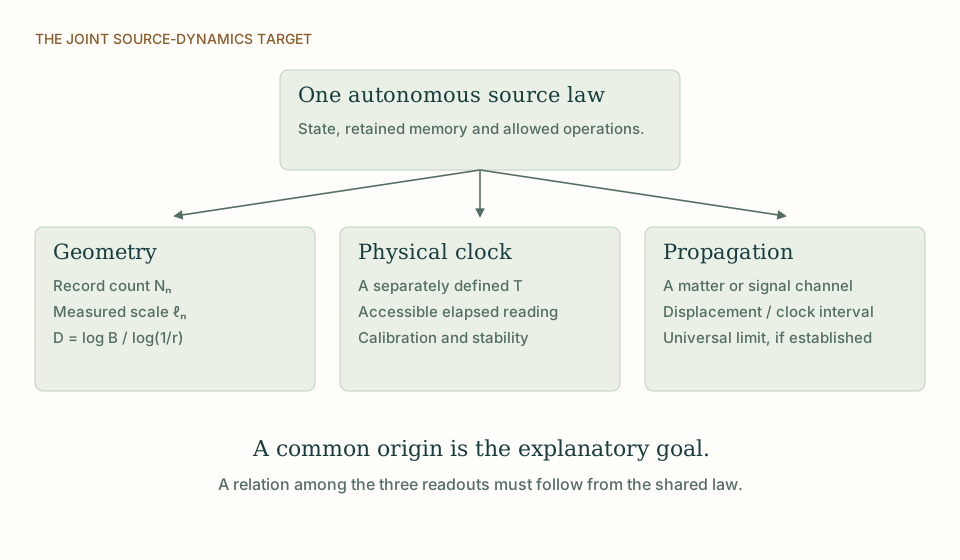
Geometry, clocks and propagation as independent readouts. A single source model should explain the relation between separately defined measurements. Sharing a diagram does not impose that relation. View full size ↗
03How General relativity frames the problem
General relativity describes gravitation through a dynamical Lorentzian metric coupled to stress-energy. Its coordinate freedom is a redundancy of description, while proper times, causal relations and appropriately specified observables have physical meaning. The framework supplies a demanding macroscopic benchmark and an extensive experimental record. It does not, in its classical formulation, derive a microscopic ontology of spacetime.
For this comparison, the relevant question is whether a source-generated description reproduces the metric theory in its tested domain and clarifies one of its microscopic inputs. Agreement with an Einstein equation or a boost formula is a compatibility result. A distinct physical prediction additionally requires a defined departure, with the same matter and clock observables on both sides. [4][5]
04Where the mechanisms agree and differ
General relativity determines black-hole geometry, while semiclassical quantum theory supplies the thermodynamic area law and Hawking radiation. DTT proposes an additional interpretation of the microscopic distinctions behind an exterior record. The comparison is strongest when that interpretation explains the number of states or the evolution of their correlations, not simply when it calls the horizon a temporal screen.
The state-counting calculation below shows why an area law can be easy to fit. Assigning an arbitrary number of states to each chosen area cell reproduces proportionality, but the coefficient remains adjustable. A source model must determine the cell's physical area and the independent record count through separate parts of the same dynamics. Six nested inner levels do not fix the factor one quarter. Furthermore, an entropy count does not answer whether evaporation preserves information. That requires a map between initial and final states and an account of what an observer can recover. DTT's distinction between inner history and outer access could clarify this map, provided inaccessible history is not used as a substitute for a unitary or otherwise well-defined physical evolution. [4][5]
05Worked example: assumptions, calculation and result
Suppose a horizon has N=A/a₀² independent cells, each with q equally allowed states. Then Ω=qᴺ and S=kᴮlnΩ=kᴮ(A/a₀²)lnq. Matching the semiclassical coefficient requires a₀²=4ℓᴾ²lnq. For q=2, this gives a₀≈1.665ℓᴾ.
The result is a consistency relation, not a prediction of the cell size or binary alphabet. Choosing either input to obtain the required coefficient simply transfers the unknown. Correlations, gauge constraints and unequal weights can change the count. This exercise shows what a genuine completion-based entropy theorem would accomplish: it would determine the allowed states and the physical area cost independently, so that their ratio could be compared with 1/(4ℓᴾ²). [1][2][3]
A and a₀² are areas; q is a dimensionless integer in this toy model. The standard entropy formula is semiclassical.
06An independent operational check
A physical state count must also avoid counting gauge copies as distinct states. If several descriptions differ only by a local basis transformation, multiplying the entropy by the number of descriptions would be artificial. Conversely, physically distinct but inaccessible states can contribute to thermodynamic entropy even when an exterior observer cannot distinguish them individually. A completion rule must define that distinction. This is one reason a neutral projector can be useful: its invariant subspace is mathematically identifiable. The entropy still depends on the physical ensemble within that subspace and on how its states relate to independently measured horizon area.
07What follows from the comparison
Information recovery is a further question. An area count says how many states are compatible with a macrostate, but it does not show whether evaporation preserves correlations or how an exterior observer reconstructs them. The most useful DTT comparison keeps state counting, dynamical information flow and observer accessibility connected without treating success at one task as a solution to all three.
THE SAME QUESTION, DIFFERENT STARTING POINTS
The comparison at a glance
Question
SMM/DTT
General relativity
Starting physical structure
One nonspatial source; six nested inner functional levels produce records accessible through outer completion.
A dynamical Lorentzian metric and covariant matter fields.
The central mechanism in this topic
A completed exterior record may identify classes of hidden source histories.
Classical horizons and semiclassical thermodynamics supply the macroscopic benchmark.
How the claim is made operational
A source-to-record map must define geometry, material response and physical clocks with shared inputs.
Metric field equations, proper-time observables and their controlled approximations.
Meaning of agreement
Agreement is a compatibility result; a source-selected relation or fixed residual would add explanatory content.
The stated framework provides a benchmark within its own assumptions and established domain.
KEEP THE CONNECTION
Key ideas
The source must calculate the entropy normalization and information dynamics as separate linked results.
The worked example establishes only the result stated under its explicit assumptions.
Six nested inner levels describe one generative organization; outer time orders accessible completion.
Develops the source construction or operational distinction used in this comparison.
Sources and further reading
References support the comparator and the specific mathematical or interpretive claims indicated. SMM/DTT connections are developed in the analysis above.