A continuous, strictly positive, additive completion cost invariant under carrier rotations is proportional to trace. Its remaining calibration and lack of boost invariance distinguish it from an already established proper-time reading.
A common source should assign the same completion cost to histories representing the same retained record. In the chosen matrix model, continuity, additivity, positivity, and rotational symmetry constrain that cost to trace. The theorem selects its mathematical form but leaves a scale and an operational interpretation: accumulation cost and proper time need not be the same observable.
02What a completion cost is assumed to do
Let T(X) assign a nonnegative cost to each positive record. The draft assumes continuity, additivity under appending records, strict positivity for nonzero records, and invariance under all SU(2) rotations of the carrier. These properties represent a particular isotropic apparatus or completion frame. The theorem asks what functional is compatible with them. It does not begin with an identified laboratory clock, and its result should not silently be read as proper time.
T(X+Y)=T(X)+T(Y)
T(UXU†)=T(X), U∈SU(2)
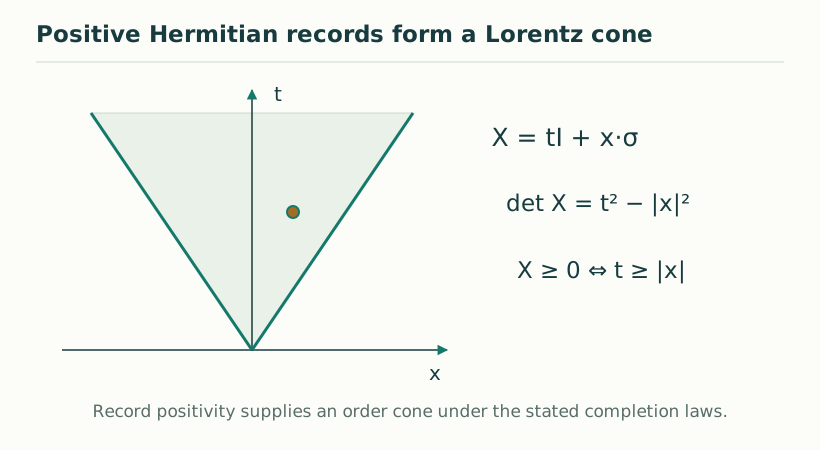
Figure 1. Positive Hermitian records form a Lorentz cone. Writing a Hermitian 2×2 record as X = tI + x·σ gives det X = t² − |x|². Positivity is equivalent to t ≥ |x|. The diagram is a two-dimensional section of the four-dimensional cone. View full size ↗
03The trace characterization
Every Hermitian matrix is a difference of positive matrices, so additivity extends the cost consistently to the Hermitian difference space. Continuity makes the extension real linear, and every such functional has the form tr(HX) for a Hermitian H. Rotation invariance forces H to commute with the irreducible SU(2) action, leaving H=cI. Strict positivity fixes c>0. Thus trace is the unique isotropic additive cost direction up to one multiplicative calibration.
T(X)=c tr X, c>0
04A simple cost comparison
The record diag(3,1) and the isotropic record diag(2,2) have the same trace four, hence the same additive isotropic cost. Their determinants differ, so the cost does not exhaust their geometric information. A rank-one packet diag(a,0) costs ca even though its determinant is zero. Appending two such packets adds costs, regardless of whether their carrier directions coincide. This illustrates why trace cost and determinant interval answer different questions about a history.
05Why this is not boost-invariant proper time
A determinant-preserving congruence B=diag(e^(s/2),e^(−s/2)) sends diag(1,0) to diag(e^s,0), changing its trace. A nonzero trace cost therefore cannot remain invariant under all such boosts. It belongs to an isotropic completion frame, while determinant-based intervals have a different transformation property. A physical DTT clock must specify how its apparatus, gain and record law transform between observers. The mathematical uniqueness theorem helps by narrowing the allowed additive cost, but it leaves the overall scale and its operational relation to outer time unresolved.
06A null packet can consume positive completion cost
The trace theorem assigns positive cost to every nonzero packet even though a rank-one packet has determinant zero. This is not inconsistent: the two functionals answer different operational questions. Trace counts an additive amount of completed norm in one isotropic frame; determinant measures a quadratic relation in the difference carrier. A source clock built from the first may tick during a record that has vanishing determinant interval. Therefore a physical identification must explain how the apparatus distinguishes accumulation cost from elapsed proper time. This is a sharper target than declaring every scalar extracted from a record to be the outer-time reading.
07The conceptual bridge and its remaining calibration
In SMM, a shared source motivates the demand that the cost of a completed record be defined consistently across its different history decompositions. Here that motivation becomes an explicit additivity and symmetry problem. The trace functional is the selected cost only after those mathematical assumptions and the chosen record carrier are supplied.
DTT distinguishes inner recurrence from outer completion; this model makes the distinction concrete by showing which source information survives in records. The six nested inner stages describe generative organization, while outer completion is the public interface. Their interpretation does not add six independent clock coordinates to the matrix construction. To turn the derived record carrier into physical spacetime, one must additionally identify accessible events, spatial differences, clock readings and compatible future dynamics. Lorentz-cone algebra is a valuable intermediate result, but it does not by itself supply observer-equivalent apparatus, matter propagation or Einstein’s equations. The article keeps those interfaces explicit.
Exact cone reconstruction assumes arbitrary nonnegative packet weights and sufficiently rich directional controls. With only finitely many packet directions, the attainable unit-cost section is their convex hull, generally a polyhedron rather than a round ball. For example six axial directions give an octahedron, whose diagonal reach differs from its axial reach. Thus the quaternionic or complex carrier alone does not guarantee isotropic attainable geometry. A physically complete completion apparatus must explain its directional resolution, allowed amplitudes and refinement law, in addition to the algebraic dimension of its possible records.
KEEP THE CONNECTION
Key ideas
Additivity, continuity and rotational isotropy select trace.
The multiplicative calibration remains free.
Trace cost is frame dependent and differs from a determinant interval.
Scope of the argument. Conditional uniqueness of a completion cost; no identification with calibrated proper time.
Sources & further reading
complexification_from_temporal_completion_v9.pdf — working draftpp. 13–16, Proposition 5.1 and §5
Source editions and catalogue entries
Working manuscript
Complexification from temporal completion — working draft v9
Working manuscript. Article-level references identify the consulted sections and the scope of the interpretation. No public URL was supplied for this exact manuscript version.