
In this article
- Histories need a rule for probability
- The source and its two temporal roles
- Worked family of stable records
- A record and a counterfactual proposition differ
- Why some histories still interfere
- The constructive comparison


A sequence of propositions becomes a classical probabilistic history only under suitable consistency conditions. This article develops an elementary qubit family, explains why incompatible descriptions cannot be combined into one unrestricted archive, and compares that restriction with DTT’s programme of source-generated observable records.
The consistent-histories approach assigns probabilities to suitable families of time-ordered quantum alternatives. Its decoherence functional tests whether interference prevents ordinary addition of probabilities under coarse-graining. A family can be meaningful even when no external human observer is inserted at every stage.
DTT’s completed world can be compared with such a family if the accessible archive is defined by a set of compatible tests and a physical recording mechanism. A claim that every possible proposition already belongs to one classical archive is much stronger. Quantum contextuality and interference make that unrestricted claim untenable without changing the theory or specifying additional context dependence. [2] [3]
The Single Monad Model begins with one nonspatial generative source. The Duality of Time Theory distinguishes the source’s inner production from the outer order in which completed records become accessible. Its six inner levels are nested functional roles of one process: a higher role organizes lower-level work. The seventh is the completion or observation interface. They are neither six independent clocks nor six additional time coordinates.
This distinction supplies a useful research question: which features of an observed world can follow from the way a source produces, retains and releases information? A concrete answer needs a state space, an autonomous update, retained memory and a rule connecting completion to an accessible measurement. In the constructions discussed here, those mathematical ingredients are stated explicitly. A successful finite example establishes what its specified mechanism can do; further arguments connect it to physical particles, spacetime or universal laws. [1]
Prepare a qubit in |+x⟩ and consider Z alternatives at two successive times with identity evolution. Write P₀=|0⟩⟨0| and P₁=|1⟩⟨1|. The chain operators are C00=P₀, C11=P₁ and C01=C10=0. The two nonzero histories have weights Tr(P₀ρP₀)=Tr(P₁ρP₁)=1/2.
Their cross term is Tr(P₀ρP₁)=0, so this simple family is consistent. It describes a stable Z value within the chosen history framework. A different X-based family can assign certainty to the initial plus state. The two descriptions cannot be naively combined into a single classical catalogue of simultaneous sharp X and Z values. Their propositions belong to different incompatible frameworks. [2]
The example uses identity evolution and specified projective alternatives. It is a history-family calculation, not a claim that every projector was physically measured.
A durable apparatus record can make a particular family operationally salient, but the formal consistency of a family does not by itself explain why the world contains that apparatus or why its pointer variable is stable. DTT can contribute by constructing the source dynamics that produces the record and its persistence.
The construction must distinguish the questions an observer can actually ask from unrestricted counterfactual values. Two inner histories may be equivalent under a limited test language while differing under a larger one. A completed record is therefore an interface with a specified scope. That is a natural source-based interpretation of why an observer can have a coherent classical history without possessing a classical answer to every possible quantum question. [2] [4]
Let signal paths and marker states be in (|0⟩|m₀⟩+e^{iφ}|1⟩|m₁⟩)/√2, with orthogonal marker states. Ignoring the marker leaves the signal in an equal path mixture. Its balanced-recombiner output probability is 1/2, independent of φ. Measure the marker instead in the basis |m±⟩=(|m₀⟩±|m₁⟩)/√2. Each marker outcome occurs with probability 1/2.
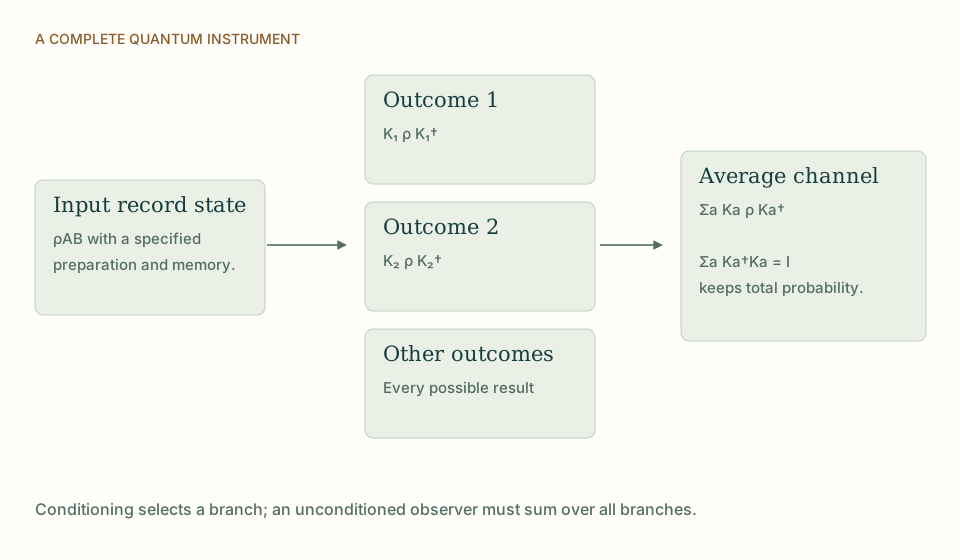
Conditioned on the plus marker, the first signal output has probability cos²(φ/2); conditioned on the minus marker, it has sin²(φ/2). Averaging the two gives 1/2 again. At φ=0, the two sorted subsets are completely different, but the unsorted earlier data remain evenly distributed. A later selection can reveal this organization only when the marker result is communicated and the records are compared. The arithmetic explains why the effect offers no channel for controllable messaging into the past. [4] [3]
Ideal orthogonal path markers and balanced recombination are assumed. Conditioning requires access to the marker outcome.
Consistent histories offers a probability framework; SMM/DTT seeks a generative account of the state, dynamics and accessible archive that make a framework physically relevant. A source model can be valuable when it derives approximate decoherence and stable record variables from the same update. The six nested roles can organize that mechanism without introducing a conscious observer as an extra dynamical ingredient.
The remaining selection issue should stay explicit. If many consistent families or source readouts remain possible, the model has not uniquely derived one completed world. It may still have established a useful class of observationally equivalent archives. A stronger result would constrain that class through physical resources, symmetry or stability and identify a measurable consequence. This makes the comparison a route to an actual record mechanism rather than a claim that the mere existence of a consistent probability family proves the Single Monad ontology. [2] [5]
THE SAME QUESTION, DIFFERENT STARTING POINTS
| Question | SMM/DTT | Consistent histories |
|---|---|---|
| Completed archive | DTT can define an archive through its accessible test language and physical records. | Consistent histories assigns probabilities within suitable history families. |
| Compatibility | A source archive need not contain context-independent values for every possible observable. | Incompatible frameworks cannot be combined as one unrestricted classical sample space. |
| Selection | A physical source law must explain stable records and any preferred family. | Formal consistency alone does not create the apparatus or select every physical condition. |
KEEP THE CONNECTION
Connects this comparison with the author’s underlying construction.
Connects this comparison with the author’s underlying construction.
Connects this comparison with the author’s underlying construction.
Connects this comparison with the author’s underlying construction.
Connects the comparison to the programme’s current statement of results and assumptions.
References support the comparator and the specific mathematical or interpretive claims indicated. SMM/DTT connections are developed in the analysis above.
How these comparisons distinguish premises, results and physical claims
SMONAD
Share this page, or keep a clear reference to the work you are reading.
Use this reference for the explanation on this page. “n.d.” means its first publication date is not specified; the update date is recorded separately.