
In this article
- The question behind this comparison
- The SMM/DTT starting point
- How the comparator works
- The decisive comparison
- Worked benchmark
- What follows for the source programme


A recorded outcome and a fully classical post-measurement state are different physical objects. Comparing DTT with relational quantum mechanics, this article uses a weak measurement to show how completion, disturbance and retained coherence fit together, then identifies what an autonomous source mechanism could explain beyond an ordinary measurement interface.
A measurement involves at least three distinguishable tasks: coupling the measured system to a pointer, selecting a readable outcome variable, and retaining a record long enough for later use. Unitary entanglement with a pointer performs the first task; it does not by itself choose one globally unique outcome. Decoherence explains the practical suppression of interference between pointer alternatives, while different interpretations disagree about what observed definiteness means.
DTT places the distinction between inner work and outer completion at the centre of the account. This is useful when completion is a concrete instrument with a success flag, a conditional output and an accessible archive. Its significance depends on the actual rule: releasing a record, conditioning on an outcome and physically destroying alternatives are different operations. Keeping them distinct makes the Single Monad idea sharper and prevents the word completion from silently supplying a solution to the measurement problem. [3] [4]
The Single Monad Model begins with one nonspatial generative source. The Duality of Time Theory distinguishes the source’s inner production from the outer order in which completed records become accessible. Its six inner levels are nested functional roles of one process: a higher role organizes lower-level work. The seventh is the completion or observation interface. They are neither six independent clocks nor six additional time coordinates.
This distinction supplies a useful research question: which features of an observed world can follow from the way a source produces, retains and releases information? A concrete answer needs a state space, an autonomous update, retained memory and a rule connecting completion to an accessible measurement. In the constructions discussed here, those mathematical ingredients are stated explicitly. A successful finite example establishes what its specified mechanism can do; further arguments connect it to physical particles, spacetime or universal laws. [1]
Relational quantum mechanics treats physical quantities and state assignments as relative to interactions between systems. An observer is any relevant physical system, not necessarily a conscious mind. What is definite relative to one system need not be represented by the same state relative to an external system that has not yet interacted with it. Communication and subsequent interactions are part of the physical account of how records are compared.
DTT’s separation of generation from accessible records can be formulated in this language when completion is indexed to a receiving system. A universal outer archive, by contrast, would add an observer-independent structure beyond Rovelli’s original proposal. Neither choice is settled merely by saying that observations occur. The useful comparison concerns exactly which system retains a record, which interactions make it accessible, and which consistency conditions connect descriptions. Relational quantum mechanics does not derive the six inner levels, while their presence alone does not decide whether completion should be universal or relational. [2]
Relational quantum mechanics makes the receiver of a measurement record part of the physical specification. A pointer can have a definite result relative to the measured system’s interaction history while another system assigns a joint superposition before interacting with it. DTT’s completion interface is compatible with this organization if it names the recipient and the correlations that make the record accessible.
A universal outer-time archive would go beyond that relational account. It would assert a common completed world underlying all receivers, so its theory must explain how local access and relativistic separation fit the universal structure. This is not resolved by using the word observation: a material memory can receive a record without a conscious subject. A simple two-receiver model is therefore valuable. One receiver reads the pointer, another later performs either a record comparison or a coherent joint operation. The allowed operations determine which predictions can be compared. DTT can add substance by deriving restrictions on those operations from source memory and completion, rather than assuming every observer has simultaneous access to one global archive. [2] [3] [4]
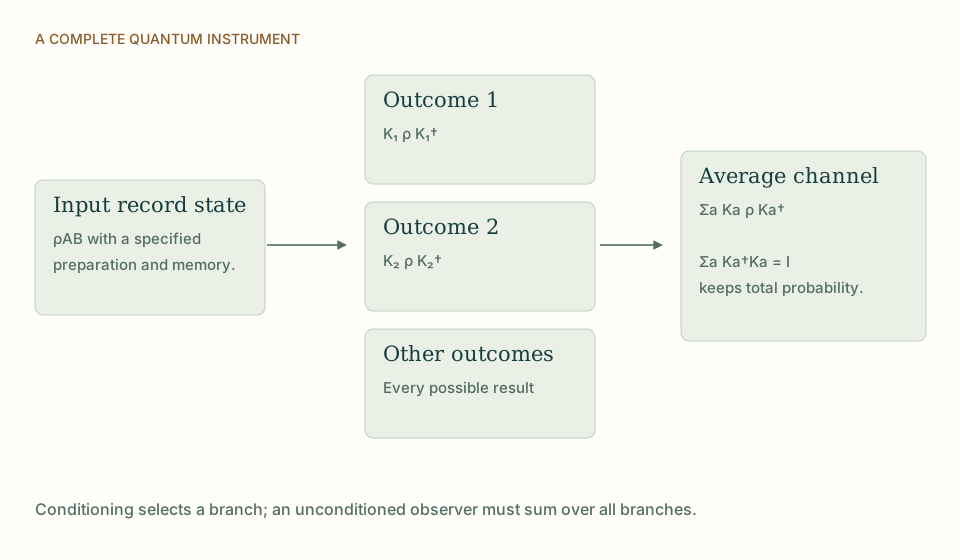
Consider a two-outcome weak Z measurement. Let M₊ be diagonal with entries √(3/4), √(1/4), and let M₋ have the two entries reversed. The operators satisfy M₊†M₊+M₋†M₋=I. For an input |+x⟩, the two outcomes each occur with probability one half. Conditional on the plus result, the normalized output is (√3|0⟩+|1⟩)/2: a definite registered outcome has occurred without a sharp projection onto a Z eigenstate.
If the outcome is ignored, the diagonal density-matrix entries remain unchanged while the off-diagonal entry is multiplied by √3/2. This distinguishes three observable facts: the record is a binary value, the retained quantum state remains coherent, and the average disturbance is calculable. An inner completion mechanism reproducing these Kraus operators must reproduce all three. Simply declaring that a completed record means total collapse would predict an unnecessarily strong disturbance and fail this elementary benchmark. [3] [4]
Finite-dimensional instrument benchmark. Operators are dimensionless; probabilities are normalized before conditioning.
A particularly valuable DTT construction is an autonomous flag that certifies when a defined operation has finished without revealing an unwanted property of the unknown input. Whether such a flag exists depends on the channel and the physical resources. The conceptual gain is to study completion as a mechanism whose accuracy and disturbance can be calculated, then ask whether that mechanism also explains record stability and the temporal ordering visible to an observer. [3] [4]
THE SAME QUESTION, DIFFERENT STARTING POINTS
| Question | SMM/DTT | relational quantum mechanics |
|---|---|---|
| Starting structure | One nonspatial source, retained memory and six nested inner functions with an outer completion interface. | Interactions among physical systems and relative state assignments. |
| Observable connection | The source update and readout must generate the measured records and their calibrated relations. | A record is a fact relative to its interacting receiver. |
| Measurement and completed records | A universal outer-time archive would go beyond that relational account. | Relational quantum mechanics makes the receiver of a measurement record part of the physical specification. |
| Status of the claim | A constructive research programme; a specified finite model establishes only its stated conditional results. | Relational interpretation does not require a privileged conscious observer. |
KEEP THE CONNECTION
Connects this comparison with the author’s underlying construction.
Connects this comparison with the author’s underlying construction.
Connects this comparison with the author’s underlying construction.
Connects this comparison with the author’s underlying construction.
Places the comparison alongside the programme’s published results, assumptions and open targets.
References support the comparator and the specific mathematical or interpretive claims indicated. SMM/DTT connections are developed in the analysis above.
How these comparisons distinguish premises, results and physical claims
SMONAD
Share this page, or keep a clear reference to the work you are reading.
Use this reference for the explanation on this page. “n.d.” means its first publication date is not specified; the update date is recorded separately.