Gravity-mediated entanglement and a functional DTT mechanism
Gravity-mediated entanglement proposals ask whether two masses can acquire a quantum correlation through their interaction. This guide derives the relevant two-body phase invariant, explains the assumptions behind a mediator witness, and identifies the source Hamiltonian and record dynamics DTT would need to make a concrete prediction.
The 2017 proposals by Bose and collaborators and by Marletto and Vedral use entanglement between controlled masses as a potential probe of the nonclassical character of their gravitational interaction. They are cited here as original theoretical proposals, not as a report that the proposed gravitational signal has been detected.
This is a useful comparison for SMM/DTT because the programme aims to generate matter, geometry and interactions from one source. A functional theory should specify how a pair of matter records acquires a joint phase and how completion preserves or reveals the resulting correlations. The question is more concrete than whether gravity is fundamentally temporal. [2][3]
02The source and its two temporal roles
The Single Monad Model begins with one nonspatial generative source. The Duality of Time Theory distinguishes the source’s inner production from the outer order in which completed records become accessible. Its six inner levels are nested functional roles of one process: a higher role organizes lower-level work. The seventh is the completion or observation interface. They are neither six independent clocks nor six additional time coordinates.
This distinction supplies a useful research question: which features of an observed world can follow from the way a source produces, retains and releases information? A concrete answer needs a state space, an autonomous update, retained memory and a rule connecting completion to an accessible measurement. In the constructions discussed here, those mathematical ingredients are stated explicitly. A successful finite example establishes what its specified mechanism can do; further arguments connect it to physical particles, spacetime or universal laws. [1]
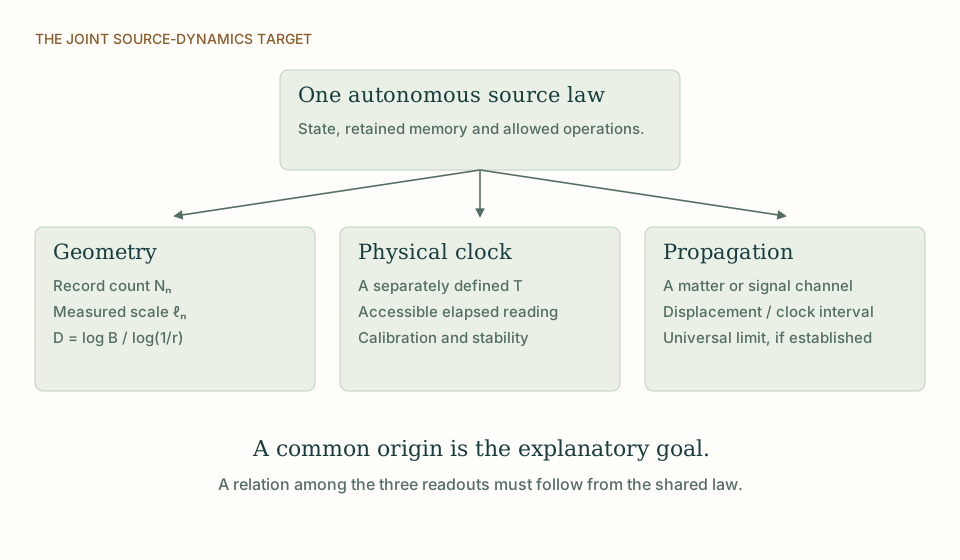
Geometry, clocks and propagation as independent readouts. A single source model should explain the relation between separately defined measurements. Sharing a diagram does not impose that relation. View full size ↗
03Worked phase invariant for two path qubits
Let each mass occupy a superposition of two locations, labelled 0 and 1. In a simplified weak-field treatment, branch ab has potential energy Vab=−Gm₁m₂/rab and phase φab=Gm₁m₂t/(ℏrab). Starting from equal path superpositions gives |ψ⟩=½Σab e^{iφab}|ab⟩.
Local phase changes can remove three independent combinations, leaving the entangling phase Δ=φ00+φ11−φ01−φ10. For this equal-amplitude pure state, the concurrence is C=|sin(Δ/2)|. If Δ=0 modulo 2π, the phases factor into local contributions and the state is unentangled. If Δ=π modulo 2π, the state is maximally entangled. A phase acquired by each mass separately is therefore insufficient; the invariant joint combination is the observable target. [2][3]
Ideal coherent path states, fixed branch separations, weak-field Newtonian potential and negligible motion during the interaction. The phase is dimensionless.
04Why an entanglement witness has assumptions
Under local mediation and suitable subsystem assumptions, a mediator restricted to classical information cannot generate entanglement between initially unentangled quantum probes by local operations and classical communication alone. Observing entanglement attributed to that mediator would therefore support nonclassical features of the mediator or interaction.
The inference depends on excluding other entangling channels and on the intended meaning of mediation. Initial correlations, electromagnetic interactions, direct nonlocal dynamics or a different subsystem decomposition can change what the observation establishes. It would not uniquely prove one full quantum-gravity theory. DTT should engage with the witness at that precise level rather than claim any correlated pair confirms a temporal origin of gravity. [3][2]
05The source Hamiltonian is the missing physical link
A DTT model could derive the joint phase by generating an effective interaction Hamiltonian for retained matter records. The same source dynamics should determine the masses, separation readout and physical duration that enter the phase, or clearly identify which are inherited calibration inputs. Choosing the Newtonian potential after constructing an unrelated source clock is a valid effective model but not a complete common-source derivation.
The six nested roles can organize the production and completion of the path records. Their mere existence does not fix G, the potential or the entangling phase. A substantive source result would remove an independent freedom, such as relating the interaction phase to a clock observable or constraining the allowed decoherence through the same retained-memory mechanism. [2][5][1]
06Completion can preserve or destroy the target
If the source publishes which-path information into an uncontrolled environment before the relevant coherent comparison, the entanglement signal can be suppressed. If it retains only a neutral completion certificate while protecting the path amplitudes, the joint phase can remain observable. The distinction is an instrument-level question about what information the record reveals.
A useful model therefore predicts both phase accumulation and noise. A visibility factor inserted independently after the calculation leaves the central source relation untested. The same dynamics should explain whether errors are correlated, whether rejected partial work can be reversed and which final measurement witnesses entanglement. These are theoretical quantities that can be calculated in a finite model without claiming an experimental result. [4][5][2]
07What would count as a strong DTT contribution
A focused paper could present one autonomous source–memory Hamiltonian, derive its low-energy two-body interaction and calculate the completed-record entanglement with all physical scales defined. Recovering the Newtonian phase in a controlled limit would be a valuable compatibility result. A further linked correction, fixed by the source law and distinguishable from ordinary environmental effects, would be its new prediction.
This comparison does not require DTT to claim that it uniquely explains every prospective witness. Its strength lies in making the theory functional: state preparation, interaction, physical timing, record release and final correlations are generated by one explicit model. The mediator proposals provide a demanding benchmark for that common mechanism while leaving the broader ontology and full gravitational completion open to mathematical and empirical assessment. [2][3][5]
THE SAME QUESTION, DIFFERENT STARTING POINTS
The comparison at a glance
Question
SMM/DTT
Quantum-gravity entanglement witnesses
Interaction
DTT must derive a joint phase through an explicit source-generated effective Hamiltonian.
The ideal Newtonian branch energies yield an entangling phase invariant Δ.
Record dynamics
Completion must preserve the relevant coherence or predict its loss from the same mechanism.
The entanglement witness depends on controlled path coherence and exclusion of other channels.
Inference
A successful source model would provide a constrained mechanism, not unique confirmation from generic entanglement.
Mediator-witness conclusions depend on locality, subsystem and interaction assumptions.
KEEP THE CONNECTION
Key ideas
DTT must derive a joint phase through an explicit source-generated effective Hamiltonian.
Completion must preserve the relevant coherence or predict its loss from the same mechanism.
The source interpretation becomes additional physics when it constrains an independently measurable process.
Connects the comparison to the programme’s current statement of results and assumptions.
Sources and further reading
References support the comparator and the specific mathematical or interpretive claims indicated. SMM/DTT connections are developed in the analysis above.