
Proper time is a path-dependent metric quantity. A source oscillator measures it only when its readable relative phase follows the same law with retained cycle count.
What you will learn
- Calculate proper time for constant-speed and piecewise constant-speed paths.
- Distinguish accumulated clock duration from received signal frequency.
- Identify the calibration and universality requirements for a DTT clock.
Before you begin: Lessons 01–07. Square roots and the meaning of speed as distance divided by time are sufficient.
Give the clock an operational reading
A clock needs a repeatable process, a rule for accumulating cycles and a calibration assigning units. A circular hand alone forgets how many turns have passed. A retained counter can distinguish a phase after one turn from the same phase after a thousand. DTT's outer record must carry enough memory for this distinction if the reading is to measure accumulated duration.
Earlier lessons separated internal update count from completed event count. A clock may couple to either, or to another combination. Its dynamics decides. Comparing two clocks requires preparing and calibrating them together, applying a declared protocol and comparing their later readings. Agreement for one preparation does not establish agreement for every allowed motion or source operation.
The relativistic benchmark
Supply flat spacetime with invariant speed c. Along a massive clock moving at speed v relative to inertial coordinates, the interval relation is c²dτ²=c²dt²−dx². Substituting dx=vdt gives dτ=dt√(1−v²/c²). The positive root represents the forward proper duration accumulated along the clock's path.
The last expression assumes constant speed for coordinate duration T. If speed changes, calculate the integral along the full path or add the contributions of constant-speed segments. Here the metric is an input. Recovering this clock law from a source construction is a substantive additional result, not a consequence of having an internal phase.
Worked example: two bars on one scale
Use the proper-time demonstration with T=10 and β=0.6. The rate factor is √(1−0.36)=0.8, the Lorentz factor is 1.25, and the moving clock accumulates 10×0.8=8 time units. Both bars use the same units, so their difference is two.
At β=0, the factor is one and both readings agree. At a larger subluminal speed, the moving clock accumulates less proper duration over the same coordinate interval. These statements compare ideal clock readings through an inertial timing procedure. They do not directly state the frequency seen in incoming light pulses, which also depends on signal propagation and Doppler effects. Those effects require their own exchange calculation.
Compare clocks where they meet again
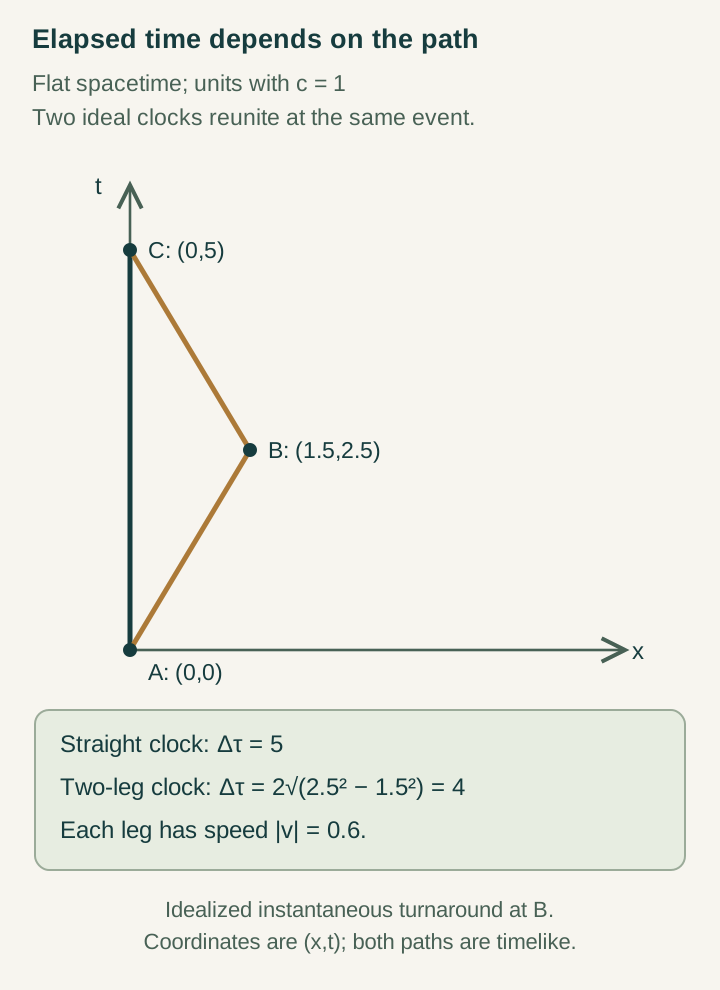
A reunion makes comparison local. In units c=1, let one clock remain at x=0 for five coordinate-time units. Let another move outward at speed 0.6 for 2.5 units and return at the same speed for 2.5. Its turning point is x=1.5. In the ideal limit of a negligible turnaround duration, the traveller accumulates 2.5×0.8+2.5×0.8=4.
The stationary clock accumulates five. The difference follows from integrating along the two paths. A finite turnaround must be included using its actual speed profile; no separate mysterious ageing penalty is assigned to acceleration. The following figure displays this exact piecewise-inertial benchmark under the stated idealization.
Open the full-size diagram →
How a relative phase can measure duration
Suppose a stable transition has rest angular frequency ω0 and obeys dφ=ω0dτ. Its unwrapped phase then gives τ=(φ−φ0)/ω0. This is a clock realization once the coupling law and readout are established. An arbitrary oscillator could instead follow coordinate time or some internal work count, so recurrence alone does not choose the proper-time response.
A global phase multiplying one isolated state is not a directly readable hand. A clock uses a relative phase between states or paths and an apparatus that can compare it. This connects Lesson 06's phase carrier with Lesson 07's instrument and the earlier requirement for memory: phase coherence, cycle count and measurement all enter a usable clock.
The common-source target
A successful SMM/DTT construction would explain why different stable material clocks, after calibration, measure the same proper-time functional in their ideal regimes. It would connect their response to the metric used by rulers and signals. A protected logical clock that ignores one selected class of inner operations is useful but does not alone prove this universal relativistic response.
Keep the six inner roles as nested dependencies, not extra durations added to τ. The seventh role makes the accumulated clock record available. The proper-time guide extends the benchmark to gravitational lapse and matter phase. The clock-selection comparison asks which source restrictions exclude alternative clock couplings across multiple preparations.
Try the exercises
Work through each question, then open the answer to compare the steps.
Exercise 1
A clock moves at speed 0.8c for twelve coordinate-time units. Find its Lorentz factor, proper duration and difference from a stationary clock over that interval.
Show the worked answer
The rate factor is √(1−0.8²)=√0.36=0.6. Thus γ=1/0.6=5/3 and Δτ=12×0.6=7.2. A stationary ideal clock accumulates twelve, so the assigned duration difference is 12−7.2=4.8 units. Directly received pulse rates need not show this factor without accounting for propagation.
Exercise 2
A path consists of three coordinate-time units at rest, then five units at speed 0.6c. Calculate its total proper time and the phase count for a clock making two cycles per unit proper time.
Show the worked answer
The rest segment contributes three and the moving segment contributes 5√(1−0.36)=4. Total proper time is seven. At two cycles per proper-time unit the unwrapped phase count is fourteen cycles, or 28π radians. A circular display would return to its initial angle, so a retained cycle counter is required to recover the elapsed seven units.
Continue with the articles
- When an additive clock is unique
An ordered rank-one return structure permits a faithful additive scalar clock only up to positive rescaling. Independent return directions and path-dependent delays show where that uniqueness stops.
- A protected material clock
An encoded two-qubit clock can ignore branch activity while responding to resolution. A controlled coupling mismatch produces a calculable failure, making both the protection and its assumptions testable.
- Why one clock model does not prove universality
Protected and ungated clocks can coexist with the same record geometry while assigning different readings to it. This countermodel shows why constructing one desired clock does not establish a universal material-clock law.
- Calibrating a conformal geometry
Causal order fixes a conformal class of metrics; an independently calibrated record density fixes the local scale. A reproducible clock then sets any remaining overall unit, provided the source supports the required protocol agreement.