


The answer in brief
A generative level is a dependent role in one process. Its significance lies in the operations it enables and the information it retains; six nested roles require an explicit interface before they become a physical readout.
Go to the research challengeA level is a dependency in the generative process
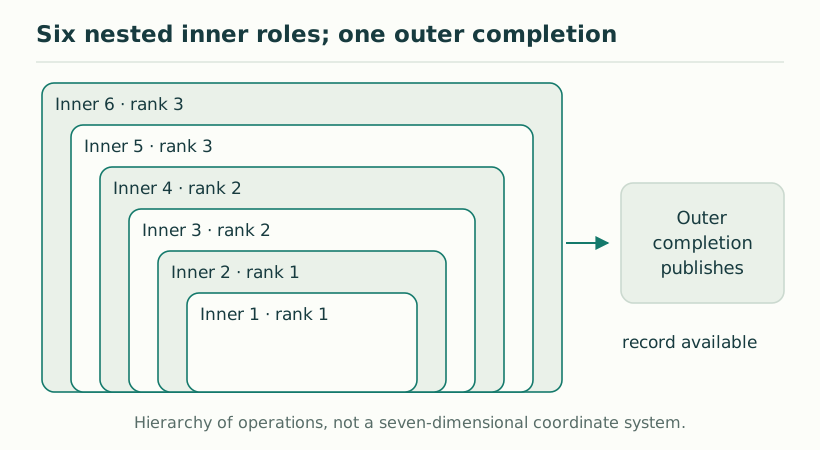
The six inner levels of DTT describe nested work: a higher role depends on what lower roles have completed and retained. The seventh role makes a completed result available to outer observation. A level is therefore specified by its inputs, permitted operations, stored result and completion condition. Its label alone does not identify a separate physical clock, a spatial axis or an additional observer.
This interpretation makes the proposal mathematically usable. A source state can contain several registers while evolving under one autonomous update. Some transitions are enabled only when lower registers reach specified states. An observer may read only completed records. The internal dependencies and the observer’s sequence of available records then describe different aspects of the same process. The task is to show what those dependencies force the completed world to retain.
To define a proposed level, ask what becomes possible when its lower work is complete, what it must remember and what may reset. If these answers are identical for two alleged levels, their distinction may be representational. If a higher role can advance without the lower result, the claimed nesting is absent from that realization.
An exact six-digit example
Consider six binary digits d₁,…,d₆, initially zero. A source update adds one to the six-bit integer, taking d₁ as least significant. Digit d₁ changes every update; d₂ changes when a carry passes from d₁; d₃ changes only when a carry passes through the two lower digits. The same dependency continues upward. There are sixty-four addresses before the initial address returns.
The lower three digits run through 000, 100, 010, 110, 001, 101, 011 and 111 when written in the order d₁,d₂,d₃. The fourth digit changes only after that entire lower cycle. These are not six simultaneous free choices. One successor function determines the complete carry structure. Replacing the update by six independently controlled flips creates a different process even if its state labels look similar.
A completion flag could be set after the source has processed a declared six-digit cycle. The flag must specify which data have been retained and whether their write is complete. It does not automatically imply that an observer has measured a sixty-four-unit duration. The physical time spent on carries, reset and registration is a separate property of the realization.
The same nesting admits different readouts
Keep the six-digit update fixed. Detector A reports only d₁ and therefore distinguishes two present labels. Detector B reports the full address and distinguishes sixty-four. Detector C reports (d₁−d₂,d₃−d₄,d₅−d₆), giving twenty-seven displayed positions of affine rank three. All three observe the same internal dependency structure through different maps.
This example pinpoints the role of the readout law. The nested update supplies ordered histories and possible completion events. The paired difference map supplies a particular relation between those histories and three components. A detector observing just one component does not acquire three spatial directions because five additional hidden levels are present. Accessible tests and the physical coupling to the detector are necessary parts of the model.
The paired-rank discussion proves a useful exact theorem once the paired map is supplied. The next question is whether one source interaction selects that map and maintains its conditioning. Treating nesting and readout as separately inspectable ingredients makes it possible to discover a law that connects them.
A real dependency changes the allowed intervention
A useful test distinguishes nested generation from a diagram divided into six boxes. Interrupt a lower role before completion. If the proposed higher output remains available with exactly the same validity, the lower result was not necessary for that output. If the higher role blocks, changes or produces a declared failure record, the model has an operational dependency that a reader can inspect.
For a simple example, let level one write a data bit, level two calculate its parity with a retained bit, and level three certify that the parity and data belong to the same episode. Removing the episode label can make an old parity appear valid for new data. The certificate then has a concrete function: it prevents two individually plausible values from being mistaken for one completed record.
Similar checks apply to larger constructions. A dependency should constrain permitted updates, not only annotate their order after they occur. Deliberate interruption is a mathematical intervention used to test the claim; a fundamental autonomous source need not contain an external agent performing it. The intervention language describes which hypothetical variations the model is supposed to answer.
Resetting a level must preserve the right information
Lower registers often reset when a higher level advances. The model must identify where their useful information goes. In a classical counter, the carry records that an entire lower cycle occurred while the lower digits return to zero. If a later observation needs the detailed lower history, a carry alone is insufficient. That history must be stored elsewhere or declared inaccessible.
The physical reset mechanism matters as well. A reversible source can transfer information to other registers instead of deleting it. An effective dissipative description can discard information into an environment that remains part of the larger physical account. No generic reset operation should be assigned zero duration, zero memory and zero back reaction without an explicit idealization.
Nested work is particularly useful when it compresses information relevant to the next role. A lower register can summarize many histories by a conserved charge or a completion condition, provided that summary is sufficient for all later allowed tests. The predictive-record criterion gives a precise way to check that sufficiency.
Make each level earn its place
A strong finite realization should publish a transition table and one line of operational meaning for every register. For each of the six roles, identify an output that cannot be validly produced without its lower completion. Then remove or merge one role while keeping the permitted preparation and readout tasks fixed. The resulting failure, or the success of the simplification, reveals whether that level has indispensable work to do.
This challenge leaves room for a positive selection theorem. Perhaps six nested roles are minimal for a specified bilateral preparation, comparison and retention task. That theorem would require a stated class of permissible implementations and a lower-bound argument across the class. It would say more than one successful six-stage construction, while remaining narrower and more informative than an unqualified claim that any physical world must have six internal levels.
The role of outer completion should be tested in the same way. It must distinguish available records from unfinished work and connect them consistently across episodes. Once these requirements are explicit, physics, mathematics and philosophy can address the same object: a single process whose internal dependencies generate an observable history.
Develop the argument
Questions to take further
- What fails if a lower role is interrupted before completion?
- Can two proposed levels be merged without changing any permitted observation?
A concrete next step
Audit six nested roles
Specify one autonomous finite update, retained registers and a completion flag; test removal or merger of each role.
What to share
A dependency table, transition diagram and six concrete interruption or simplification tests.
I welcome collaboration with experts in physics, mathematics and philosophy. Get in touch with a question or proposal.