
The paired architecture gives three readout directions exactly. Selecting that architecture, stabilizing its detectors and deriving spatial distance are distinct parts of the dimensional-emergence problem.
What the six roles actually count
In the DTT construction, each inner role depends on work completed at lower levels. A higher counter digit advances only after lower digits complete their cycles. The seventh role exposes a completed result. These are functional dependencies within one generative process, rather than six independently readable time axes or six spatial shells.
Dimension can mean several different things: the number of independent readout components, the growth of nearby records with scale, a spectral exponent or the number of tangent directions in a smooth limit. The paired construction first answers a rank question. Asking that question precisely gives an exact result and exposes which extra measurements are needed before the rank can be identified with physical spatial dimension.
The exact paired-rank argument
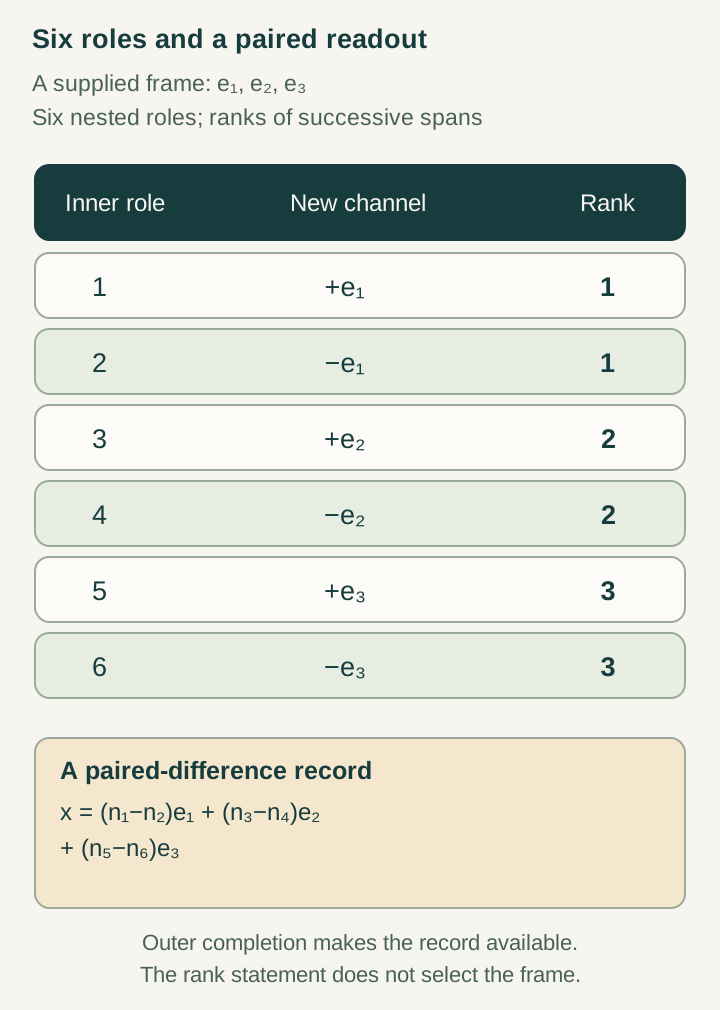
Choose a radix q≥2, six digits d₁,…,d₆ and three independent vectors e₁,e₂,e₃. One update increments the six-digit address, with the first digit least significant. Supply a positive scale ℓ and the readout below.
Start at the zero address and examine the first qᵃ states. Exactly the first a digits vary. Their readout columns span at most ceiling(a/2) directions. Conversely, the zero address and a single one in each available odd digit produce zero and the independent vectors ℓe₁, ℓe₂, ℓe₃ as they become available. This proves the matching lower bound. The successive affine ranks are therefore 1,1,2,2,3,3. Initialization, pairing and the independent frame are inputs to the proof.
Open the full-size diagram →
When six primitive channels really are minimal
A more general theorem explains why the pairing matters. Let P exchange primitive channels in opposite pairs, and let a linear readout C obey CP=−C. Decompose any channel state into P-even and P-odd parts. The even part is annihilated because Cx=−Cx there. Every output therefore comes from the odd subspace.
Each exchanged pair contributes one odd direction; a fixed channel contributes none. If there are p pairs, rank C≤p. A rank-three output needs at least three pairs, hence six primitive channels. This is a genuine minimality result within the declared architecture. Turning it into a minimum number of inner levels additionally requires one primitive channel per level. A source selection theorem must justify that organization rather than treating the correspondence as a consequence of linear algebra.
Do alternatives invalidate the proposal?
Three initially signed coordinates already span three dimensions and do not satisfy the primitive opposite-pair convention. Another instructive alternative uses four nonnegative tetrahedral generators: (1,1,1), (1,−1,−1), (−1,1,−1) and (−1,−1,1). They span three dimensions and sum to zero. Thus the negative of any one is the sum of the other three, although none has an individual opposite partner.
This countermodel does not invalidate the paired theorem; it prevents an unrestricted inference from rank three to six generators. It sharpens the physical question. Do the admitted source operations select bilateral exchange partners, or do they allow tetrahedral combinations? An operational reason for the first choice would carry explanatory weight. Simply redrawing the same rank-three space with six arrows would not supply that reason.
A second route through quaternionic readout
The algebraic reconstruction starts from different inputs: a finite-dimensional real associative unital carrier, a positive multiplicative quadratic norm and noncommuting circular phases. Under those hypotheses the quaternionic carrier is selected. Removing scalar information gives the linear quotient ℍ/ℝ1, which is the three-dimensional imaginary sector.
For q=2+3i−4j+12k, the retained vector is (3,−4,12), with norm thirteen. Adding five to the scalar component changes the carrier while leaving this readout unchanged. Complete directional tests must actually distinguish all three components; one detector sensitive only to the first component does not do so. Agreement between the quaternionic rank and the nested paired rank is promising, but identifying their composition law and detector interface in one source is the theorem that would connect them.
What rank leaves for geometry and observation
The binary paired model has 64 internal addresses and 27 displayed sites. Under uniform address sampling, the centre receives eight addresses and a corner one. Their probabilities are 1/8 and 1/64, despite equally spaced displayed coordinates. A spatial measure is therefore another observable, not a consequence of rank.
Likewise, a frame does not fix physical distance until a metric and scale are selected. A graph of allowed transitions can supply adjacency, but matter transport must respect it. A detector with three independent components can become practically useless if two directions nearly align and noise amplification grows. Stable dimension requires conditioning bounds and persistent neighborhoods, followed by a controlled comparison between geometric, spectral and propagation probes across refinements.
What would strengthen the three-dimensional claim?
A useful source theorem would derive the primitive operation class, the opposite pairing and accessible detector family, then show why competing architectures cannot satisfy the same physical requirements. It should retain predictive memory: in the binary counter, addresses zero and three have the same spatial output but successors in different directions. The displayed site alone is not a complete elementary state.
The immediate positive result is exact: nested dependencies can generate a rank-three paired readout, with a restricted six-channel lower bound. The next programme is equally concrete: derive the architecture, control its stability and connect its output to independently measured locality and clocks. This preserves the explanatory ambition of DTT while making the claimed dimensional selection a sequence of inspectable mathematical and physical results.
Continue with the articles
- Why quaternions appear in the reconstruction
Positive multiplicative norm, finite dimension, associativity, and two noncommuting circular phases select a quaternionic carrier. The algebraic conclusion is rigorous within those hypotheses, whose physical selection remains open.
- The center-blind route to three dimensions
Removing the scalar center of a quaternionic carrier leaves a three-dimensional readout space. Accessible rotations or a suitable finite acquisition protocol are needed to ensure that detectors actually recover all three directions.
- Six inner stages and one publication interface
A six-digit nested counter with paired signed readout realizes ranks 1, 1, 2, 2, 3, 3 before one completion interface. Its exact counts reveal sampling bias and the restricted assumptions behind the six-channel bound.
- Generating a neighborhood and preserving local transport
A generated graph predicts local influence only when later operations respect its edges and retained ports. Guarded transport supplies a finite-update support bound while exposing runtime and controller-memory requirements.
- What spatial readout forgets
Different inner states can share one spatial readout and still have different successors. A concrete counterexample and a kernel-preservation criterion identify the memory needed for autonomous completed evolution.
- Why a bare source does not imply spacetime
A structureless source cannot select a nonzero metric, an oriented vector or a proper causal cone while preserving every change of representation. Recurrence, composition and observable readout supply the additional structure needed for an SMM/DTT reconstruction.
- One clock direction plus three readout directions
A rank-one duration space and a rank-three quaternionic readout combine into four record directions under stated clock and detector assumptions. A separate soldering map connects those internal directions to a smooth spacetime manifold.