


The answer in brief
Outer completion orders available records. A physical duration emerges only after a readable material clock and its coupling are specified; a common source can support clocks with different responses.
Go to the research challengeA completed sequence orders events; a clock measures duration
Outer time in DTT concerns the availability and ordering of completed records. A physical clock is an actual system with a readable state whose response can be compared across processes. The two notions can be connected, but they answer different questions. Numbering records 1,2,3 establishes succession. It does not establish equal elapsed durations between adjacent records.
Imagine a source whose first accepted record requires one attempt and whose next record requires five. The completed sequence contains two events either way. A material clock that runs throughout the attempts can report different waiting intervals. A clock coupled only to a successful registration can instead advance once per accepted event. Both are legitimate finite models; their physical couplings determine which temporal feature each reads.
The useful DTT question is therefore constructive: what clock apparatus is built from the same source, what drives it, and what makes its calibration stable? The time section distinguishes generation, completion and clock response. A successful relation among them must survive independent measurement of its terms.
Two clocks can read the same source differently
Let an episode contain a branch activity u and a resolution activity τ. A protected clock C advances only during resolution, giving C=τ. An ungated clock A advances during both activities, giving A=u+τ. For u=3 and τ=1 in calibrated units, the two readings are one and four. Nothing about the shared source alone makes one apparatus disappear.
If a matter degree of freedom evolves by exp(−iuH/ℏ), its evolution per protected clock unit has coefficient u/C=3. Per ungated clock unit, the coefficient is u/A=3/4. The matter evolution itself has not changed. The conversion to a clock reading has changed because the two apparatuses accumulate different source activity.
One can choose a preferred clock class for a defined effective theory. The stronger universality claim must explain why physically available material clocks belong to that class, or how other devices are recognized as measuring a different observable. Calling every unwanted apparatus a defective clock after examining its answer would make the claim untestable.
What an additive clock law does establish
Suppose elapsed readings form a function T on completed episodes and concatenation obeys T(ab)=T(a)+T(b). This gives a useful consistency condition: joining two measured intervals adds their durations. It does not by itself select a unique clock. If T works, λT also works for any positive λ, representing a different unit. If independent additive activities u and τ exist, positive combinations au+bτ may also satisfy additivity.
For a source with only one independent additive activity, every admissible linear reading may be proportional to it. A uniqueness theorem then has substantive content: the space of admitted additive readings is one-dimensional. Its premises include which episodes may compose, which loops have zero reading and which regularity or positivity conditions are required. The additive-clock article develops this distinction.
A chosen unit converts proportionality into a numerical comparison. This calibration should be fixed before comparing different source preparations. If the scale is independently adjusted in every setting, a putative universal relation can be imposed by calibration. The experiment or mathematical model should identify one reference procedure and hold it fixed throughout the comparison.
Protection is a statement about accessible observables
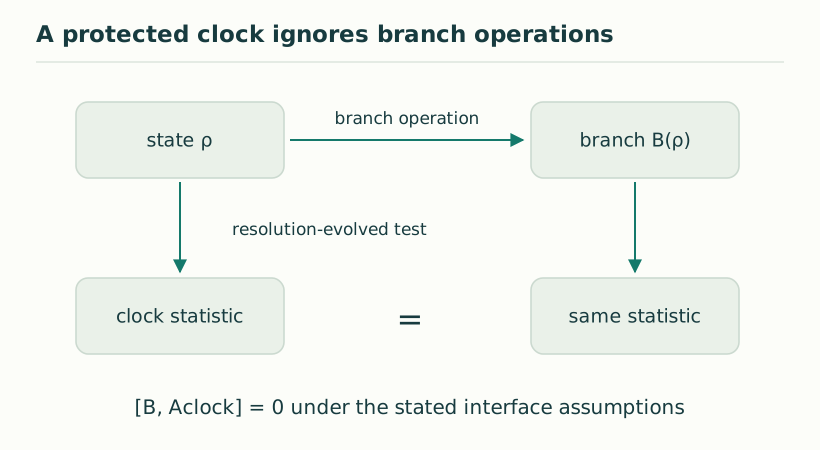
In a finite quantum example, let branch dynamics be generated by Hᵦ and let C be the measured clock observable. If [Hᵦ,C]=0, branch evolution alone does not change the expectation of C in any initial state. More generally, if resolution dynamics changes which clock tests are later performed, the branch generator must commute with the relevant resolution-evolved observable family. Commuting with a single initial pointer need not protect every later clock statistic.
A two-qubit example is transparent. Branch operations act on the first qubit, while a pointer Z on the second is read as the clock. Product operations on the first factor commute with that pointer. Add an interaction that conditionally flips the second qubit when the first is one, and the protection can fail. The extra interaction must be excluded by a physical restriction or included in the calculated error.
This test connects temporal terminology to an actual apparatus. It also suggests useful intermediate results: classify a protected observable algebra, bound its sensitivity to small unwanted couplings, and examine whether a clock prepared from the source remains inside the protected sector.
A readable clock has finite resolution and a memory window
A clock with four distinct pointer states cannot give an unambiguous reading of every integer time without extra memory. If its pointer cycles 0,1,2,3,0, the first and fifth displayed states agree. A cycle counter extends the readable range, but the counter is an additional physical register. A model should state the interval over which the clock is unambiguous and its ability to distinguish nearby durations.
Completion noise creates another issue. A flag may announce that a write has finished while the exact finishing time remains uncertain within a finite window. The resulting clock comparison should report a probability distribution or an error interval. Replacing every successful event by a precisely timed tick can discard the duration uncertainty that an independent apparatus would observe.
These finite features are opportunities for analysis. A clock model can be judged by accuracy, range, retention and coupling sensitivity without assuming an ideal unlimited time coordinate. The source should supply the material resources needed for those properties.
Derive the preferred clock class from the source
The next research target is a family of source preparations with at least two independently variable activities and several clock designs. Fix their coupling law and calibration, then determine which readings remain proportional across the family. A counterexample should be retained as evidence about the missing restriction. If the source excludes that counterexample through a common interaction or conservation law, state exactly how.
The desired result could be approximate: all admissible clocks agree within an error bounded by a specified coupling parameter and observation window. That would be more physically informative than exact agreement imposed by the definition of a tick. The same analysis can then compare matter evolution and propagation against the protected reading.
Outer completion supplies a natural place to register the result, while a material clock supplies its duration. Demonstrating why these two roles cooperate under one law is the substantive goal. It gives collaborators a sharply defined problem linking quantum dynamics, measurement theory and the philosophy of temporal order.
Develop the argument
Questions to take further
- Which interaction excludes an ungated clock with reading u+τ?
- Can the admitted clock observables be shown to form one protected calibration class?
A concrete next step
Compare clocks without retuning
Fix one source law and vary branch and resolution activities independently while retaining the same clock couplings and calibration.
What to share
A response table, a protection proof or error bound, and every surviving counterexample to universality.
I welcome collaboration with experts in physics, mathematics and philosophy. Get in touch with a question or proposal.