


The answer in brief
Renewal can preserve identity through lawful transport, retained correlations and stable responses. A physical model must show which information survives and how the claimed persistence behaves under disturbance.
Go to the research challengePersistence is a relation between successive records
The SMM/DTT idea of renewed generation asks how a world recreated through successive completions can contain persistent things. The strongest answer treats persistence as a lawful connection among records: a charge is transported, a pattern responds consistently, or a stable excitation survives bounded disturbance. It does not require every microscopic register to remain unchanged.
A model must specify what counts as the same object across two records. Similar appearance is insufficient if unrelated processes can reproduce the same image. A transport rule, conserved quantity or intervention response supplies a stronger criterion. The renewal and persistence guide separates these forms of continuity and connects them to retained history.
This operational account does not settle every philosophical question of numerical identity. It identifies what a physical reconstruction can establish: repeatable relations between preparations, later observations and allowed changes. A metaphysical interpretation can then address the significance of those relations without replacing their dynamical analysis.
An exact moving pattern on a finite ring
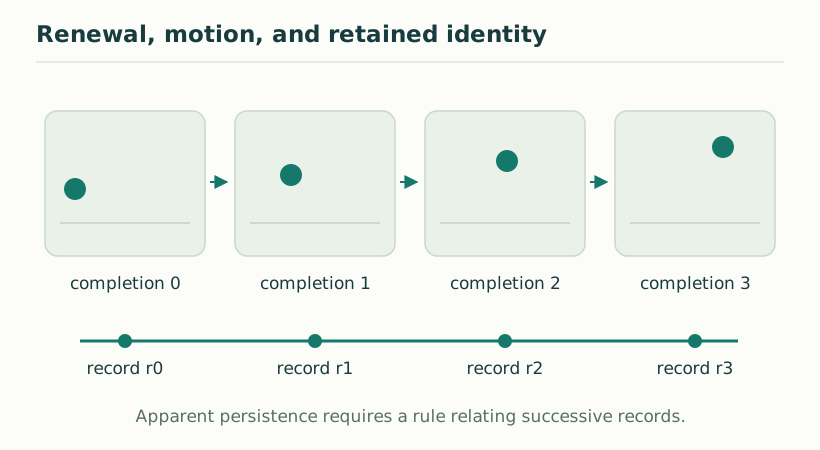
Take a ring of five binary registers, initially x=(1,0,0,0,0). Define U as a cyclic shift by one position. After one step the state is (0,1,0,0,0); after five steps it returns to the initial state. No fixed register remains occupied throughout the motion. Nevertheless the total occupation Q=Σxᵢ is one at every step, and the transport rule identifies a continuous sequence of occupied locations.
The proof of conservation is immediate: a permutation of the entries leaves their sum unchanged. To test identity more strongly, add a label a to the occupied excitation and transport the pair (occupation,a). A detector that reads the label at successive positions can verify the correspondence. The additional label and its storage cost are explicit inputs.
This construction realizes persistence through change. It does not yet realize a bound particle, a mass or resistance to noise. A shift merely transports every admitted pattern. Those stronger physical properties require an interaction that stabilizes selected configurations and a response law under perturbation.
Stability requires a response to errors
For a simple classical memory, encode zero as 000 and one as 111. A majority decoder recovers the original value after any single bit flip. If three independent bits flip with probability p during one storage interval, the decoded value is wrong when two or three flips occur. The failure probability is 3p²(1−p)+p³=3p²−2p³.
At p=0.01 this gives 0.000298, compared with 0.01 for a single unprotected bit. The improvement has an explicit mechanism and cost: three registers, independent error assumptions, a decoder and a defined interval. Correlated flips of all three bits defeat the same protection. The example shows why a source model should state which disturbances its persistent records withstand.
If the model repeats repair, it must account for the repair apparatus and the information it acquires. A record does not become stable merely because a completion label is attached to it. The stable-label article provides a route into the corresponding record dynamics. A lifetime estimate can be finite and conditional while still being a useful quantitative result.
Quantum renewal should use transfer, not unrestricted copying
Classical label copying cannot be extended to arbitrary unknown quantum states. If a unitary copied both |0⟩ and |1⟩ into a blank register, linearity would send (|0⟩+|1⟩)|0⟩/√2 to (|00⟩+|11⟩)/√2. That differs from two independent copies of |+⟩, whose joint state contains all four basis terms. The general copying assumption therefore fails.
This is the no-cloning limitation established by Wootters and Zurek, A single quantum cannot be cloned. A renewal construction need not demand cloning. A SWAP operation transfers an unknown state from an old register into a new one while moving the old blank state back. It preserves the state’s correlations with an external reference under the declared unitary evolution.
The physical questions then concern how transfer is implemented, how long it takes and which correlations survive. A succession of transfer operations can realize continuity across changing carriers. Claiming that a source independently recreates a quantum state from a classical description would require access and preparation assumptions that are absent from simple transport.
A conserved label alone does not identify one history
Return to the five-site ring. Two distinct trajectories can each carry occupation one. A source that moves right and a source that moves left conserve the same Q. Measuring only the conserved total cannot distinguish their histories. Position-sensitive interventions or additional transported labels are needed to reconstruct the path.
Conversely, an exact sequence of positions can be replayed from a stored script while lacking any dynamic response to a new disturbance. If an observer blocks one route, a genuine transport law predicts an altered successor, scattering or failure. A replay that continues unchanged does not implement the same object dynamics. This distinction helps separate an animation of persistence from a mechanism for persistence.
In a more complete theory, several records can cooperate: charge tracks a sector, correlations connect the object to previous interactions, and local responses determine transport. No single diagnostic needs to answer every identity question. Their consistency should follow from the same update rather than from independent retellings of a desired history.
Test continuity under a controlled interruption
A useful collaboration project is a finite renewal model with a transport register, a completion certificate and one explicit repair rule. Compare normal evolution with an interrupted write, a missing transport step and a corrupted certificate. State in advance which later tests should still identify the object and when the identity assignment must be rejected.
The deliverable should include conserved quantities, retention error and a bound on the duration for which the approximation remains valid. In the quantum version, include a reference system so that preserving a local density matrix cannot conceal lost correlations. The task is to retain a declared operational identity through the same autonomous dynamics that generates successive records.
This gives renewal a positive, testable role. Re-creation can describe the ongoing work by which a persistent world is maintained, provided the theory supplies its transport and memory laws. The remaining philosophical question concerns what kind of continuity those laws explain, and how that explanation relates to the Single Monad interpretation.
Develop the argument
Questions to take further
- Which interventions distinguish a transported object from a replayed sequence of labels?
- Can the renewal operation preserve correlations with a retained reference?
A concrete next step
Build and interrupt a renewal model
Choose a finite transport law, an identity test and a bounded error model; include the memory and completion mechanism.
What to share
Conservation proofs, a retention or lifetime estimate, and outcomes for interrupted writes and corrupted records.
I welcome collaboration with experts in physics, mathematics and philosophy. Get in touch with a question or proposal.