


The answer in brief
A physical observer can be defined through its preparation, interaction and retained record. Conscious experience raises further questions, but it is not required by the finite record mechanisms described here.
Go to the research challengeAn operational observer is a physical role
In a mathematical model of observation, an observer can be a detector, a memory register or an apparatus that distinguishes preparations and retains a readable result. This definition specifies a physical task. It does not assume that the device has experience, understands the result or can describe it in language.
The distinction is useful for SMM/DTT because outer completion concerns available records. A record may become stable before any person examines it. To claim that conscious awareness is necessary for the physical completion would require an additional law defining awareness and changing the model’s predictions accordingly. That law is not supplied by the existence of inner generation or a completion flag.
Questions about lived time and consciousness remain significant. They concern why experiences have their character, how memory contributes to awareness and how subjective duration relates to apparatus readings. The observer and record guide makes room for these questions while keeping the measurement task explicit.
A detector can make a record without interpretation
Let a source bit S interact with a blank detector bit D=0 through the reversible map (S,D)↦(S,D XOR S). If S=0 the detector remains zero; if S=1 it becomes one. Reading D now distinguishes the two source preparations. A second blank register E can be coupled in the same way, yielding two records of the same classical label.
No psychological variable occurs in the transition rule. The reliability claim is limited but exact: for the two declared input labels and ideal operations, both detectors agree with S. If one detector is disturbed before reading, its error must be modeled. If the source is permitted additional states, the detector’s ability to distinguish them must be checked separately.
A completion certificate could indicate that the interaction and write have finished. It would not explain what the registered bit means to a later reader. Meaning can involve a calibration dictionary, a scientific model and a conscious interpretation, while the physical correlation already has a precise operational description.
Quantum correlation is a different step from selecting an outcome
Apply the same controlled interaction to a quantum input a|0⟩+b|1⟩ with a blank detector. Linearity gives a|0⟩|0⟩+b|1⟩|1⟩. The detector is correlated with the source. The unitary calculation alone does not replace the joint state by one selected product term.
If an environment becomes correlated with orthogonal labels |e₀⟩ and |e₁⟩, the joint state becomes a|00e₀⟩+b|11e₁⟩. Tracing out that environment removes the cross terms because ⟨e₀|e₁⟩=0. The retained system-detector density matrix is then diagonal in those two correlated branches. This is a calculation inside the stated quantum framework, with the environment and tracing operation explicitly identified.
The calculation distinguishes formation of correlations, suppression of interference in a reduced description and the rule for individual registered outcomes. It does not derive the Born rule or establish a unique interpretation of quantum theory. A DTT completion mechanism should specify which of these tasks it performs and how it handles every allowed input.
Experienced time calls for a different explanatory bridge
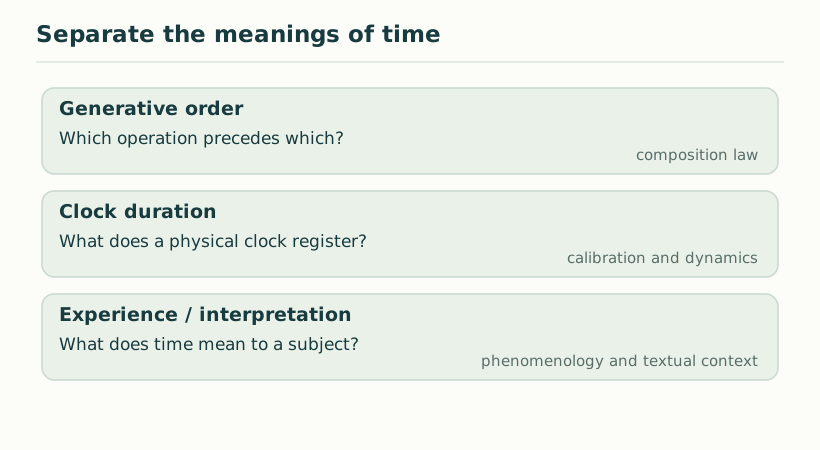
A person can remember an interval as long or short while an apparatus gives a fixed duration. Such statements concern different observables: the apparatus record, the person’s report and the conditions under which the report was formed. A theory relating them would need a model of memory, attention and report, together with a way to test its predictions.
The DTT distinction between inner generation and outer availability may inspire an interpretation of the relation between unfolding activity and remembered events. Inspiration is a useful beginning, but it should not silently turn an operational completion variable into a measure of consciousness. Two quantities with similar descriptive roles may have different states, transformations and evidence.
The introductory discussion of time in philosophy and science provides a route into the broader questions. A carefully stated dialogue can compare these perspectives while preserving the distinct work required by physics and the philosophy of mind.
Agreement among observers needs common calibration
Two detectors may produce different symbols while recording the same source distinction. Detector A displays 0 for preparation s₀ and 1 for s₁. Detector B displays red for s₀ and blue for s₁. A calibration table identifies the correspondence. The physical content is the stable relation between preparations and results, not the visual similarity of the displays.
Agreement can fail if the calibration changes unnoticed or if one detector responds to a hidden variable that the other ignores. This is why an observer model needs its permitted preparations and tests. Shared consciousness is not required to calculate the disagreement; shared access to a sufficiently stable calibration procedure is the operational condition.
For SMM/DTT, multiple observers should recover compatible completed relations even if their internal encodings differ. The theory should specify which records can be compared, how comparison is performed and what happens when observers retain different amounts of history.
Build observation before adding a theory of experience
A productive first task uses two finite apparatuses and one source. Specify their couplings, completion flags, readout alphabets and error channels. Prove the conditions under which their calibrated records agree, then construct a disturbance that makes them disagree. Include the environment or discarded registers whenever they carry relevant information.
A separate philosophical contribution can analyze what this physical model explains about observation and what it leaves for an account of experience. That analysis can be rigorous without asserting that a detector feels anything or that awareness changes a quantum outcome. If a new consciousness-dependent physical law is proposed, it should define a discriminating prediction and explain how the relevant variable is measured.
This division creates a useful meeting point for physics, mathematics and philosophy. The physical model supplies inspectable records and transitions; the philosophical inquiry clarifies their relation to knowledge and experience. Both can contribute to understanding outer-time observation without making one an undefined substitute for the other.
Develop the argument
Questions to take further
- When do two differently encoded detector records represent the same observation?
- What additional law would a consciousness-dependent completion proposal need to specify?
A concrete next step
Compare two operational observers
Couple two finite detectors to one source with declared calibrations and error channels; include their completion flags.
What to share
A proof of agreement, a controlled disagreement example and an explicit account of what the model leaves about experience.
I welcome collaboration with experts in physics, mathematics and philosophy. Get in touch with a question or proposal.