


The answer in brief
Metaphysical ideas can guide and constrain model building. The physical bridge becomes substantive when explicit source restrictions force measurable relations and exclude otherwise compatible alternatives.
Go to the research challengeThe bridge begins with a precise question
The Single Monad Model connects a metaphysical proposal about unity with an ambition to reconstruct physical multiplicity. These are related questions with different forms of answer. A metaphysical account asks what kind of reality is fundamental and how dependence should be understood. A physical model specifies states, operations and measurable consequences.
The bridge becomes productive when a philosophical commitment restricts a mathematical construction. A commitment to one generative origin might motivate a common update rather than independently chosen laws for positions, clocks and matter. The scientific value then lies in the restrictions that this common update imposes. A unifying interpretation can guide the search, while a derived relation shows what the selected model actually explains.
The models and reality guide explores this relation. It is possible to take the metaphysical motivation seriously while requiring every proposed physical consequence to pass through explicit definitions and tests.
Three maps make the connection inspectable
A useful reconstruction names three maps. First, an interpretation map connects a concept such as generative unity to a class of mathematical source models. Second, a readout map turns each source history into retained records. Third, a calibration map connects those records to physical preparations and measurements.
Each map has a different possible failure. The interpretation may admit almost every imaginable source, imposing little restriction. The readout may hide variables needed for prediction. The calibration may assign physical names to unmeasured mathematical quantities. A result becomes stronger when these freedoms are reduced in a way that other readers can inspect.
For example, a three-component vector can be called a spatial readout. That name is justified physically only when operations establish distance, orientation, neighborhood and transport in a compatible way. A positive quadratic form on the vector supplies mathematical geometry, while a ruler protocol supplies its physical calibration. The two should be connected by an argument.
One metaphysical description can permit different predictions
Consider a source with states 0,1,2,3 and a visible bit that is zero on 0,1 and one on 2,3. Model A advances by one modulo four. Model B swaps 0 with 2 and 1 with 3. Both are autonomous four-state systems and both can be described as one source generating many records.
Starting from state zero, Model A produces the visible sequence 0,0,1,1,0. Model B produces 0,1,0,1,0. The common description therefore does not determine a unique observable history. A further restriction must select an update, or the theory must explicitly admit a family and predict what all members share.
This counterexample identifies a positive task. Perhaps a required composition law, a completion rule or a constraint on retained memory excludes Model B. If so, state the rule and prove the exclusion. The bridge from interpretation to physics has gained content precisely where it prevents an otherwise available alternative.
Historical sources and physical models support different claims
The site’s studies of Ibn al-Arabi and the Single Monad supply an intellectual setting for questions about unity, renewal and temporal order. Readers can follow those themes through the books collection and the philosophy section. A historical interpretation should identify the text, translation and conceptual context on which it relies.
A modern equation inspired by that reading is a separate construction. Showing that a historical text uses a theme resembling recurrence does not by itself establish a quantum update law. Conversely, a successful mathematical model does not authenticate a manuscript attribution or prove that an earlier author intended its technical meaning. Each claim requires the evidence appropriate to it.
This separation can improve the dialogue. Historical work can clarify which concepts deserve formal attention. Mathematics can determine whether the proposed formalization is coherent. Physics can test the resulting interpretation through independently defined observables. The contributions cooperate when their connections are stated, rather than presumed by shared terminology.
A successful reconstruction can have several strengths
A construction may first establish feasibility: one restricted source can generate a stable family of records with a stated geometry. A stronger result can establish uniqueness within a declared class: every admissible source has the same kind of readout. Stronger still, a source mechanism may force independently measured clocks and matter to respond to that geometry with one fixed relation.
These achievements answer different questions. Feasibility shows that an interpretation can be realized. A classification shows how much its premises constrain the result. A physical comparison shows whether the resulting observable relation is supported. None needs to be disguised as a later achievement to have value.
A philosophical argument can also assess explanatory direction. If the source state contains a complete coded description of the desired universe, reproducing it may establish a representation without explaining its form. A finite resource budget and a restricted preparation class make that objection testable. They reveal how much independent information the reconstruction still assumes.
Test one bridge instead of the entire worldview
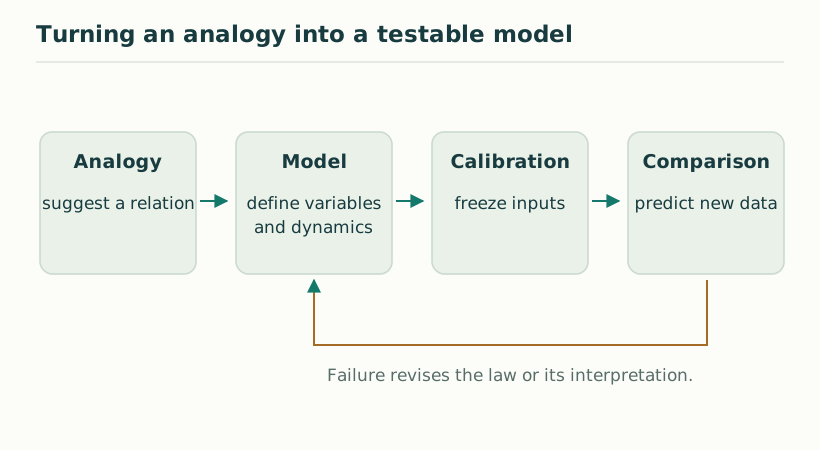
Choose one intended implication, such as “common source composition selects a shared clock ratio.” Define the source class, admissible operations, independent clock readouts and the physical calibration before computing the ratio. Construct at least one alternative source with the same broad metaphysical description and ask whether the stated restrictions exclude it.
The deliverable can be a conditional theorem with a countermodel locating its essential premise. It can also be a failed implication accompanied by a narrower correct claim. Both outcomes clarify the bridge and give future work a sharper target. A comparison that cannot distinguish any possible result needs a more restrictive formulation.
Experts in philosophy, mathematics and physics can contribute directly to this exercise. The philosophical contribution examines the intended dependence; the mathematical contribution studies the implication; the physical contribution tests the operational dictionary. Their common aim is a transparent route from a meaningful question about reality to a model whose consequences can be checked.
Develop the argument
Questions to take further
- Which mathematical models does the proposed metaphysical premise exclude?
- What independent preparation and calibration justify a physical name for a source readout?
A concrete next step
Audit one interpretation-to-physics bridge
Choose one claimed implication, define its source class and measurements, and compare at least two compatible-looking models.
What to share
A precise implication or counterexample with the indispensable bridge assumption identified.
I welcome collaboration with experts in physics, mathematics and philosophy. Get in touch with a question or proposal.