
A four-component unital envelope has ten independent symmetric pair modes. This exact count follows once free symmetric retention is selected, and requires more memory than the current quaternionic product.
A source carrier and its public directions
In SMM, one generative source underlies many completed appearances. DTT asks how inner operations produce a spatial record at outer completion. A useful mathematical candidate begins with a quaternionic carrier: q=s+x e1+y e2+z e3. A detector that ignores changes in the scalar part reads only the imaginary component. If the admitted detector family separates all such components, the public linear readout has three real directions.
The quaternionic premise is itself conditional on positive associative normed composition and incompatible circular phases. The quotient describes a local readout module. Spatial distances, neighboring records and transport still need construction. Keeping these steps separate lets the memory question be answered precisely without assuming that algebraic rank already supplies an entire universe.
Why the scalar channel returns
A displacement detector may ignore the identity channel even though the generating process needs it. To model operations and their combinations, restore that scalar and complexify the resulting envelope. Write V=ℂ⊕Wℂ, with basis e0, e1, e2, e3. Its complex dimension is four. The label zero denotes the identity channel; it is not a fourth spatial axis.
Now specify a retention task: preserve every symmetric bilinear combination of these four inputs, identifying the order of a pair but introducing no additional relations. This leads to Q=Sym²V. Complex coefficients allow coherent amplitudes over its modes. A physical preparation of pair inputs and a record-writing operation remain part of the required source realization.
Count every independent pair
There are four repeated pairs: 00, 11, 22 and 33. There are six distinct unordered pairs: 01, 02, 03, 12, 13 and 23. No pair appears twice because ab and ba have been identified. Thus the ten labels exhaust the selected basis.
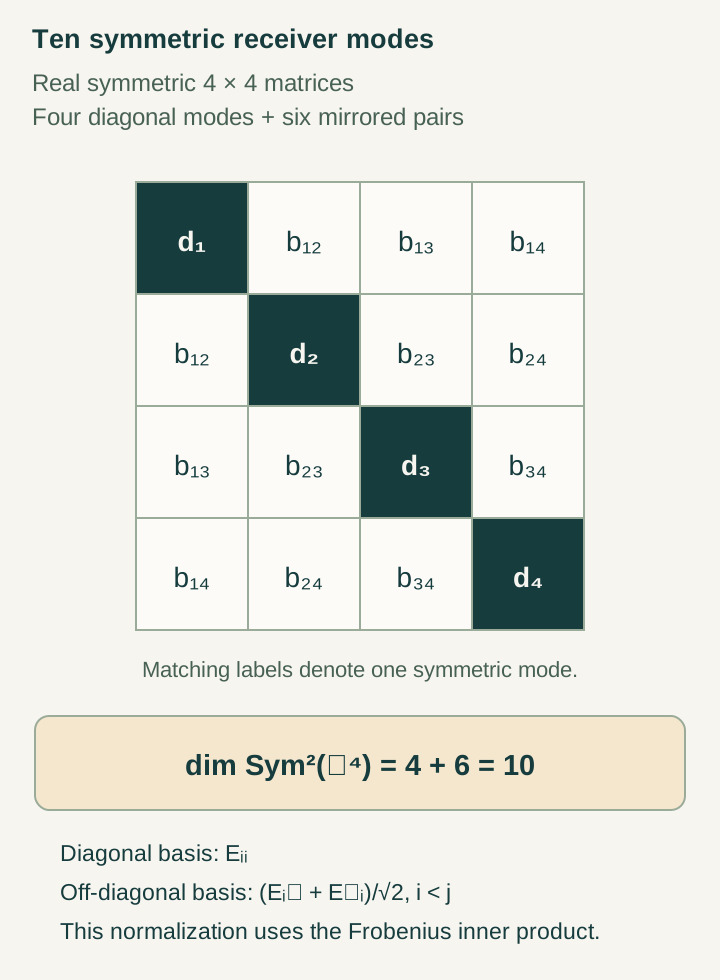
Open the full-size diagram →
The general count is n(n+1)/2: n diagonal pairs and n(n−1)/2 unequal pairs. It applies to every n-dimensional vector space in this setting. Ten follows from four inputs together with symmetric quadratic retention, not from a preference for decimal notation. Writing the final dimension in a different numeral system changes its written digits without changing the receiver.
What the free receiver preserves
The symmetric square has a useful universal property. Any symmetric bilinear readout b(u,v) can be calculated from a unique linear map on Q. Consequently one faithful Q register can support every readout in this declared class. If the register is compressed, some possible symmetric test may cease to be recoverable.
This explains why the free receiver is a natural research choice: it avoids prematurely discarding pair distinctions. It also identifies the precise physical question. Does completion actually preserve all these distinctions, and are the relevant symmetric tests operationally available? The universal property proves the correct receiver for the stated task. It does not require every physical source to perform that task or forbid a source from imposing additional relations.
A worked example of lost information
Consider storing only the symmetrized quaternionic product m(u⊙v)=(uv+vu)/2. This map reaches every quaternion because m(1⊙x)=x. Its rank is therefore four, while its domain has ten dimensions. Six independent memory directions disappear.
For distinct imaginary basis units, eiej+ejei=0, so each mixed imaginary pair is lost. Also ei²=−1, so ei⊙ei+1⊙1 lies in the kernel. These give three mixed and three diagonal relations. A current product cannot distinguish histories differing by these combinations. Retaining ten modes requires an additional register or another faithful encoding of their pair information.
Memory across nested completion
The six inner levels in DTT are nested dependency roles. Later completed work includes the results needed from earlier work; they are not six independent clocks. This makes retained memory a central resource. If a later rule asks which pair occurred, replacing the earlier history by a product that erased that distinction will change the model.
For a quantum implementation, recording orthogonal labels can create correlations with a register. It does not clone an arbitrary unknown state. Likewise, the algebraic expression u⊙u is not a physical copying instruction. A source construction must specify input preparation, register capacity, coherence, admissible operations and the resources consumed before the outer record becomes available.
From receiver capacity to a physical response
The ten-mode receiver is used as a continuation factor in the structural 137 construction. Each retained earlier record can accompany one of ten continuation labels, so dimensions multiply. That calculation assumes the pair distinctions remain accessible at every required depth.
The next research question is dynamical: can one autonomous source update generate this register, protect its distinctions, and determine how a physical source excites them? Counting available modes does not assign their energy costs or source weights. The response guide supplies that next calculation. Together these steps turn the SMM/DTT idea of multiplicity from retained generation into a concrete sequence of memory and interaction requirements.
Continue with the articles
- From three-dimensional readout to retained records
A quaternionic readout, ten-mode pair memory, and a selected stopping grammar produce 137 distinguishable records. The construction makes its retention assumptions explicit and leaves physical coupling as a separate problem.
- Retained observations versus predictive states
A readable record need not contain enough information to predict its next update. An exact leakage criterion identifies when a linear completion is autonomous and measures the error when hidden information returns.
- Why quaternions appear in the reconstruction
Positive multiplicative norm, finite dimension, associativity, and two noncommuting circular phases select a quaternionic carrier. The algebraic conclusion is rigorous within those hypotheses, whose physical selection remains open.
- The center-blind route to three dimensions
Removing the scalar center of a quaternionic carrier leaves a three-dimensional readout space. Accessible rotations or a suitable finite acquisition protocol are needed to ensure that detectors actually recover all three directions.
- Why the symmetric receiver has ten modes
The symmetric square of a four-component envelope contains four diagonal and six off-diagonal pair modes. Retaining all ten requires genuine pair memory, beyond the information in a quaternionic product.