
In this article
- The question behind this comparison
- The SMM/DTT starting point
- How the comparator works
- The decisive comparison
- Worked benchmark
- What follows for the source programme


A growing source archive becomes cosmological expansion only after records are connected to physical volume and clocks. This comparison with unimodular gravity works through e-fold growth, exposes the required calibration, and asks how DTT could derive background geometry and primordial correlations together from its nested generative process.
Inflation describes accelerated growth of physical distances, whereas inner temporal generation describes the production of the structures from which distances and records are read. Their concepts can be related, but one is not automatically the other. A fast source scan does not by itself imply a large Hubble parameter, because the source’s internal counter has not yet been calibrated against the proper time of physical clocks.
The promising comparison is to derive an effective homogeneous geometry and a perturbation field from the same source dynamics. The resulting scale factor can then be tested for accelerated expansion, and its fluctuations can be propagated into cosmological observables. This makes the six nested roles relevant as an internal architecture, while avoiding the assumption that each role is a separate expanding direction or an independent cosmological era. [3] [4]
The Single Monad Model begins with one nonspatial generative source. The Duality of Time Theory distinguishes the source’s inner production from the outer order in which completed records become accessible. Its six inner levels are nested functional roles of one process: a higher role organizes lower-level work. The seventh is the completion or observation interface. They are neither six independent clocks nor six additional time coordinates.
This distinction supplies a useful research question: which features of an observed world can follow from the way a source produces, retains and releases information? A concrete answer needs a state space, an autonomous update, retained memory and a rule connecting completion to an accessible measurement. In the constructions discussed here, those mathematical ingredients are stated explicitly. A successful finite example establishes what its specified mechanism can do; further arguments connect it to physical particles, spacetime or universal laws. [1]
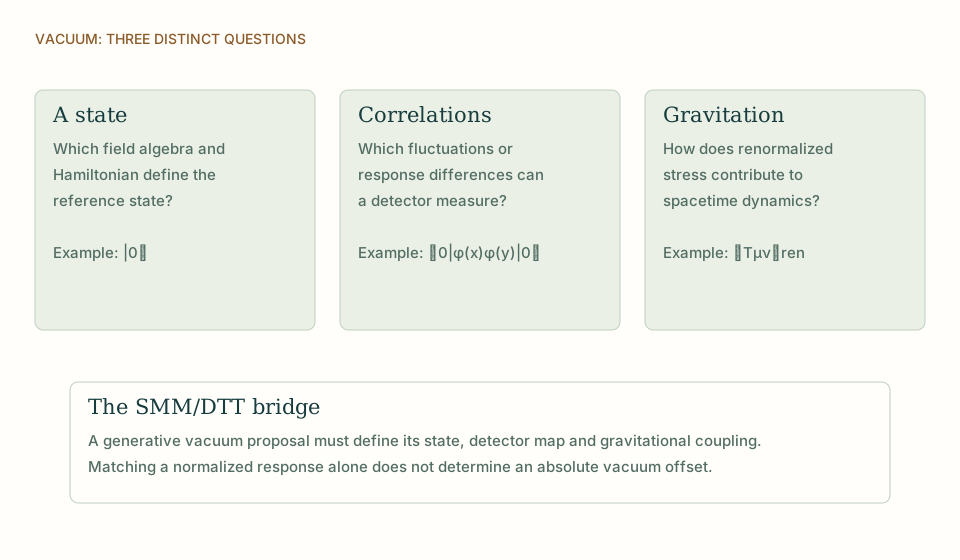
Unimodular formulations reorganize the gravitational equations so that the cosmological constant can arise as an integration constant rather than as a conventional fixed coupling in the action. In a common classical presentation, the metric equation is trace-free. With covariant conservation of matter, integration restores an Einstein equation with a constant term. Different covariant and constrained formulations can differ in their quantization and treatment of global variables.
This is relevant to SMM/DTT because a completion or normalized-response rule may remove sensitivity to an additive offset in a particular observable. But mathematical insensitivity to a constant and prediction of the constant’s measured value are different results. Unimodular gravity does not automatically select that value or explain every radiative contribution. A DTT link would need a dynamical reason that its generated geometry obeys the trace-free equation or its covariant equivalent, together with a rule fixing the global integration data. Calling the source vacuum offset unobservable in a local response is insufficient to establish its gravitational absence. [2]
Unimodular gravity reorganizes the cosmological constant while allowing inflationary solutions with matter in suitable formulations. It does not by itself turn a discrete source counter into an inflating geometry. DTT’s temporal-generation proposal therefore needs an additional bridge between its retained records, a physical volume element and a proper-time evolution.
There is a potentially useful link if source completion naturally imposes a volume condition or a global constraint. Such a construction could motivate a particular unimodular formulation and reduce an independent cosmological freedom. But the constraint must be derived from the source law, and its effect on perturbations and the exit from inflation must be calculated. The e-fold benchmark prevents an easy conflation of fixed coordinate volume with absence of physical expansion: coordinate choices and the metric’s physical volume are different objects. DTT could explain how a volume variable is generated or constrained, while unimodular dynamics supplies a precise comparison for its gravitational role. Without that mapping, the common interest in volume and time remains suggestive rather than a proof that the two theories share a mechanism. [2] [3] [4]
During an ideal constant-H phase, the scale factor satisfies a(t)=ai e^{H(t−ti)}. The number of e-folds is N=ln(af/ai)=HΔt. An illustrative N=60 multiplies physical separations of comoving points by e⁶⁰≈1.14×10²⁶. The comoving Hubble radius (aH)⁻¹ shrinks by the inverse factor. This kinematic feature allows a mode to move from inside to outside that scale.
The number 60 is a commonly useful illustration, not a universal constant fixed without the reheating history. A source model with a growing record count Nrecords=Bⁿ does not yet establish the same result: it must relate that count to physical volume and n to t. If volume is proportional to a³, the length expansion per source step is B^{1/3}, and H follows only after specifying the duration of that step in a physical clock. These conversion laws carry the missing geometry–clock content; renaming a counter as time does not derive them. [3] [4]
H is in s⁻¹ when t is in seconds. The source-count correspondence is conditional on the stated physical-volume readout.
A convincing DTT cosmology would use one calibrated solution for both background expansion and primordial fluctuations. Reproducing a large growth factor is much easier than reproducing the nearly scale-dependent spectrum, its amplitude and the permitted non-Gaussian correlations. The source’s positive contribution is the possibility of linking these quantities to a common generative mechanism. That link has to be derived before it can be called a replacement for inflationary dynamics. [3] [4]
THE SAME QUESTION, DIFFERENT STARTING POINTS
| Question | SMM/DTT | unimodular gravity |
|---|---|---|
| Starting structure | One nonspatial source, retained memory and six nested inner functions with an outer completion interface. | Trace-free or covariant constrained gravitational formulation. |
| Observable connection | The source update and readout must generate the measured records and their calibrated relations. | Local metric equations plus global integration data. |
| Cosmic inflation and temporal generation | There is a potentially useful link if source completion naturally imposes a volume condition or a global constraint. | Unimodular gravity reorganizes the cosmological constant while allowing inflationary solutions with matter in suitable formulations. |
| Status of the claim | A constructive research programme; a specified finite model establishes only its stated conditional results. | A family of formulations; local offset cancellation does not select the constant. |
KEEP THE CONNECTION
Connects this comparison with the author’s underlying construction.
Connects this comparison with the author’s underlying construction.
Connects this comparison with the author’s underlying construction.
Connects this comparison with the author’s underlying construction.
Places the comparison alongside the programme’s published results, assumptions and open targets.
References support the comparator and the specific mathematical or interpretive claims indicated. SMM/DTT connections are developed in the analysis above.
How these comparisons distinguish premises, results and physical claims
SMONAD
Share this page, or keep a clear reference to the work you are reading.
Use this reference for the explanation on this page. “n.d.” means its first publication date is not specified; the update date is recorded separately.