
In this article
- The question behind the comparison
- The single-source and nested-time proposal
- The comparator’s explanatory structure
- The precise agreement and difference
- Worked example: what follows and what does not
- What this comparison contributes


Whitehead and DTT both resist treating becoming as a superficial change of properties attached to fully formed static things. For Whitehead, occasions achieve definite actuality through their process; for DTT, inner generation leads to completed observable relations. The comparison develops this distinction through a worked example and explains its implications for SMM/DTT’s nested generation, completed records and account of the observable world.
To describe time as generative is to treat the arrival of a determinate event as part of what the theory explains. An ordinary dynamical equation begins with a state space, variables and a law. A stronger SMM/DTT construction would explain why certain variables form spatial objects and why their changes share a measurable temporal order. Its appeal lies in reducing the independence of geometry, matter and clock readings. The single-source claim becomes physically significant when the same mechanism constrains all three rather than merely running three separately chosen rules.
A generative process is not necessarily an event before the universe in an earlier external time. If space and outer time are outputs, their source cannot be located at a pre-existing spatial address or timed by an unexplained outside stopwatch. Mathematical descriptions can still use an index to express dependency. The index is then part of the representation until an operational meaning is provided. This is familiar in constructive mathematics: the order in which a proof or object is built need not be a physical sequence measured in seconds. DTT must explain when its generative order becomes more than this.
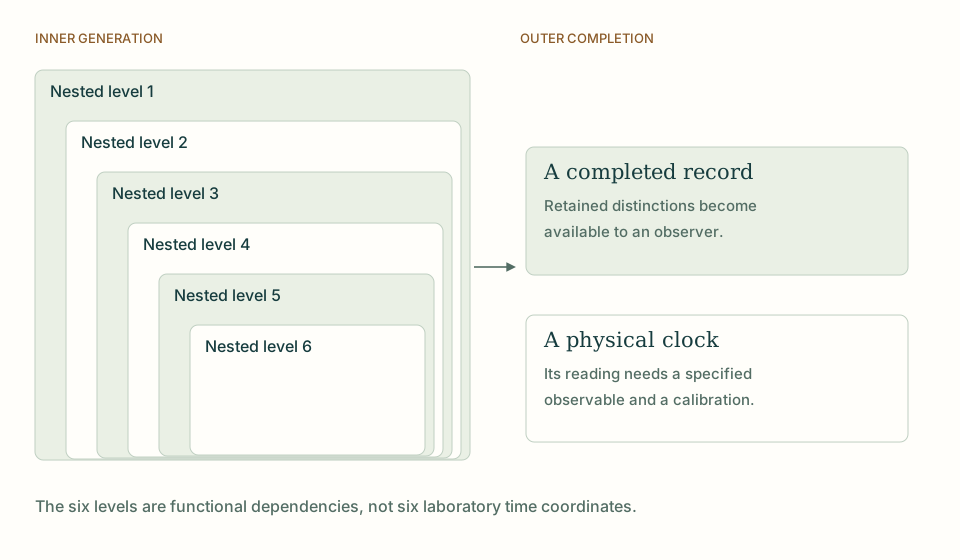
Six nested inner levels offer a proposed organization of dependencies. Their scientific role would be clearest if dropping one level destroys a necessary capability, while adding a level contributes no independent capability. Such minimality is stronger than naming six stages after a familiar result. A successful construction would also prevent arbitrary reassignment of stage labels from changing its physical conclusions. The point is not the number alone but the restrictions imposed by the nested organization on possible records and their lawful transformations.
SMM begins with one nonspatial generative source. DTT distinguishes its inner production from the outer order in which completed results become accessible. The six inner levels are nested functional dependencies within that production; the seventh denotes outer completion. They are not six independent clocks, six spatial directions, or six simultaneously occupied temporal axes. This distinction makes the framework more specific than a general claim that everything changes: it asks how a world of persistent relations can be generated before its spatial representation is taken for granted. [2]
Whitehead treats actuality through a plurality of occasions whose becoming culminates in determinate completion. His vocabulary of concrescence and satisfaction provides a close philosophical comparison with inner production and outer completion. The comparison is not an identity: Whitehead’s many actual occasions have an explanatory status different from the Single Monad’s one generative source.
A melody illustrates the process-oriented question without reducing it to acoustics. The significance of the final note depends on the pattern already realized, and the completed phrase becomes a condition for what follows. The whole is neither an unrelated collection of notes nor a timeless object unaffected by its realization. SMM/DTT can use a similar logic of inherited determination while assigning the production of multiplicity to one source. Whitehead’s metaphysical categories do not supply the specific six-level architecture, a quantum probability rule or a numerical clock calibration. Their value here is a disciplined account of becoming, relation and completed actuality. [1]
Whitehead and DTT both resist treating becoming as a superficial change of properties attached to fully formed static things. For Whitehead, occasions achieve definite actuality through their process; for DTT, inner generation leads to completed observable relations. This makes the comparison structurally close. In each, the question is how a many-sided inherited situation becomes a unified event that can affect what follows.
The Single Monad changes the explanatory direction. Rather than beginning with a multiplicity of actual occasions, SMM asks how multiplicity arises from one nonspatial source. The six nested levels offer a proposed organization for that production, but they require independent justification. Whitehead’s categories cannot be used as a ready-made proof of the number six or of a spatial dimension. The constructive benefit is a disciplined distinction between an event’s production and its completed role. DTT can strengthen the process idea by specifying state spaces, retained relations and readout maps, while retaining the philosophical question of whether any formal model captures becoming itself. [1]
Consider a rewrite system starting from one mark. A rule replaces each mark with two related marks and preserves their ancestry. After n steps there are 2ⁿ leaves and a rooted tree of relations. The construction has genuinely produced multiplicity and a distance based on shared ancestry. It has not produced ordinary three-dimensional Euclidean space: a tree has a different neighborhood structure. Giving the leaves three coordinates afterwards changes their representation, not the original relation. The example identifies a positive milestone for SMM/DTT: derive relational structure first, then prove which metric and dimension its observations support. Unity can generate many objects without uniquely selecting their geometry.
The comparison therefore concerns explanatory priority. Does a theory start from events and organize them, or provide a process that constitutes events? Both can describe change, but they answer different questions. The most useful bridge is an explicit map from generative states to the observables of a familiar theory, together with an explanation of why the map respects that theory’s symmetries. A completed reconstruction could then illuminate the origin of an established law even before it supplies a new empirical prediction.
THE SAME QUESTION, DIFFERENT STARTING POINTS
| Question | SMM/DTT | Whitehead’s process philosophy |
|---|---|---|
| Explanatory starting point | SMM treats spatial multiplicity as a result of nested source relations rather than a collection of locations supplied before generation. | Many occasions undergo becoming and achieve determinate actuality that conditions later occasions. |
| Key distinction | Generating a relational network establishes multiplicity; its metric, neighborhood structure and physical dimension require further results. | Whitehead and DTT both resist treating becoming as a superficial change of properties attached to fully formed static things. |
KEEP THE CONNECTION
Connects this comparison with the author’s discussion of generative.
Connects this comparison with the author’s discussion of generative.
Connects this comparison with the author’s discussion of generative.
Connects this comparison with the author’s discussion of generative.
Connects this comparison with the author’s discussion of generative.
References support the comparator and the specific mathematical or interpretive claims indicated. SMM/DTT connections are developed in the analysis above.
How these comparisons distinguish premises, results and physical claims
SMONAD
Share this page, or keep a clear reference to the work you are reading.
Use this reference for the explanation on this page. “n.d.” means its first publication date is not specified; the update date is recorded separately.